The Circle of Nine
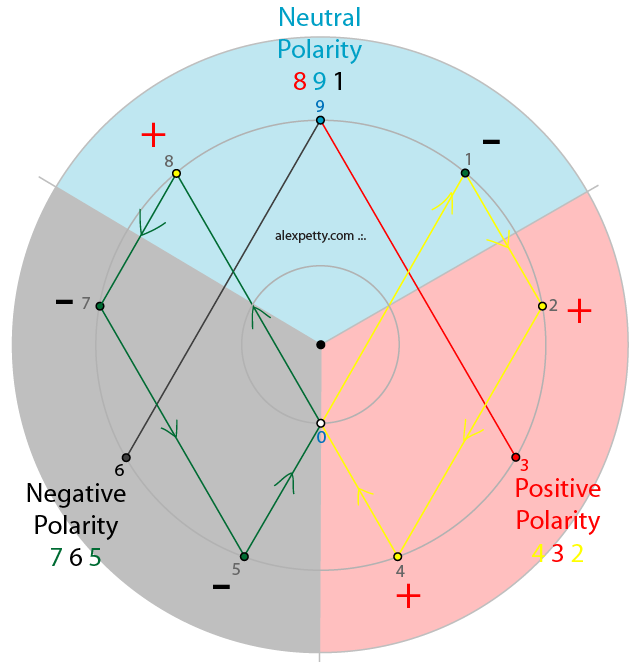
In 2009, I drew a circle with nine positions and watched where the primes landed. The classes paired. The complements avoided each other. I called it polarity.
November 2009
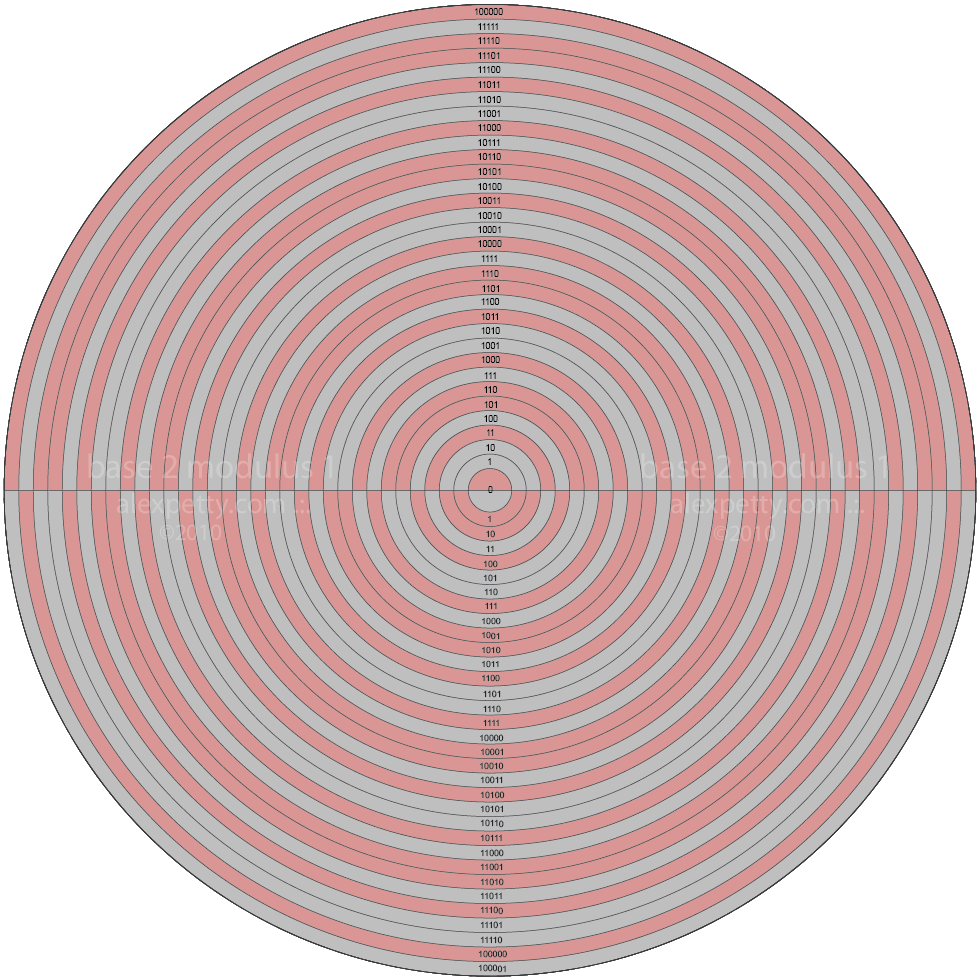
Draw a circle with nine positions. Place the integers on it: 1 through 9 on the first ring, then 10 falls on 1 again, 11 on 2, 12 on 3, and so on. Arithmetic modulo 9, laid out where you can see it.
Now mark the primes.
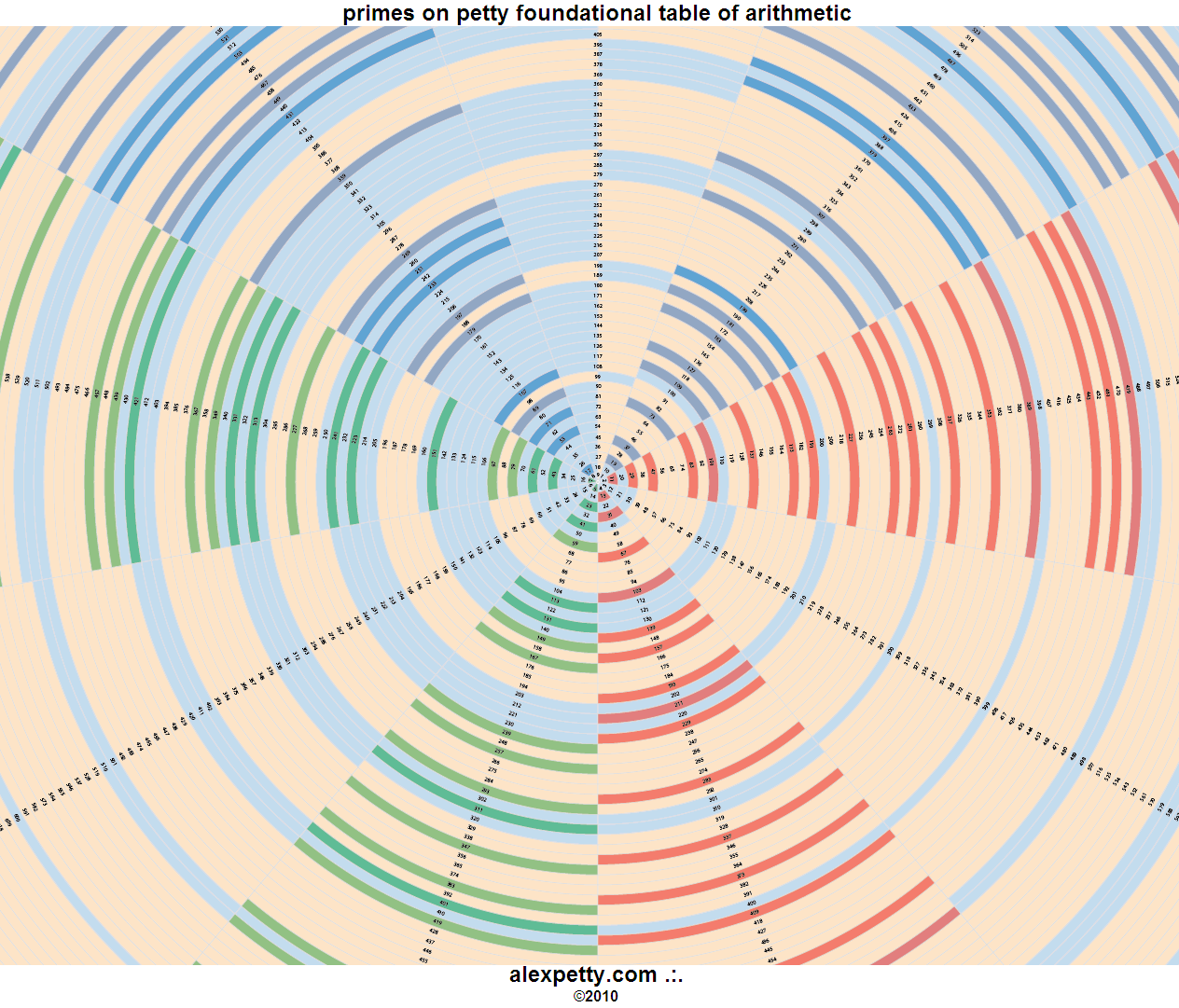
Three of the nine spokes are empty. Every prime greater than 3 avoids the positions 3, 6, and 9 entirely. The remaining six spokes carry all of them. The equivalent algebraic fact is familiar: every prime greater than 3 satisfies p ≡ 1 or 5 (mod 6). But seeing it on the circle gives it a different character. The exclusion zones are visible. Three empty radials cutting through the field of primes.
Keep looking.
The scaffold
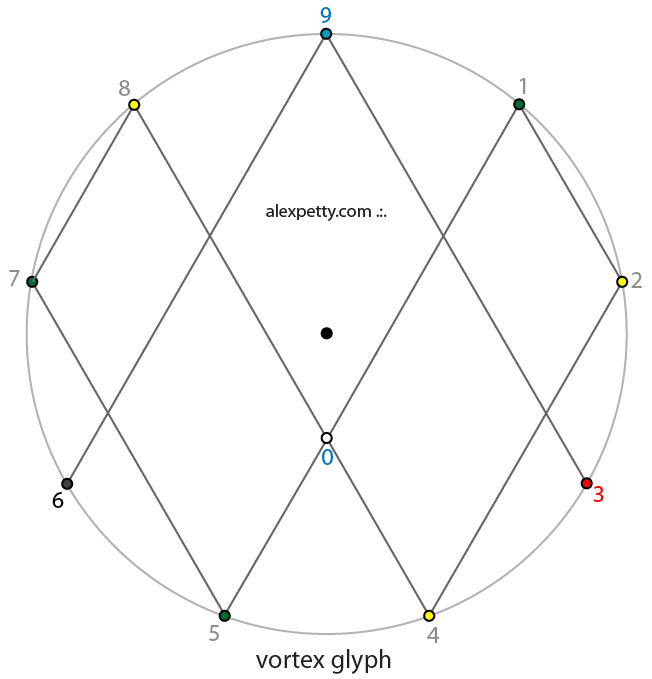
The three empty spokes are not arbitrary. They are closed under addition modulo 9.
3 + 3 = 6, 3 + 6 = 9, 6 + 6 = 3.
They form a subgroup. A static scaffold through the number system. The number 9 acts as the identity of the cycle: add 9 to anything and its position on the circle does not change. The numbers 3 and 6 are complements, 3 + 6 = 9, and in decimal their unit fractions sum the same way: 0.333... + 0.666... = 0.999... = 1.
The scaffold is fixed. The primes flow through the six positions around it.
Polarity
Something else is visible on the circle. The six prime-carrying spokes pair up.
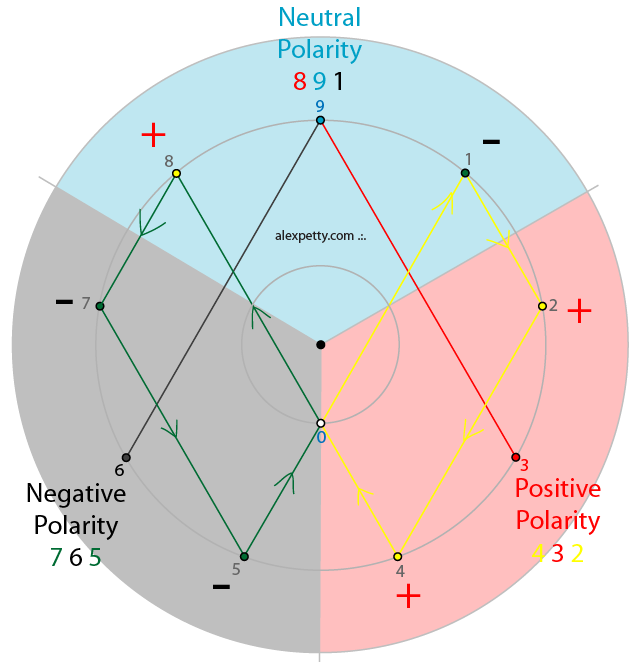
Positions 1 and 8 are complements: 1 + 8 = 9. So are 2 and 7, and 4 and 5. Each pair sits on opposite sides of the circle, and the primes landing on one side behave differently from those landing on the other.
I am calling the two sides positive and negative. Not because I have a theory. Because the structure demands a word, and polarity is the right one. The residue classes are not neutral. They come in opposing pairs, and the primes respect the pairing completely.
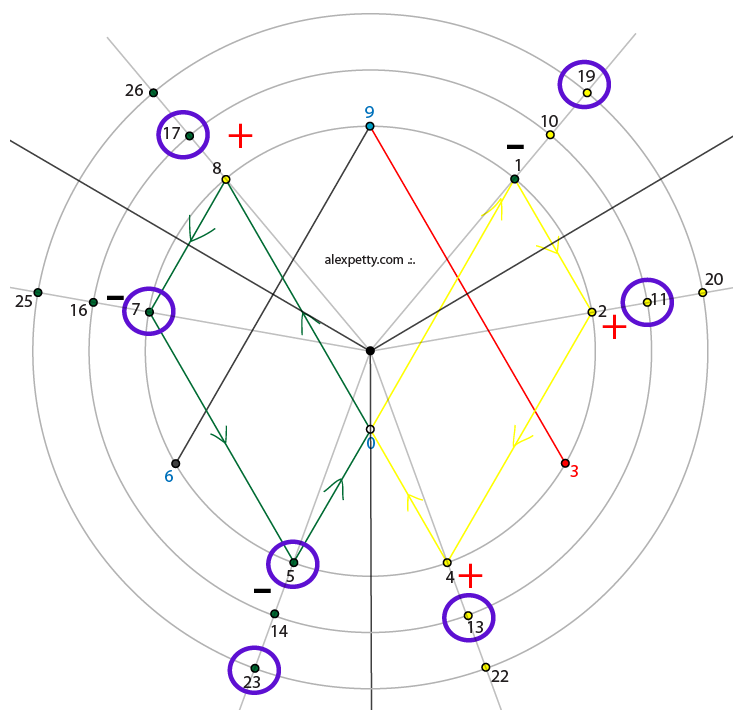
Each full rotation around the circle represents nine consecutive integers. As the rotations accumulate, the density of primes decreases. This is the familiar thinning of primes as they grow. But even as they thin, they remain confined to the same six spokes. The geometry is stable. Only the density changes.
Larger tables
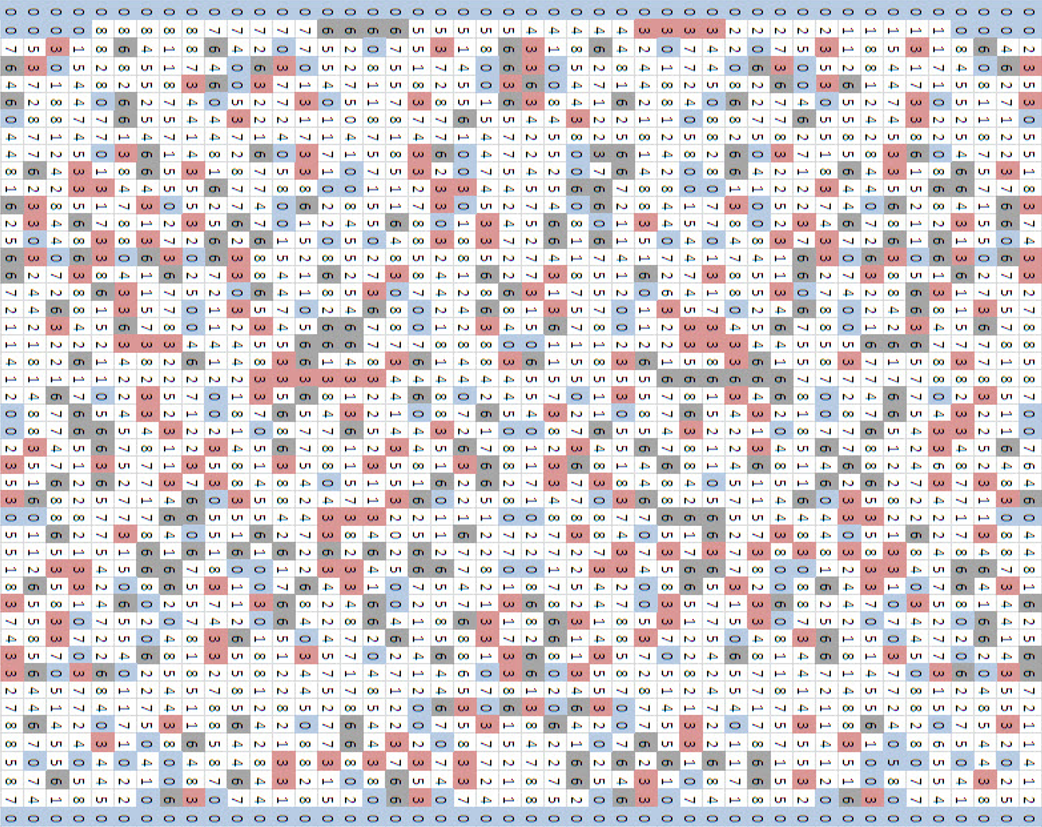
The table below extends the mapping across several hundred cycles.

When reorganized by polarity the information collapses into a denser structure. No prime appears in more than one polarity column. The positive and negative sides do not share a single prime. Whatever polarity is, the primes respect it completely. Not a curiosity. A constraint.

In this form, patterns of clustering and separation between columns become easier to see. Primes are not spread uniformly across the allowed positions. They favor certain columns and avoid others, and the preferences shift as the numbers grow. Something governs these preferences. The patterns are too persistent to be accidental.
Fibonacci
The Fibonacci sequence also locks into the ninefold structure.
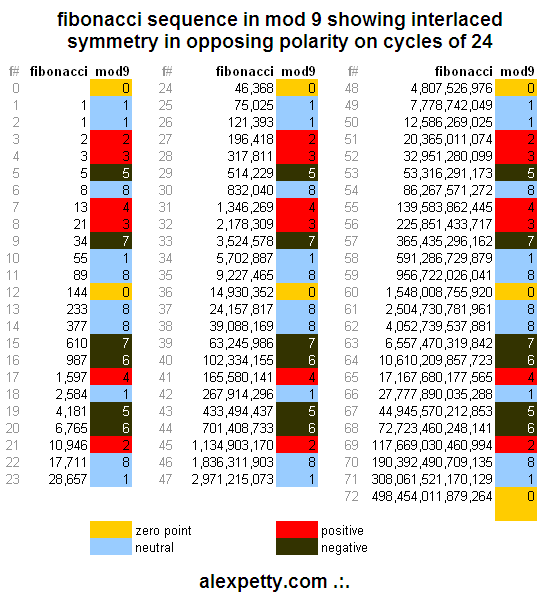
The sequence of residues repeats with a period of 24 terms. Within each period the polarity pattern is fixed and symmetric. The simplest possible recurrence, $F_n = F_{n-1} + F_{n-2}$, lands on the same scaffold that organizes the primes. I do not know what to make of this. I find it striking.
Prime quintuplets
The densest clusters of primes are the quintuplets. Five primes packed as tightly as the constraints allow.
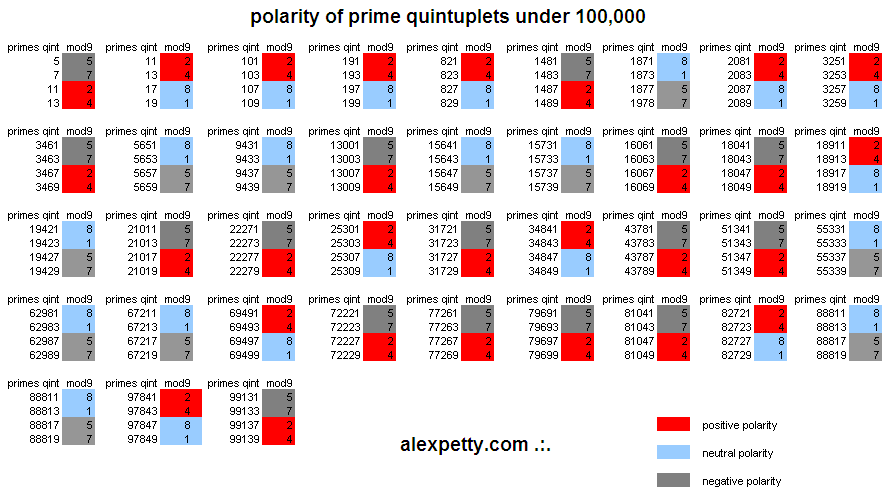
When mapped onto the circle, every quintuplet falls into one of exactly three configurations. I call them neutral, positive, and negative, based on which spokes they occupy.
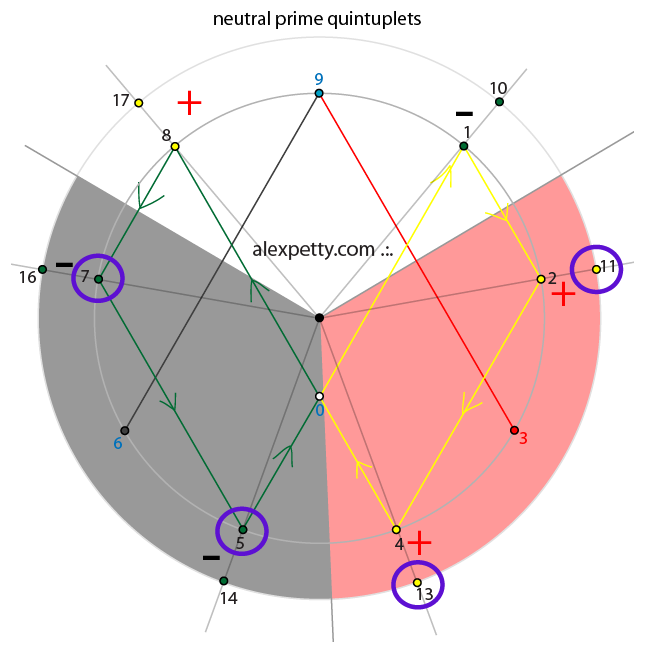
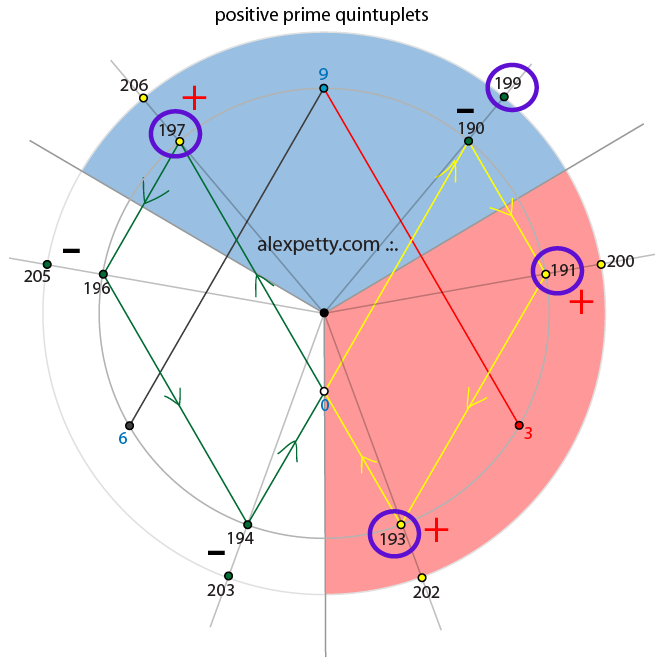
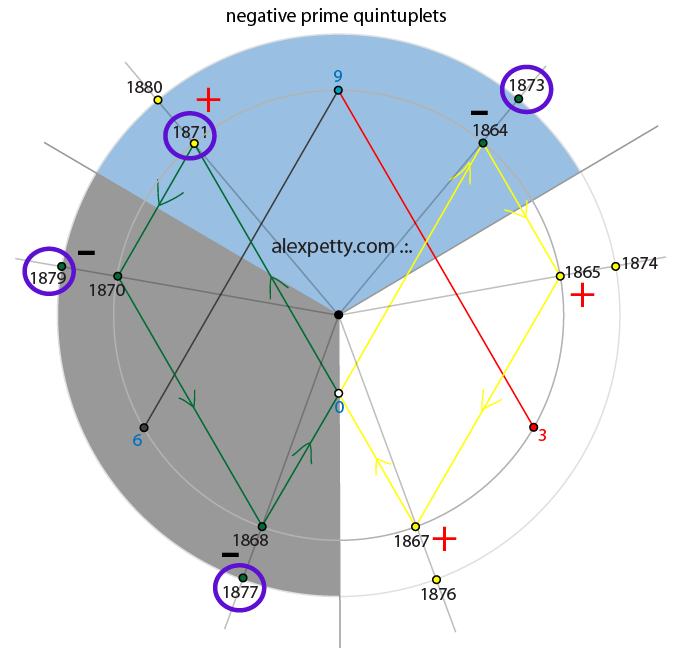
Three shapes. No others are possible. The ninefold geometry constrains even the densest prime clusters into a small family of configurations.
I can see the pairing, the exclusion, the polarity. I cannot yet name the mechanism. But the circle of nine keeps showing me things, and I am not inclined to stop looking.
.:.
A note, seventeen years later
April 2026
I wrote this in 2009. I was circling around a question I could feel but not yet articulate. Why does the prime 3 play a distinguished structural role in the organization of numbers?
It took a long time to find a precise version of that question, and longer still to answer it. The answer came through what I now call repetend alignment, a measure of how coherently a denominator $n$ organizes the fractional field ${k/n}$. For denominators of the form $n = 3m$, the alignment follows the formula $\alpha = (2m - 1)/(3m - 1)$, and the golden ratio turns out to select $p = 3$ uniquely through the factorization of a self-referential cubic. The details are in Why the Golden Ratio Selects the Prime Three.
The mod-9 circle is a shadow of the digit function $\delta(r) = \lfloor br/p \rfloor$ that became central to the later work. The polarity between residue classes is what Digit-Partitioning Primes formalizes as the digit-partitioning property: for primes $p \le b + 1$, different residue classes never share a digit at any repetend position. The exclusion zones on the circle of nine are a geometric reflection of this partition.
The polarity I was groping toward turned out to be something precise. The complement map $a \mapsto m - a$ on residue classes forces an exact antisymmetry on the collision invariant: $F(a) + F(m - a) = 0$. The positive and negative sides of the circle are not metaphors. They are the sign of a real-valued field defined on the integers, locked into opposite values on complementary classes. The field decomposes entirely into odd Dirichlet characters. No even character contributes. The complement involution forces this, the way a vibrating string fixed at both ends can only produce odd harmonics.
The three involutions I was unknowingly circling in 2009, $a \mapsto m - a$ on classes, $\chi \mapsto \bar\chi$ on characters, $s \mapsto 1 - s$ on the critical strip, turned out to be the same symmetry operating at three levels of the same structure. The polarity field lives at the first level and constrains the third.
The diagrams here are where it started.
.:.