The Effect of Base on Numeric Fields
Change the base and the field changes with it. But the complement symmetry does not. Something underneath is base-independent.
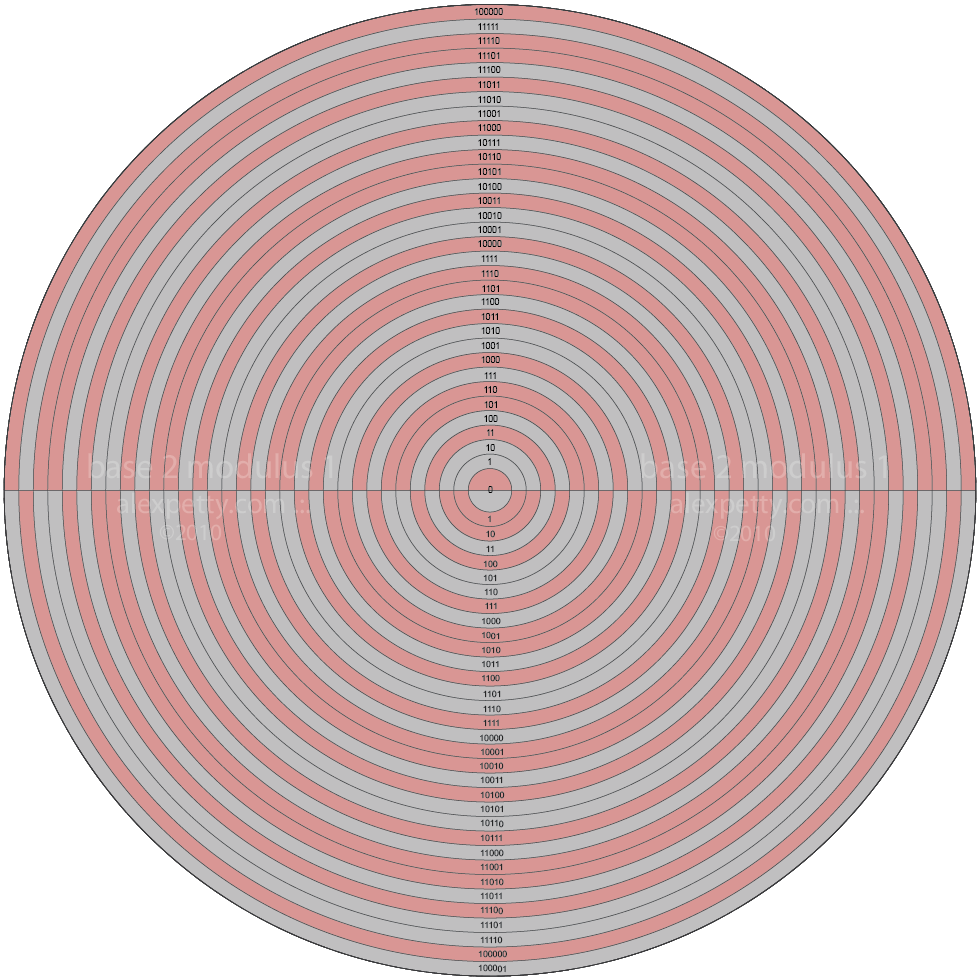
August 2010
Generate number sequences in different bases under modular reduction and the same mirrored structure appears regardless of which base you use. The values move outward and then return inward along a symmetric path. The structure is not tied to any particular base. It is a property of the relationship between a base and its modulus.
The pattern is:
Base $n$ mod $(n - 1)$
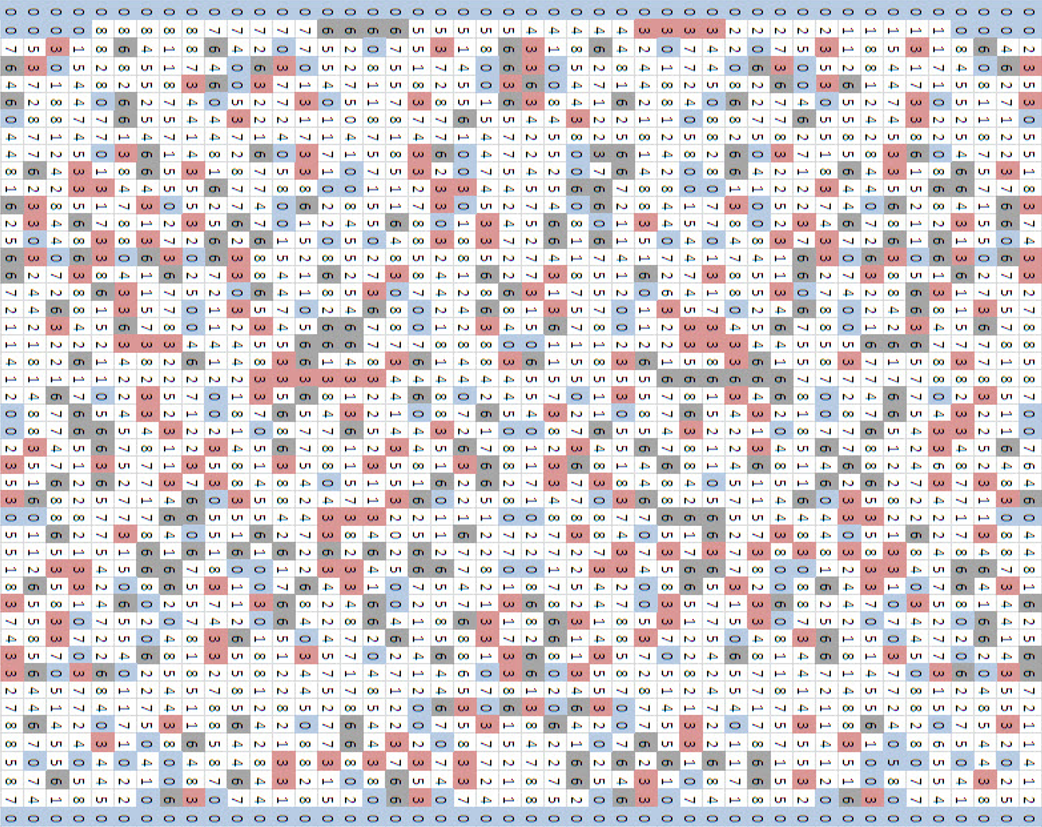
For each system, compute the first 33 increments and plot the results. Red indicates expansion or outward movement (+). Gray indicates contraction or inward movement (-).
What changes and what does not
What strikes me most about these patterns is not the motion itself but what stays the same through it.
The sequences swirl outward and collapse inward, tracing different paths depending on the base. The internal dynamics change. A base-9 field produces a rich, multi-layered oscillation. A base-3 field produces a simpler one. But in every case the system's extent, its circular boundary, remains the same. The field breathes, but it does not grow or shrink.
This is a consequence of modular reduction. No matter how large the integers become, the modulus maps them back into the same bounded set of residues. The system is confined to a fixed space. What changes is the path the sequence traces through that space, not the space itself.
The outward path and the inward path are mirror images of each other. They are complements. Their sum is always the modulus. So the expansion and contraction are not independent motions. They are two views of the same structure, one counting up from the center and the other counting down, and they balance exactly.
I find this worth sitting with. The dynamics change. The boundary does not. Something is preserved through all of the internal motion, and I think that something matters.
The simplest case makes this clearest. In base 2 mod 1, there is only one possible residue. The system has no room to move at all. Pure stillness.
The moment a third state is introduced, motion begins. The system starts to oscillate between expansion and contraction.
As more states are added, the internal dynamics become richer. More paths, more oscillations, more elaborate palindromes. But the boundary holds. The identity persists. It is the same system seen at different resolutions.
Numeric fields across different bases
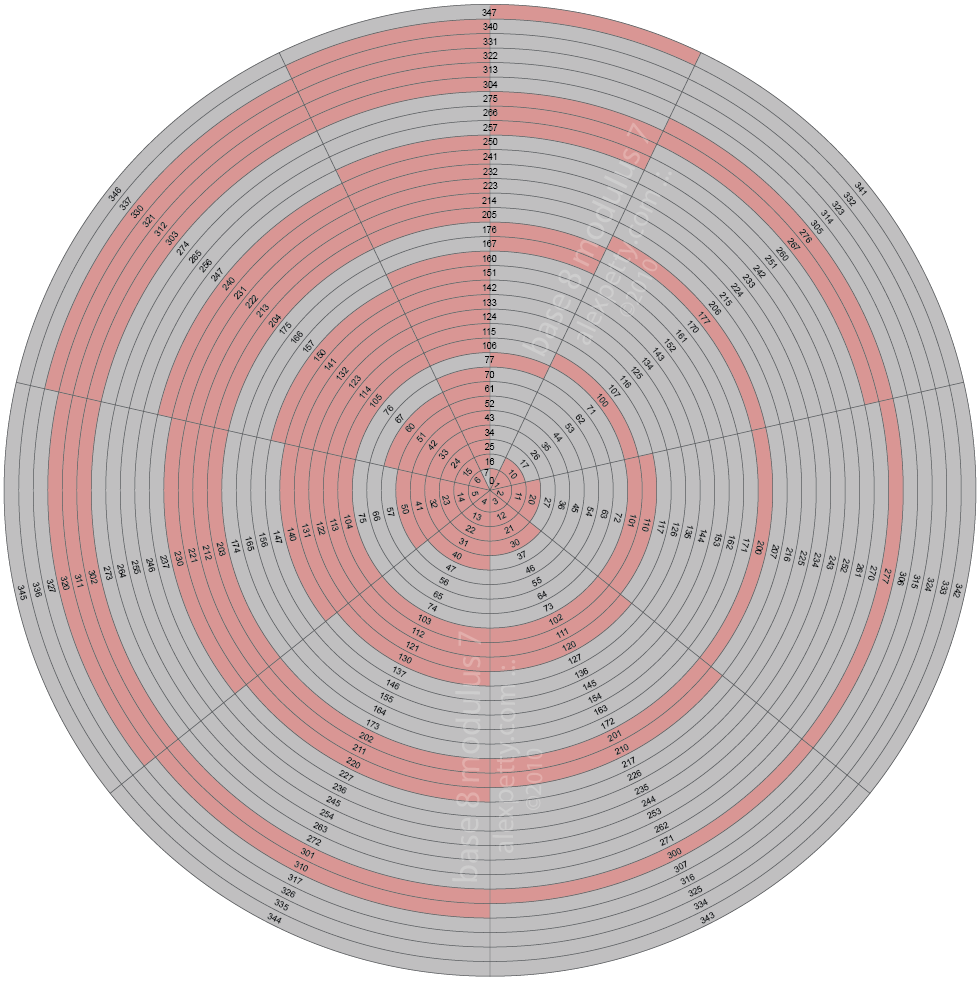
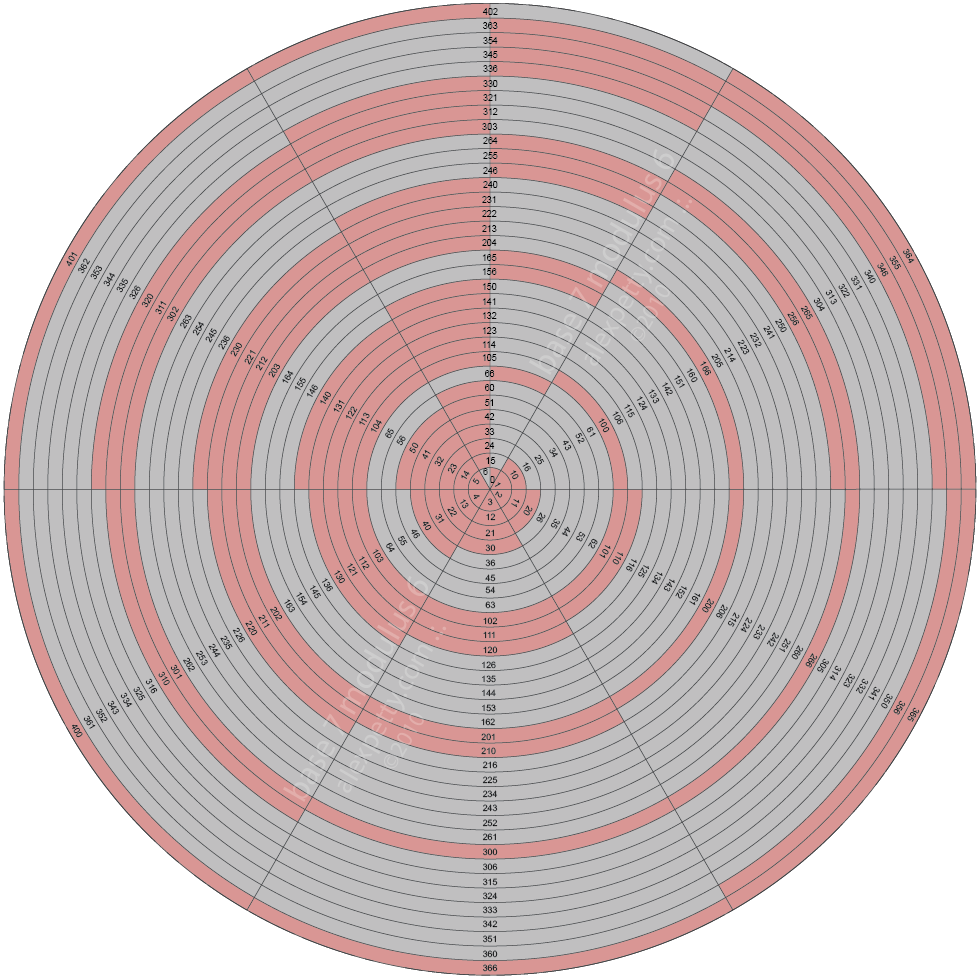
The charts below show the first 33 values produced under each base/modulus relationship. Red paths represent outward movement. Gray paths represent the inward return.
Look at how the patterns change as the base decreases. The higher bases produce complex, layered oscillations with many internal crossings. As the base shrinks, the patterns simplify, but the symmetry remains. By the time we reach base 2 the field has collapsed to a single point. The motion is gone, but the structure that generated it is still present.
Base 9 mod 8

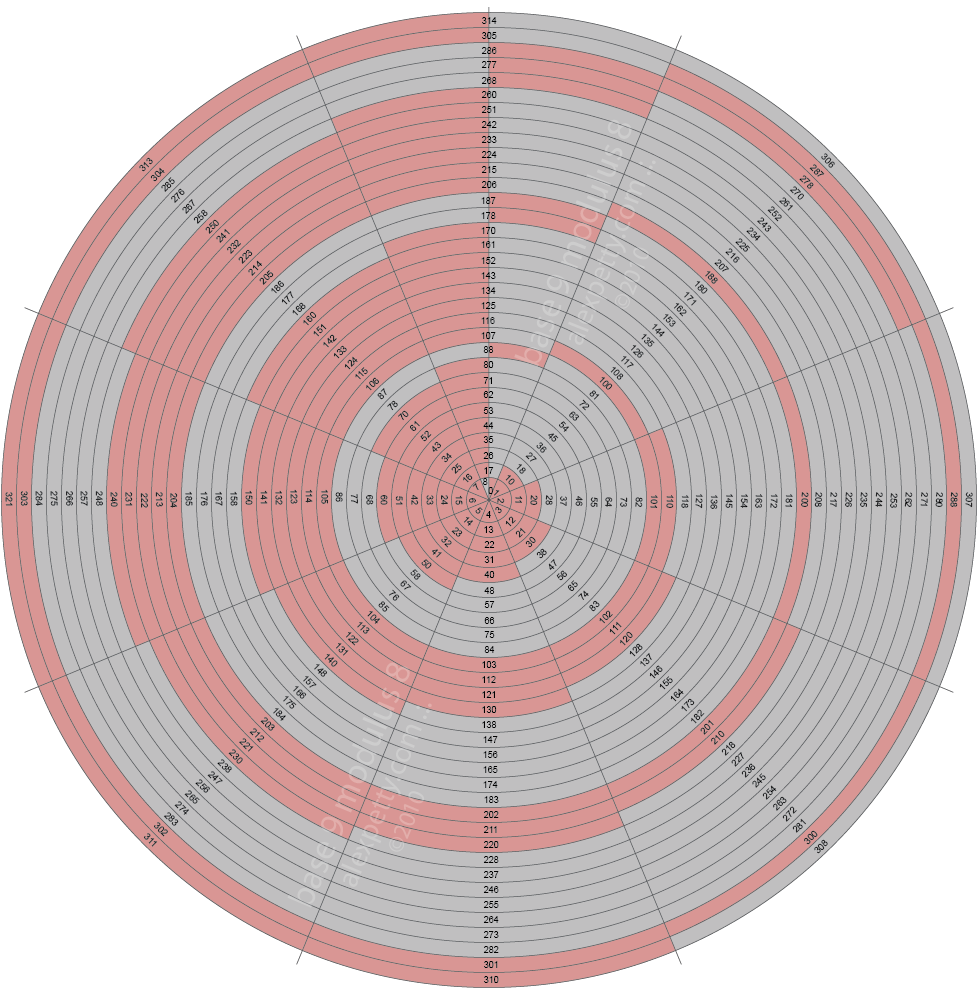
Nine states produce the richest field in this set. The palindromic paths cross and recross, forming a layered web of outward and inward motion. But count the distinct residues: there are still only eight. The complexity is in the path, not in the space.
Base 8 mod 7

Base 7 mod 6

Base 6 mod 5

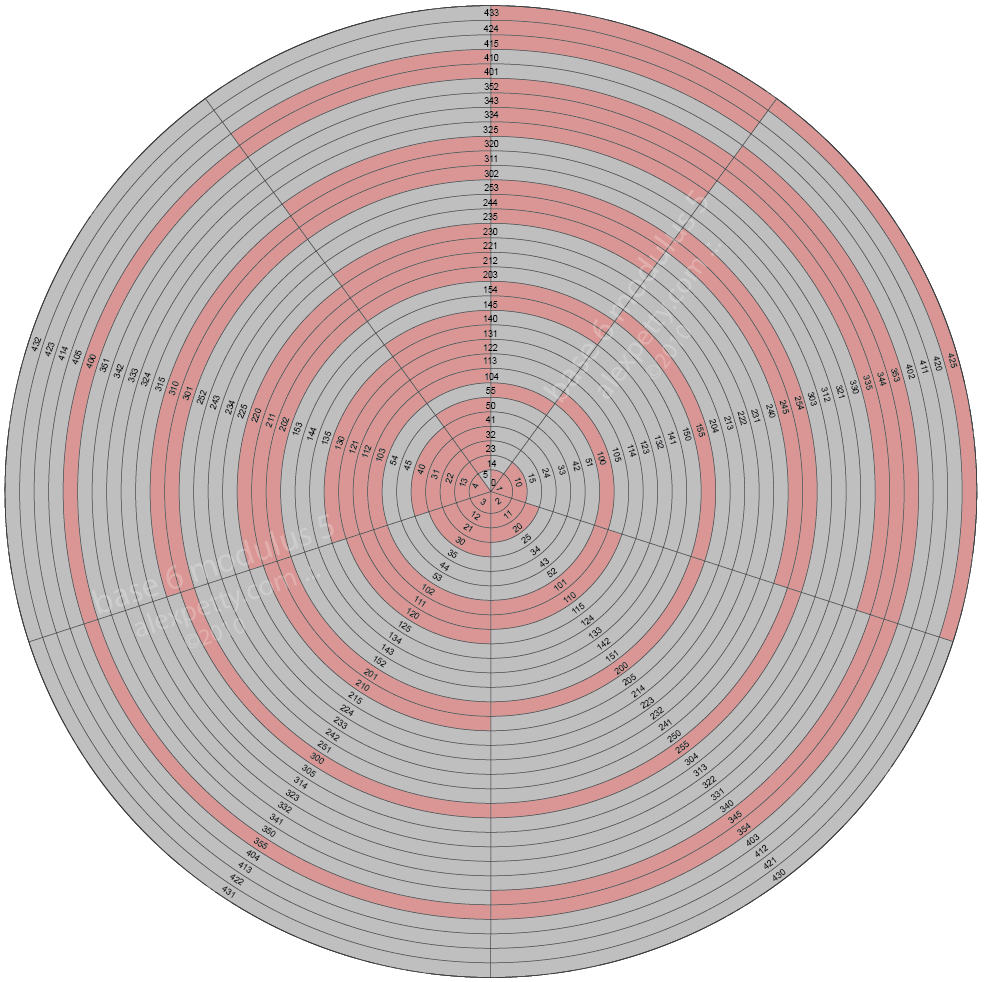
Base 5 mod 4

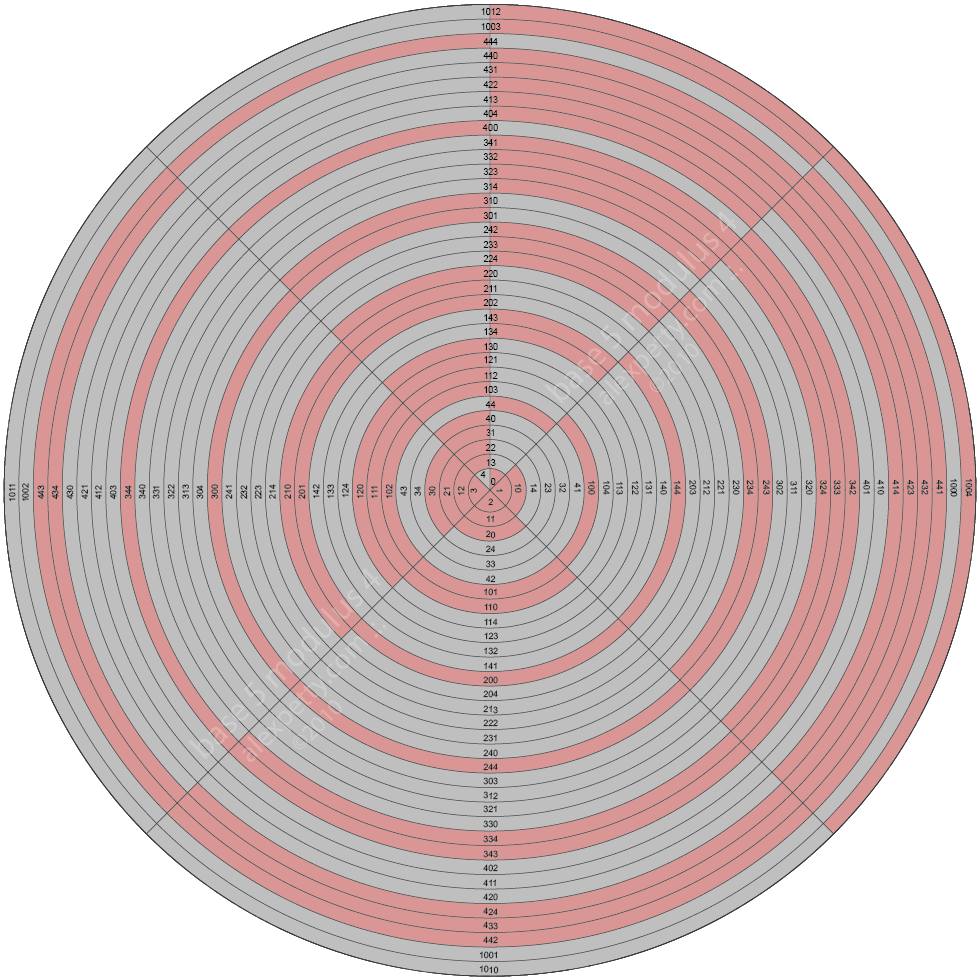
Base 4 mod 3
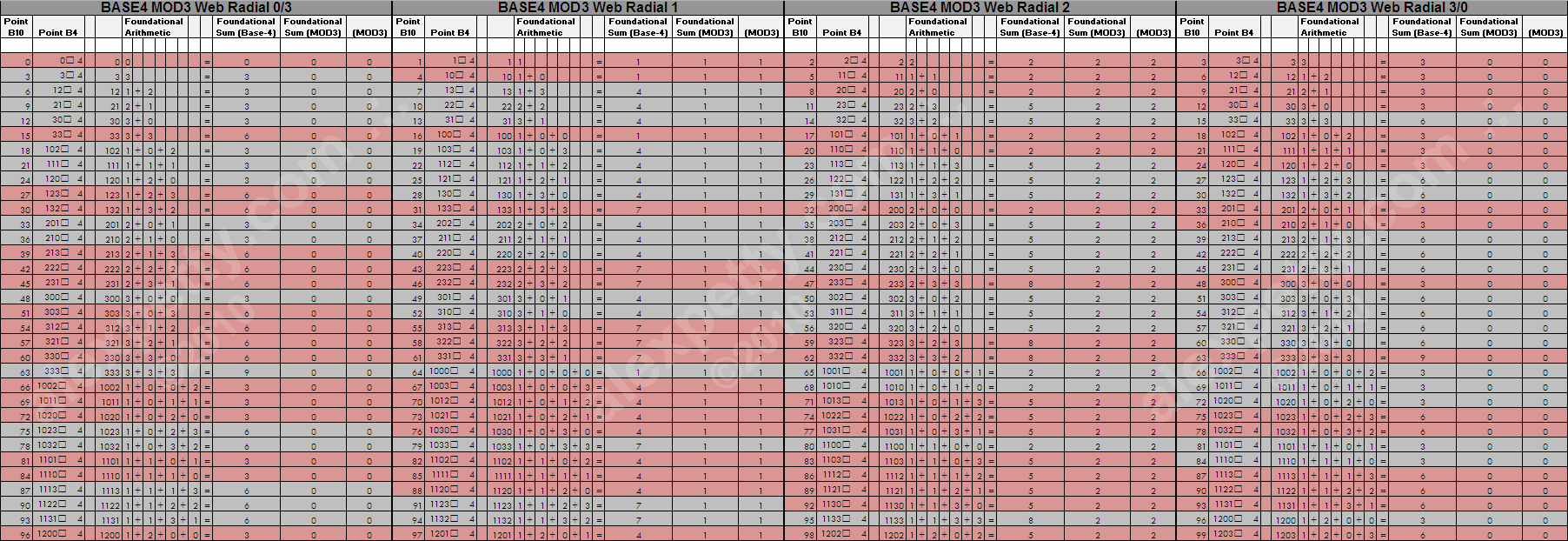
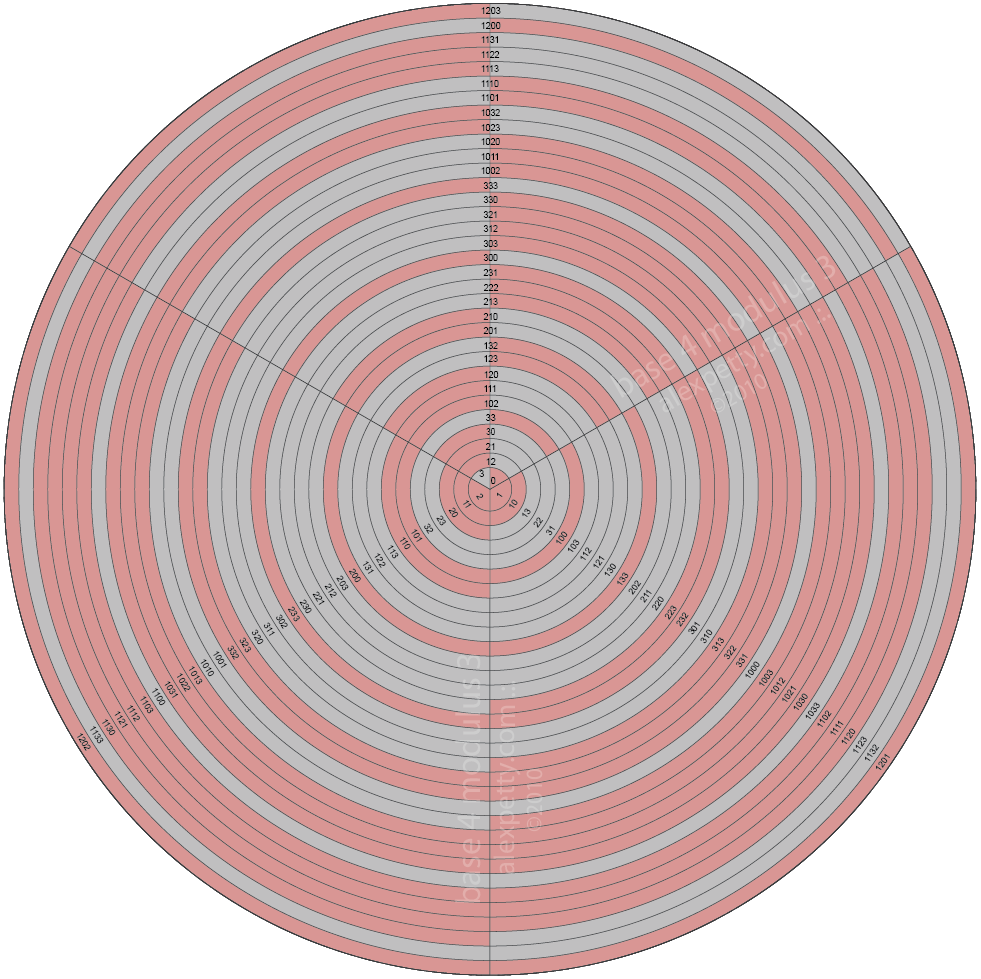
Three residues. The pattern is becoming sparse, but the palindromic structure is still clearly visible. Outward, then inward. Always balanced.
Base 3 mod 2
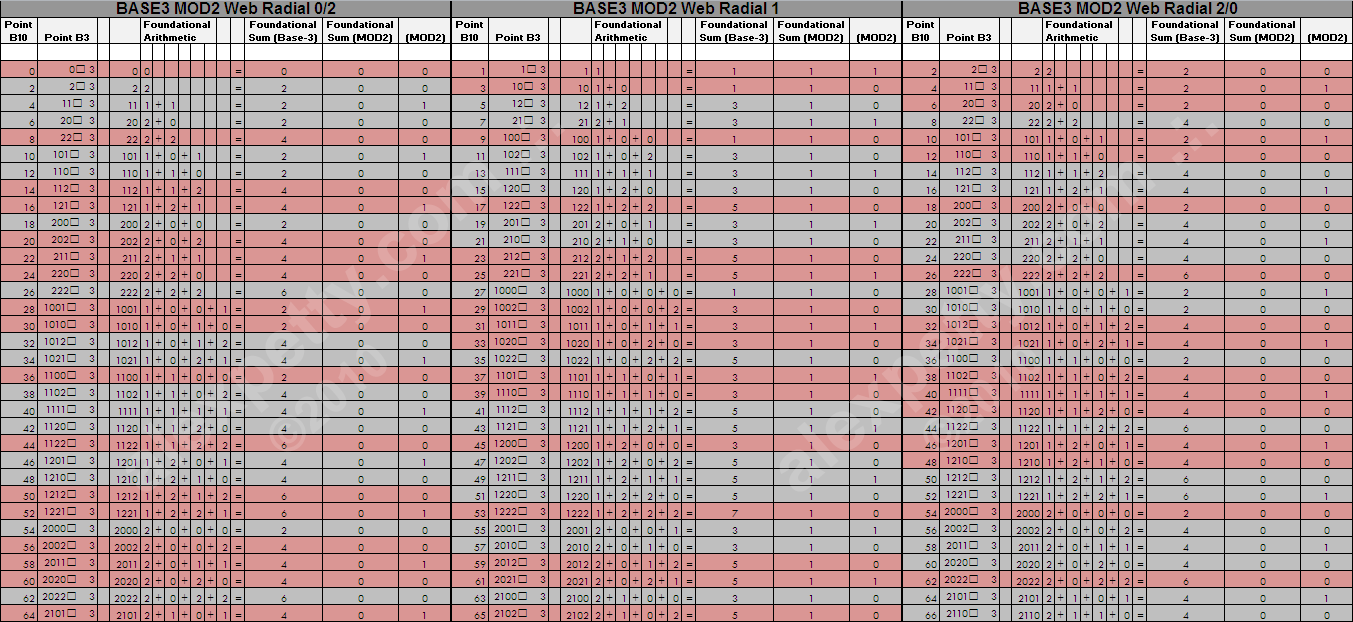
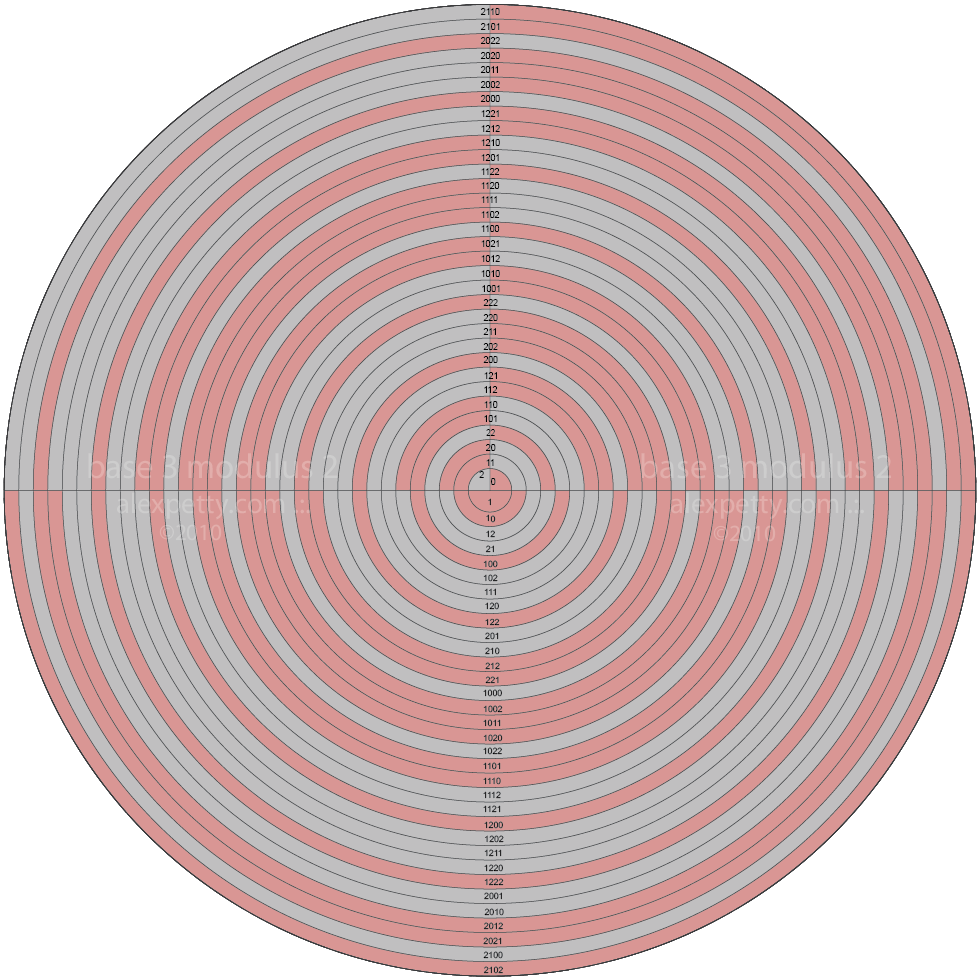
Two residues. The simplest possible oscillation. Out, in, out, in. A single alternation, repeated.
Base 2 mod 1

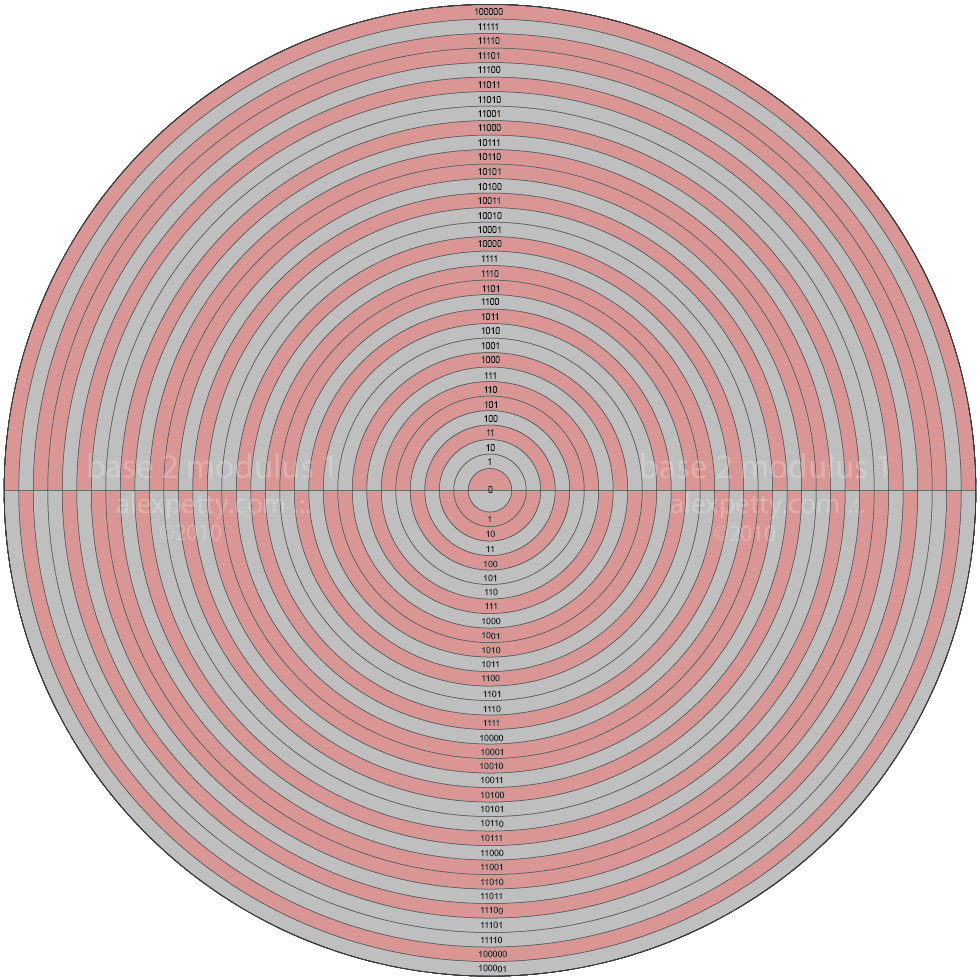
One residue. The system has collapsed to a point. There is nowhere to go. This is the identity itself, with no motion to express it.
Across every base the numeric field produces the same kind of structure. The sequences expand outward and contract inward along mirrored paths. The base determines the resolution, how many states the system has to work with, how many layers the palindrome contains. But the palindromic structure itself is invariant. It does not depend on the base.
The base is a lens. It determines how much detail you see. The structure you are looking at is the same structure regardless.
.:.
A note from 2026
April 2026
The palindromic symmetry in these charts is the complement map. The pair $k$ and $n - k$ trace mirror paths through the residue space. The outward and inward motion I was watching here is the same pairing that produces the antisymmetry $F(a) + F(m - a) = 0$ in the polarity field. The formalism came much later. The structure was already visible in these charts.
The observation that the pattern is base-independent turned out to matter more than I realized in 2010. What the later work shows is that the collision spectrum's cancellation across primes, its convergence at $s = 1$, its antisymmetry under the complement map, none of that depends on which base you look through. The base changes the internal dynamics. It does not change the boundary. I wrote that here. It took fifteen more years to prove it.
.:.