Geometries Hidden in the Number System
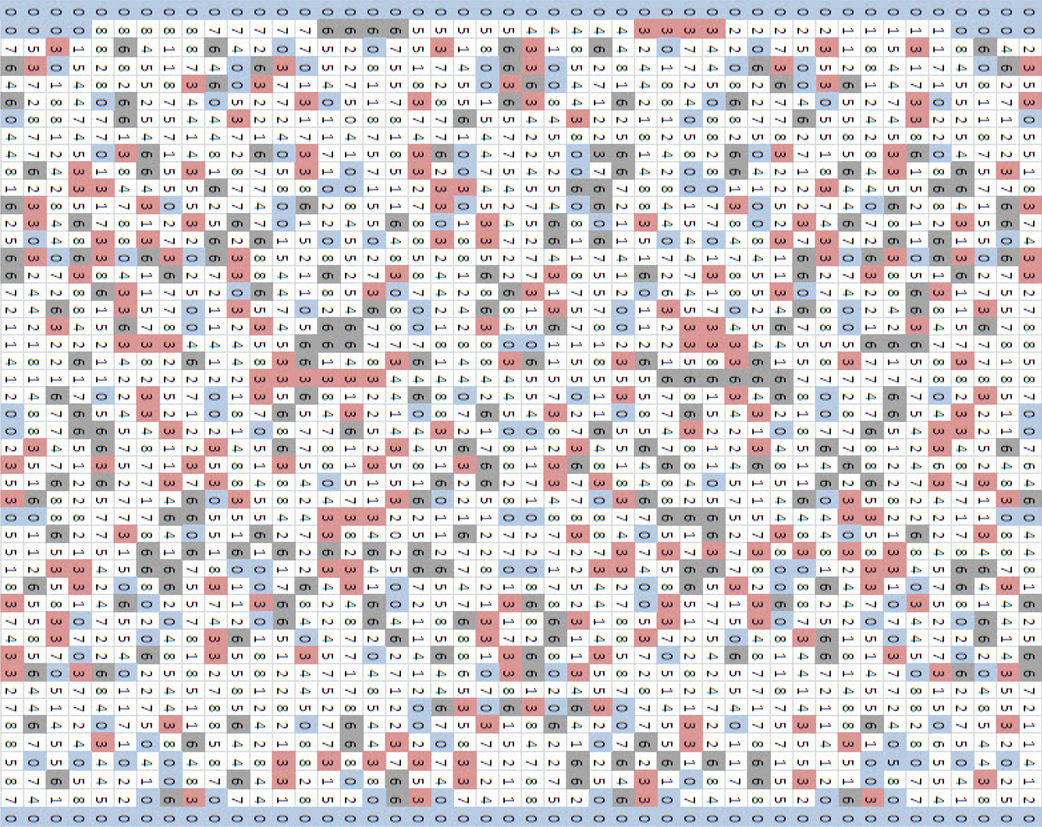
Field glyphs sort the integers into three visible categories. The geometry is base-independent. The structure was there before the formalism.
June 2010
Certain numbers produce repeating geometric structures when plotted on circular fields. The diagrams below make those structures visible.
The method is simple. Take a number $n$ and build its fractional field, the full set of fractions $k/n$ for $k = 1, \ldots, n-1$. Expand each fraction in base 10 and trace the orbits of the repeating digits around a circle with nine positions. Some fractions terminate, some repeat in closed orbits, and some do both. Then follow the cumulative polarity through each step of each orbit, the running digital root as the digits accumulate. The resulting diagram is what I call the field glyph of $n$. I use the word glyph because these shapes are not drawn. They are already there, carved into the arithmetic of each number. I am only making them visible. The geometry in the diagrams below comes from tracing that cumulative polarity around the circle.
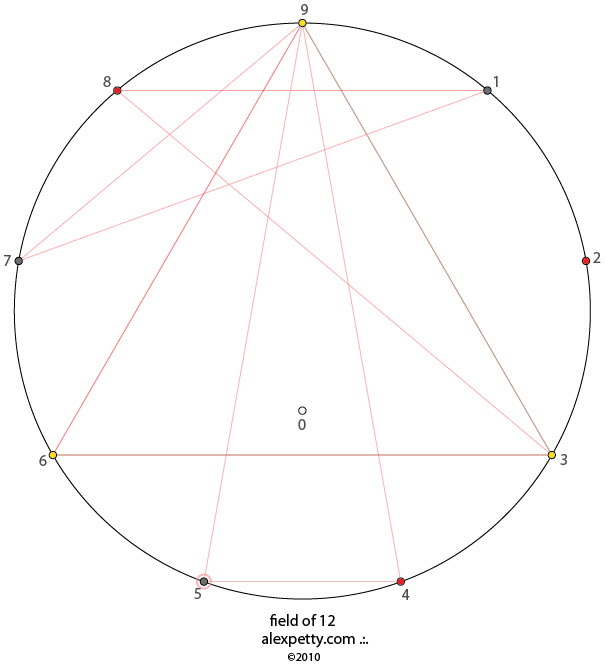
In the diagrams below, red lines denote clockwise (positive) flow and gray lines denote counterclockwise (negative) flow. Where positive and negative paths overlap the colors combine into a light brown tone. Darker brown indicates a greater number of overlapping paths.
For prime sequences, yellow denotes positive flow and green denotes negative flow. Overlapping prime paths form an olive color, and darker olive indicates deeper intersections.
Three kinds of numbers
When plotted in circular modular space, numbers appear to fall into three functional roles based on the geometry they produce.
- Structural numbers produce organizing frameworks. They generate the scaffolding that other patterns build on.
- Polar numbers produce closed rotational cycles. They circulate through the field in balanced, repeating loops.
- Form numbers produce open growth patterns. They spiral outward through the field, doubling and expanding.
These categories are not axioms. They are descriptions of what the diagrams show. But the consistency with which numbers sort themselves into these roles across many examples is what makes the classification feel meaningful rather than arbitrary.
Structural fields
Zero
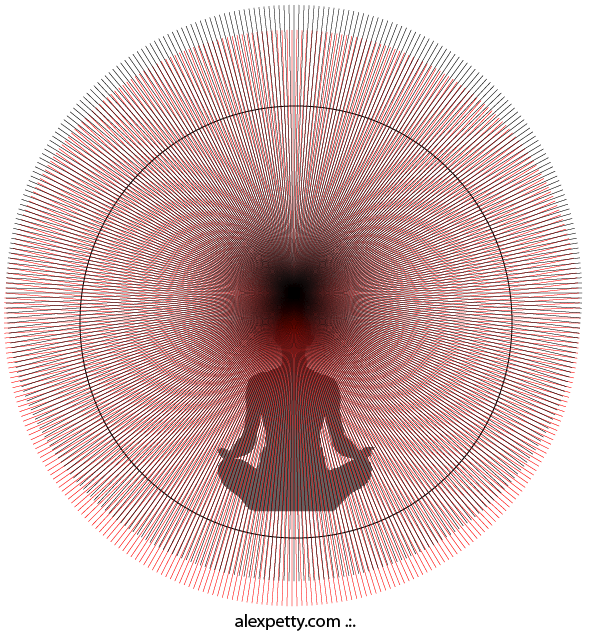
The zero field represents the origin. It contains no directionality but serves as the neutral reference point from which all cycles emerge.
Unity
Unity is not the number 1. It is the undivided state before number begins. The number 1 does not exist on its own. It comes into existence only alongside 2, the two arising together the moment unity differentiates. The boundary between them produces 5. Divide 1 by 2 and you get 0.5. The digit 5 arrives on its own. These three, 1, 2, and 5, emerge simultaneously. None of them is prior to the others. The field of 1 is the arithmetic shadow of the undivided state, not the state itself. One times anything is itself. Every path returns to its starting point. But 1 is already inside the system, already on one side of a boundary. Unity has no sides.

Plurality
The field of two represents the simplest form of separation.
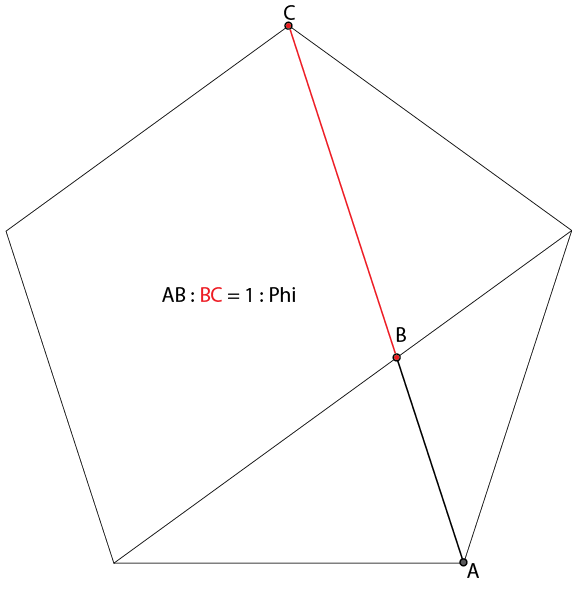
Now look at the three symbols the differentiation has produced: 1, 2, and 5. They express $\varphi = (1 + \sqrt{5})/2$. The golden ratio is written entirely in the language the structure already gives us. These are base-10 digits, but only three of them. The structure produces its own alphabet, and that alphabet is sufficient to write the golden ratio.
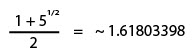
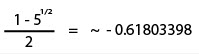
The golden ratio governs the relationship between expansion and contraction in this simplest case of separation, balancing the two so that neither overwhelms the other. Unity divides, but something of it persists in the ratio between its parts. I do not expect it to appear here, but it does, and it keeps appearing throughout many of the geometric constructions that follow. It seems to live naturally inside the relationship between two and one.
The field of five
The number five also appears repeatedly as a structural organizer.

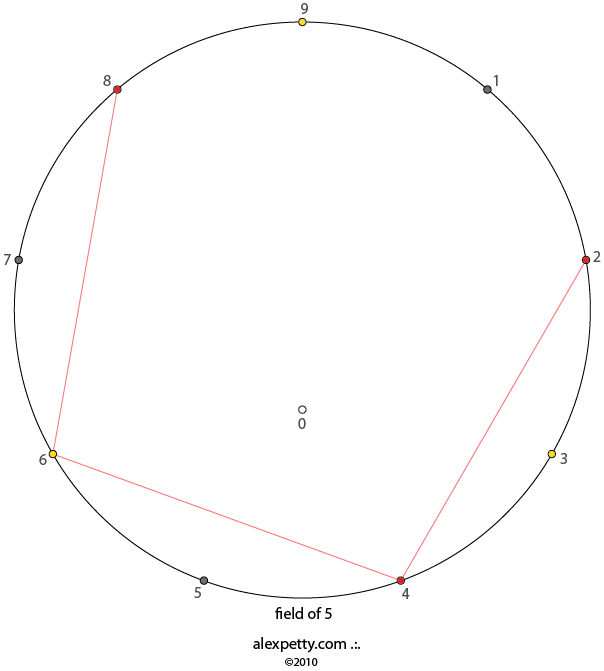
In any even base, the number halfway through divides the base. In base 10 that number is 5. Together with 2 it generates all terminating decimals. In the diagrams it acts as a boundary between the cyclic and the terminating, between structure that repeats and structure that resolves.
Polar fields
When the system is plotted as a circular field, certain numbers produce closed rotational cycles. These are the polar numbers: 3, 6, and 9.
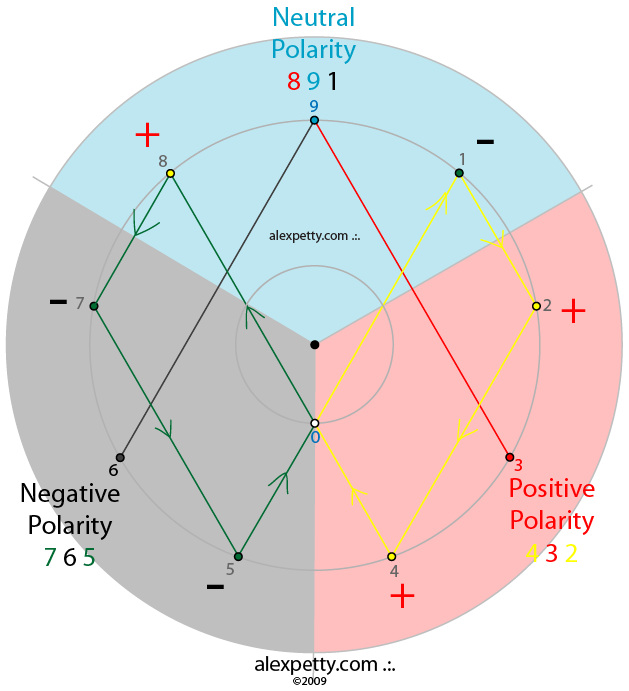
This is the same polarity structure explored in The Circle of Nine. Here we see it from a different angle. Not as a static classification of positions, but as a set of dynamic paths through modular space.
Positive polarity: the field of three
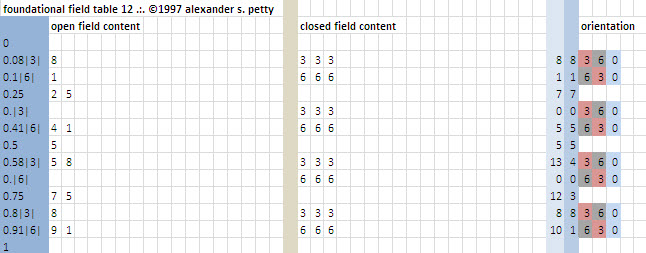
The field of three produces one of the simplest closed cycles. Its glyph is a triangle inscribed in the circle, traced in both directions.

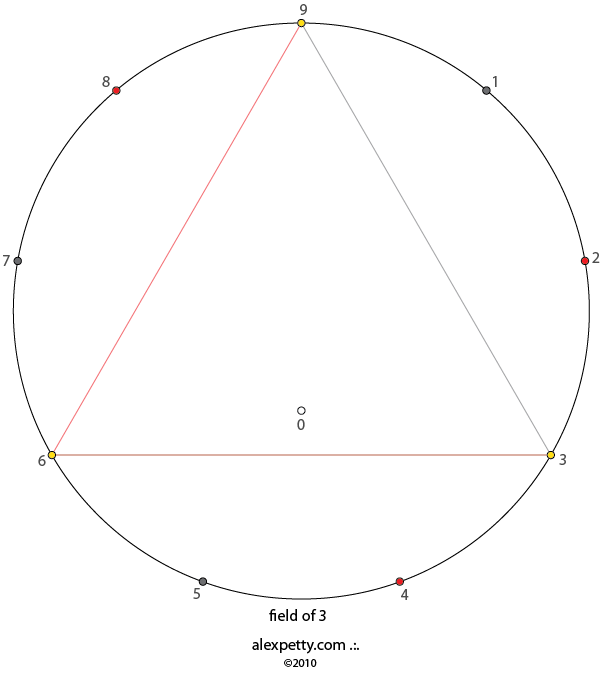
The same triangular flow reappears at every multiple of three that shares its digital root. At twelve:
And at twenty-one:
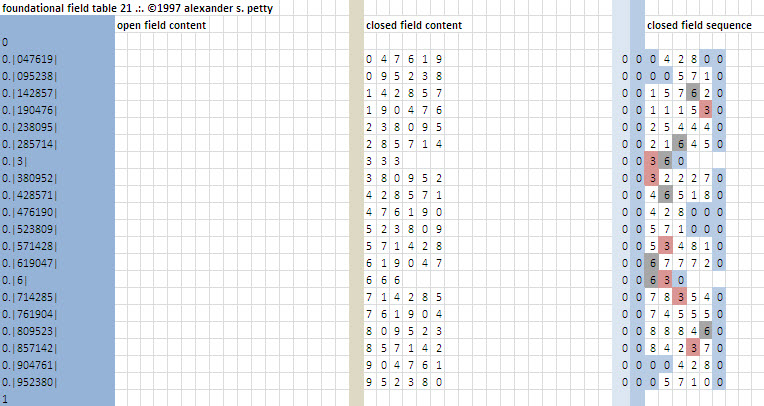
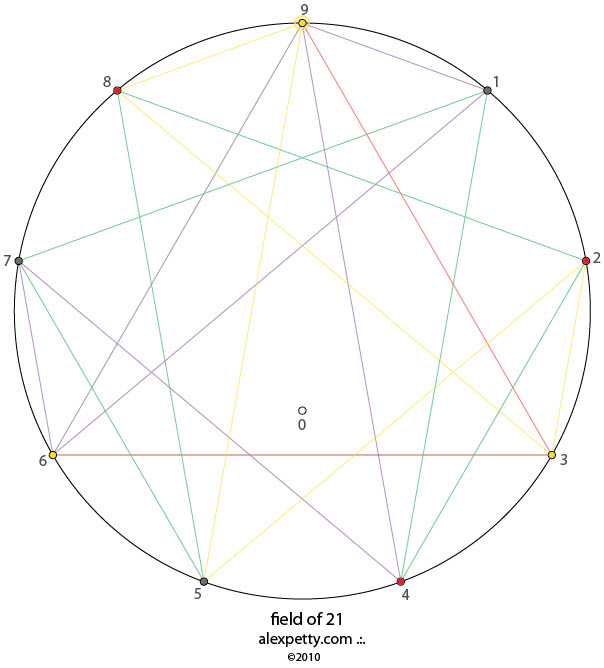
The internal detail grows more complex, but the triangular skeleton persists. The field of three is stable across its entire family.
Negative polarity: the field of six
The field of six produces a complementary rotational pattern, the same triangle but traced in the opposite direction.
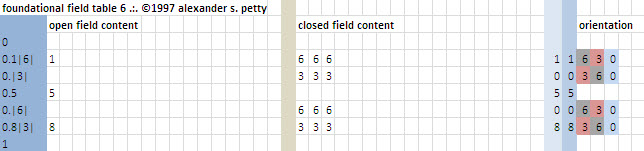
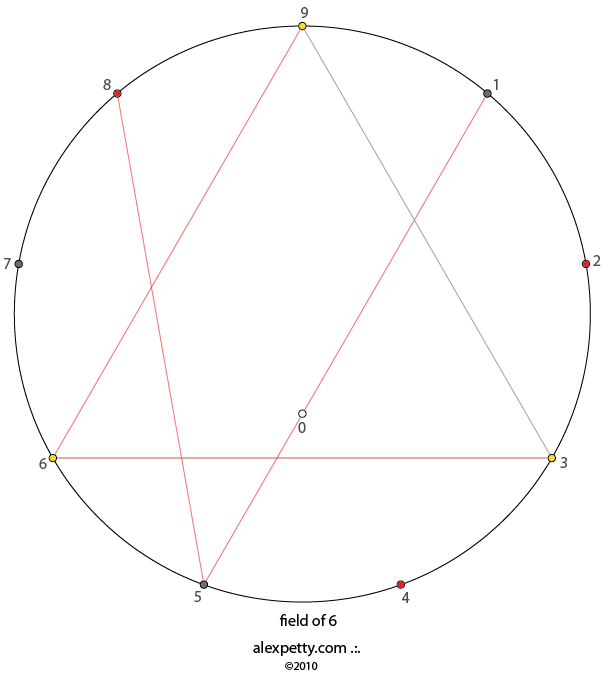
Subsequent iterations at fifteen and twenty-four:
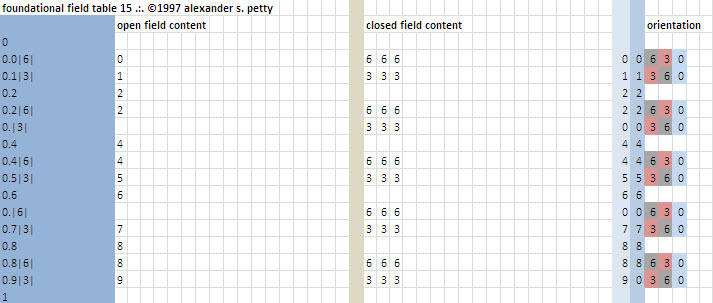
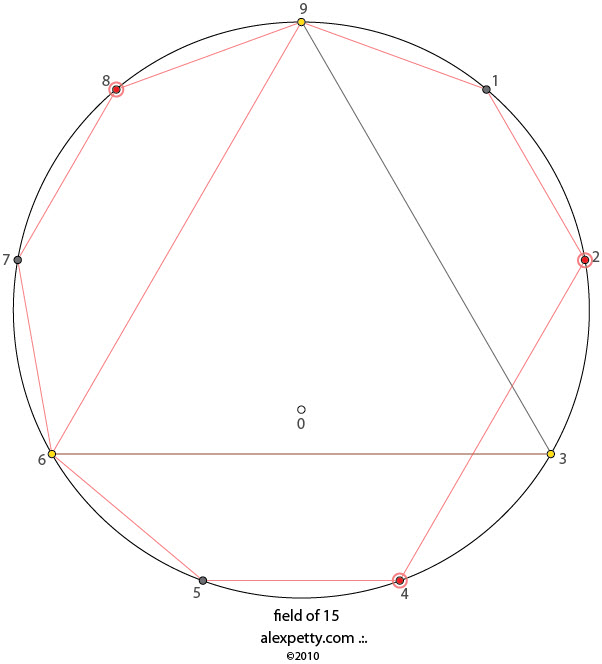
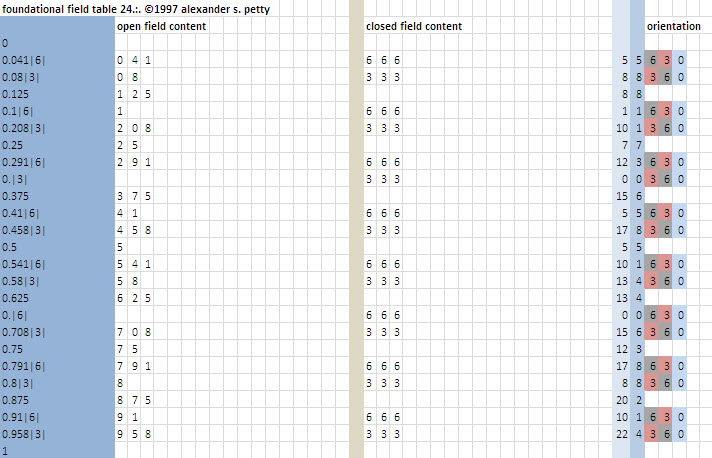
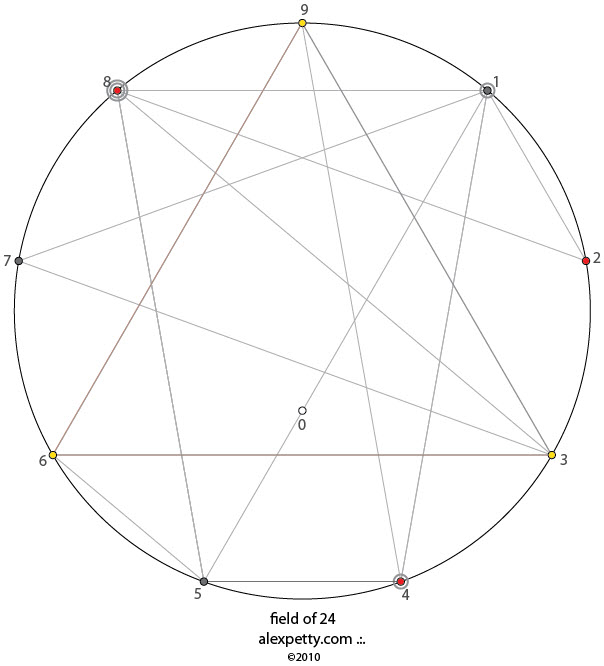
Three and six are complements. Their glyphs are mirror images. Their digital roots sum to nine. They are the two poles of the same rotational structure, one turning clockwise, the other counterclockwise.
Neutral polarity: the field of nine
The number nine behaves differently from the others. It acts as a rotational center around which many sequences stabilize.
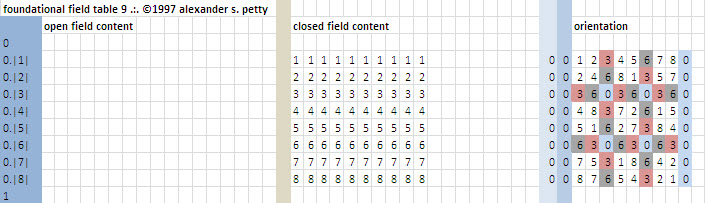
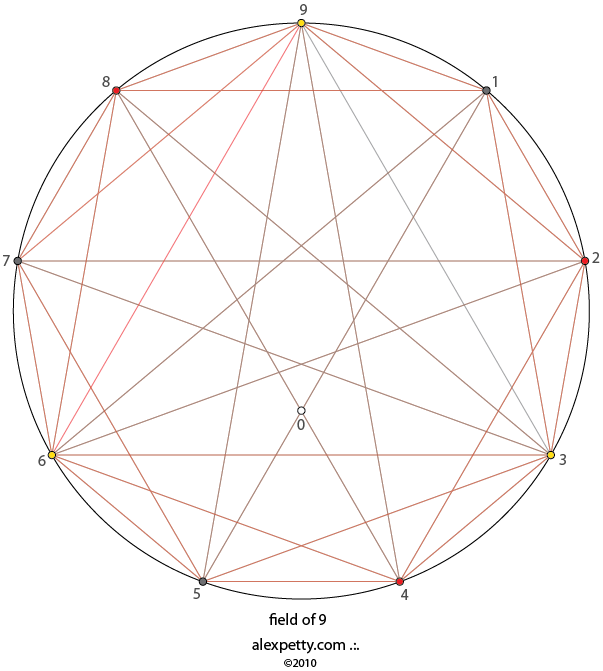
The harmonic overtone series in acoustics also displays relationships that map onto this field. When the harmonics of each harmonic are reduced modulo 9, the resulting table has a structure that mirrors the numeric polarity cycle.
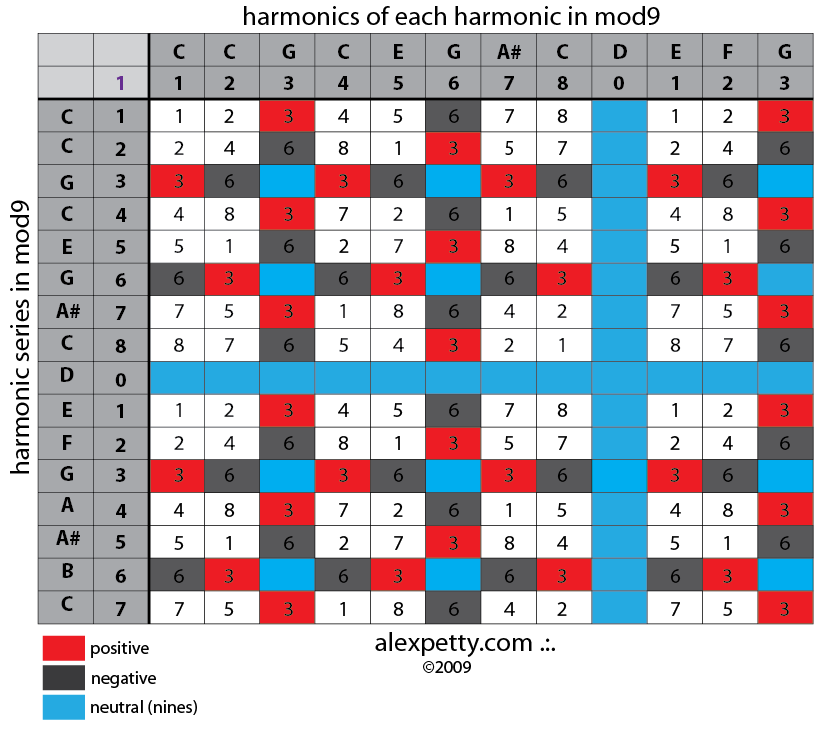
Music and number have been linked since Pythagoras, and the mod-9 field seems to be one of the places where that link becomes visible.
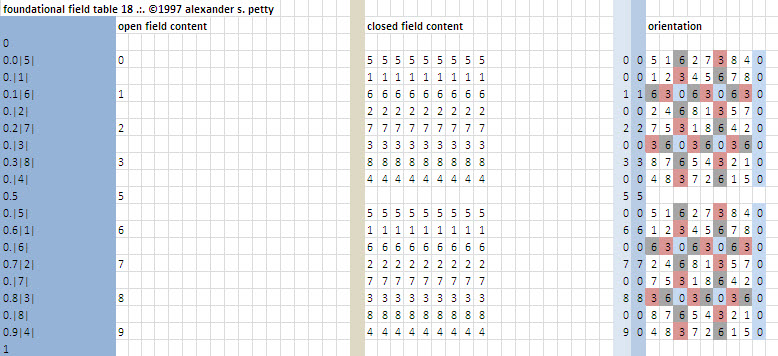
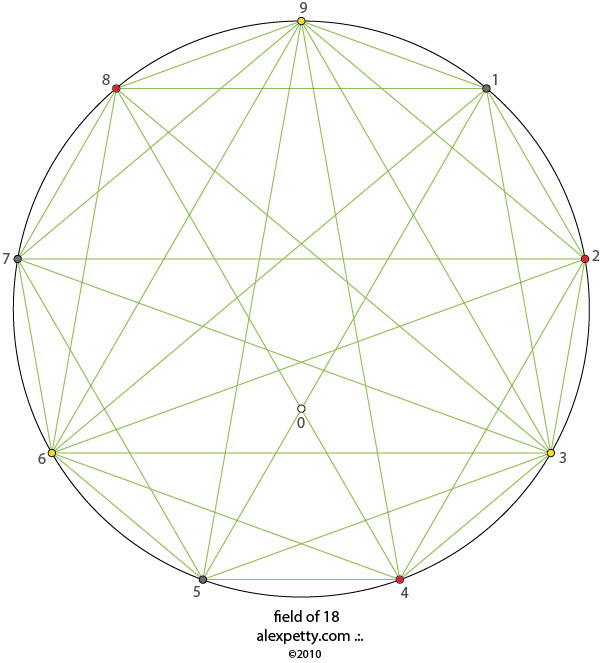
The next neutral iteration appears at eighteen:
Prime fields
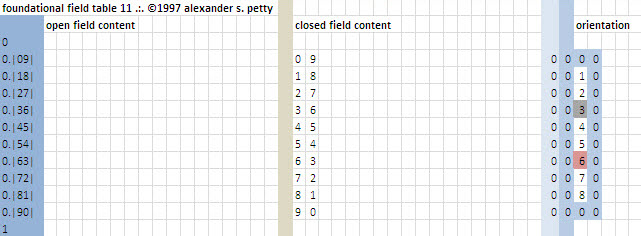
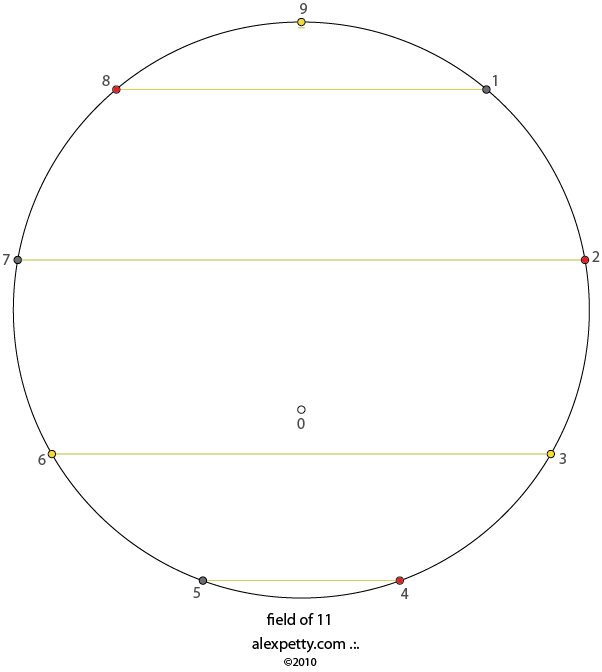
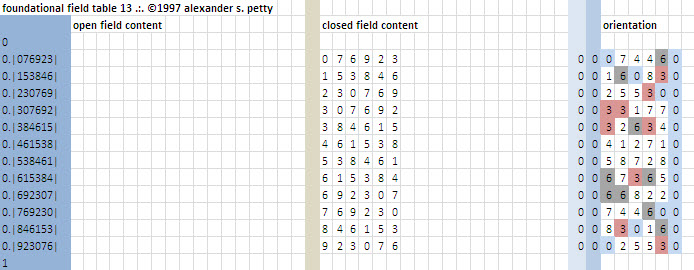
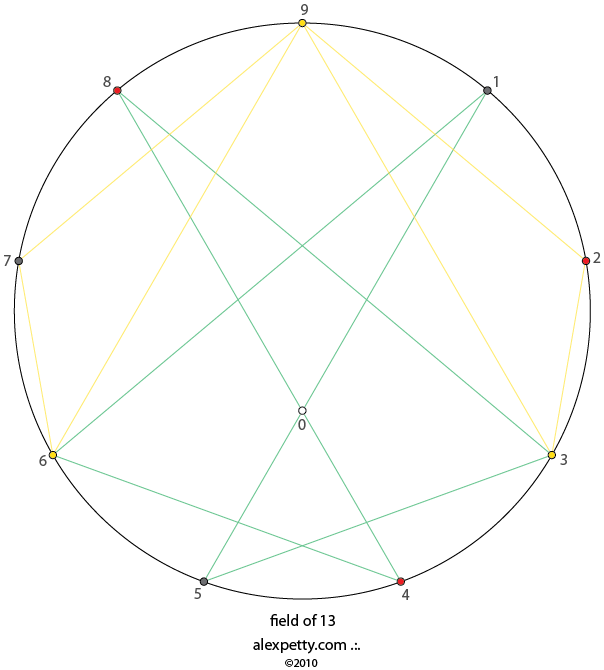
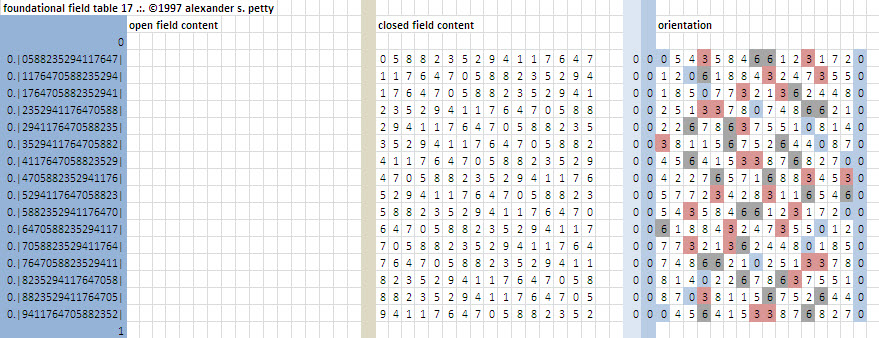
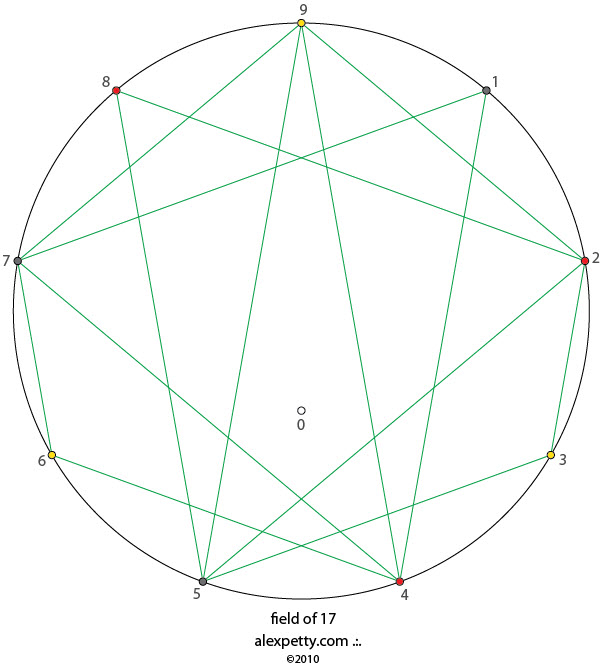
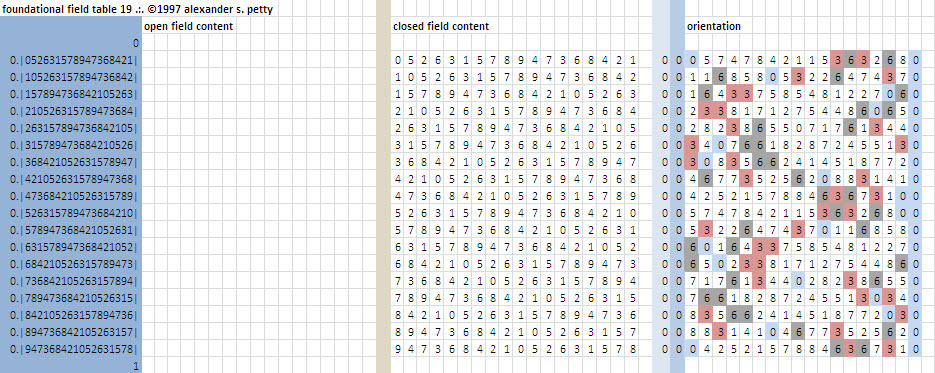
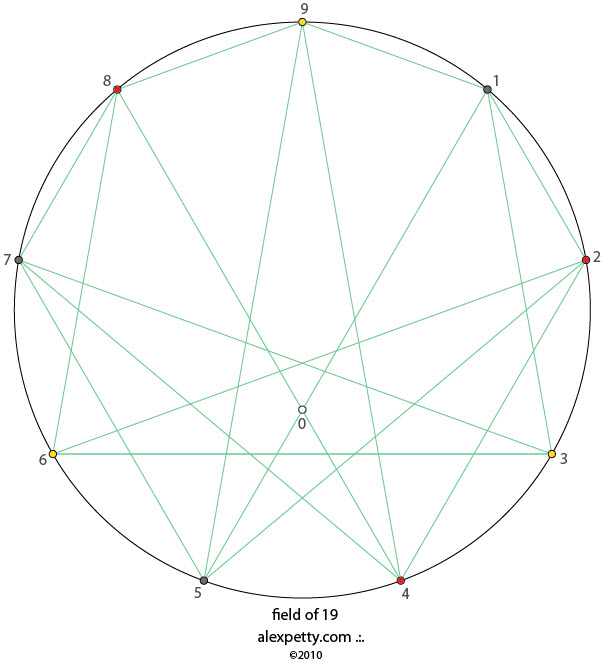
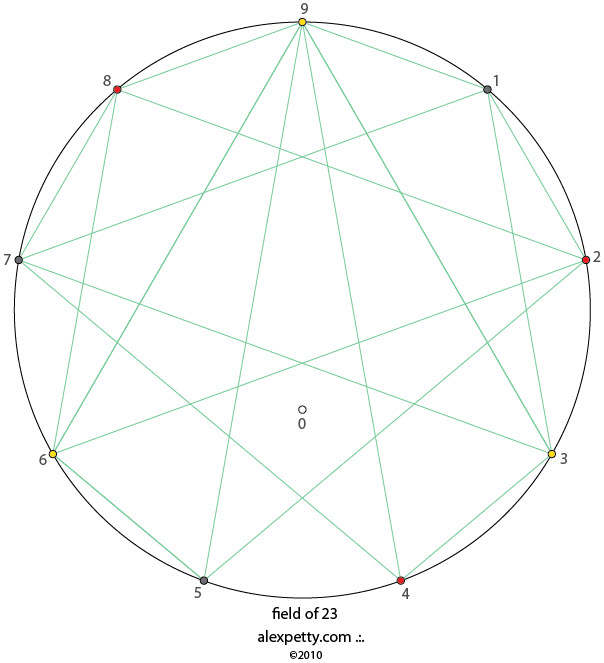
Prime numbers produce especially striking structures in these diagrams. Because a prime has no factors other than one and itself, its field glyph is not a composite of simpler patterns. It is irreducible. What you see is the prime itself, expressed geometrically.
7
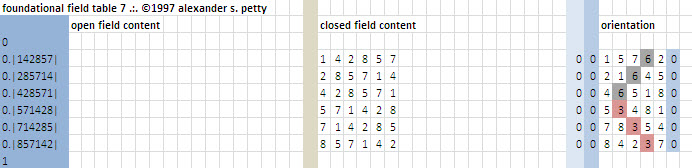
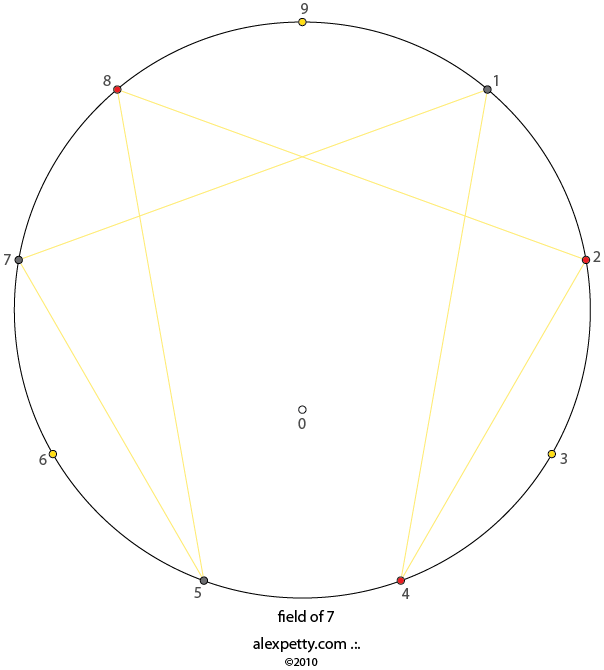
Seven is the first prime whose field glyph fills the entire circle. Its multiplicative order modulo 9 is 6, meaning it visits every position before repeating. The resulting hexagonal symmetry is unmistakable.
11
13
17
19
23
Additional prime tables
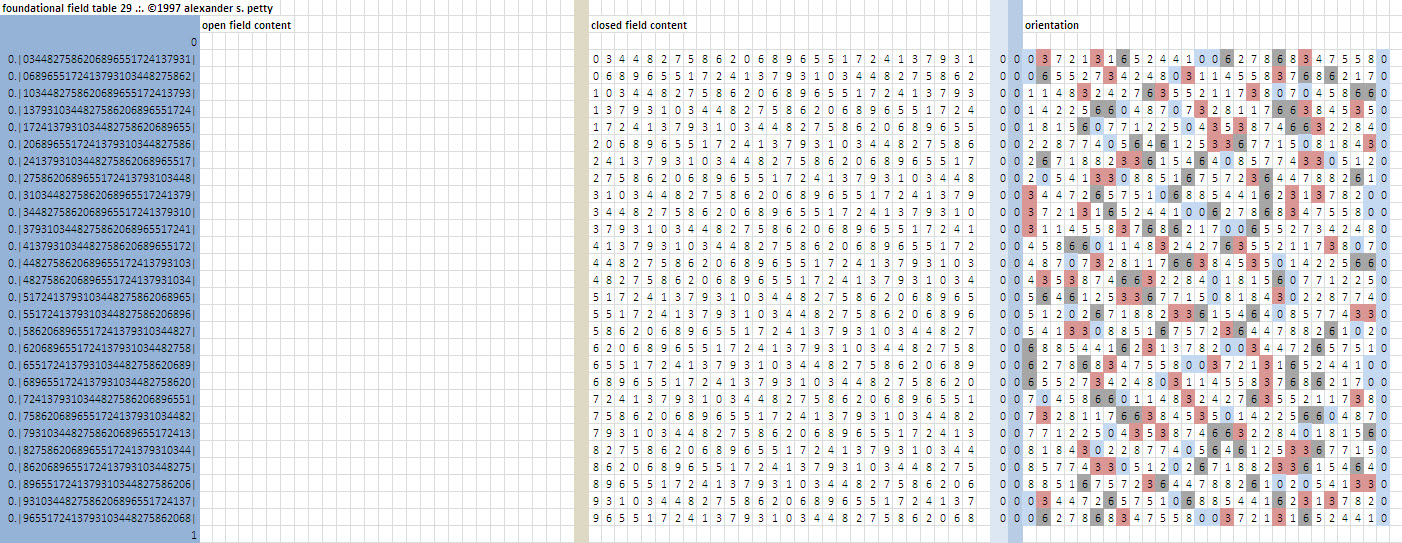
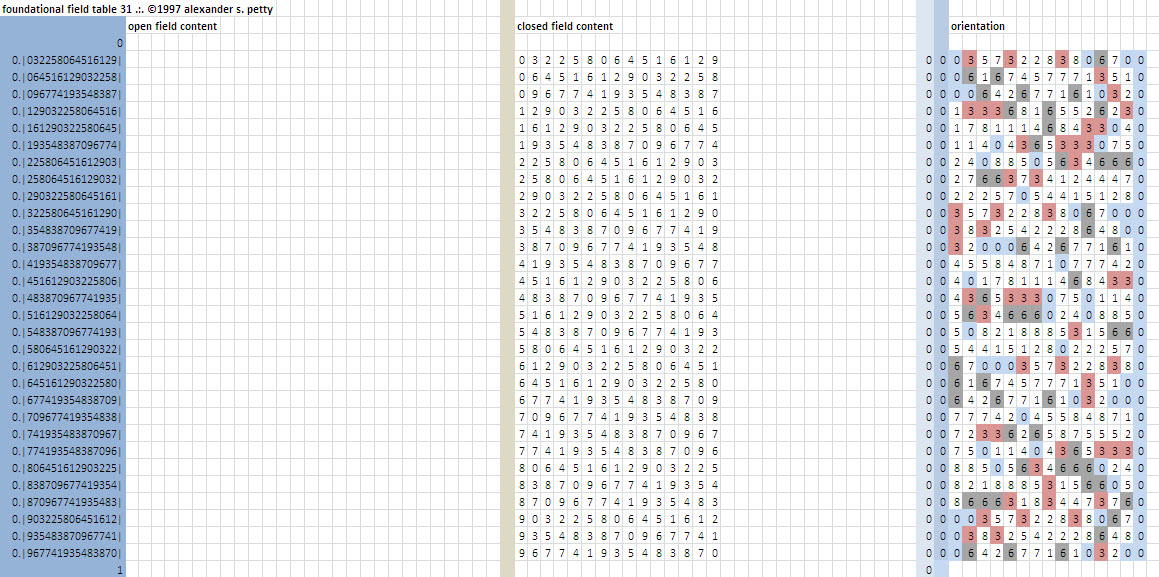
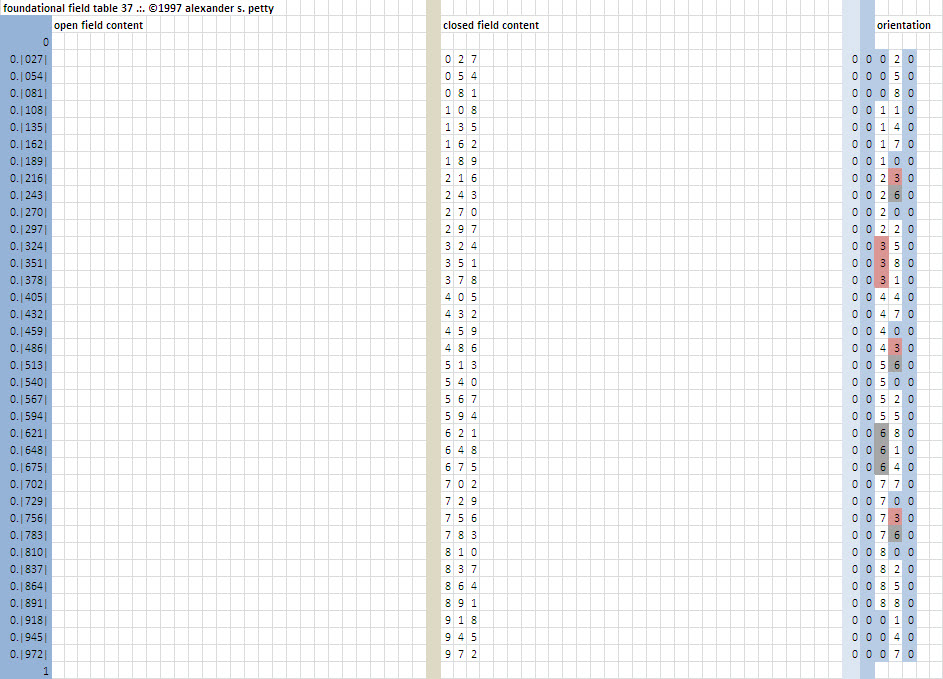
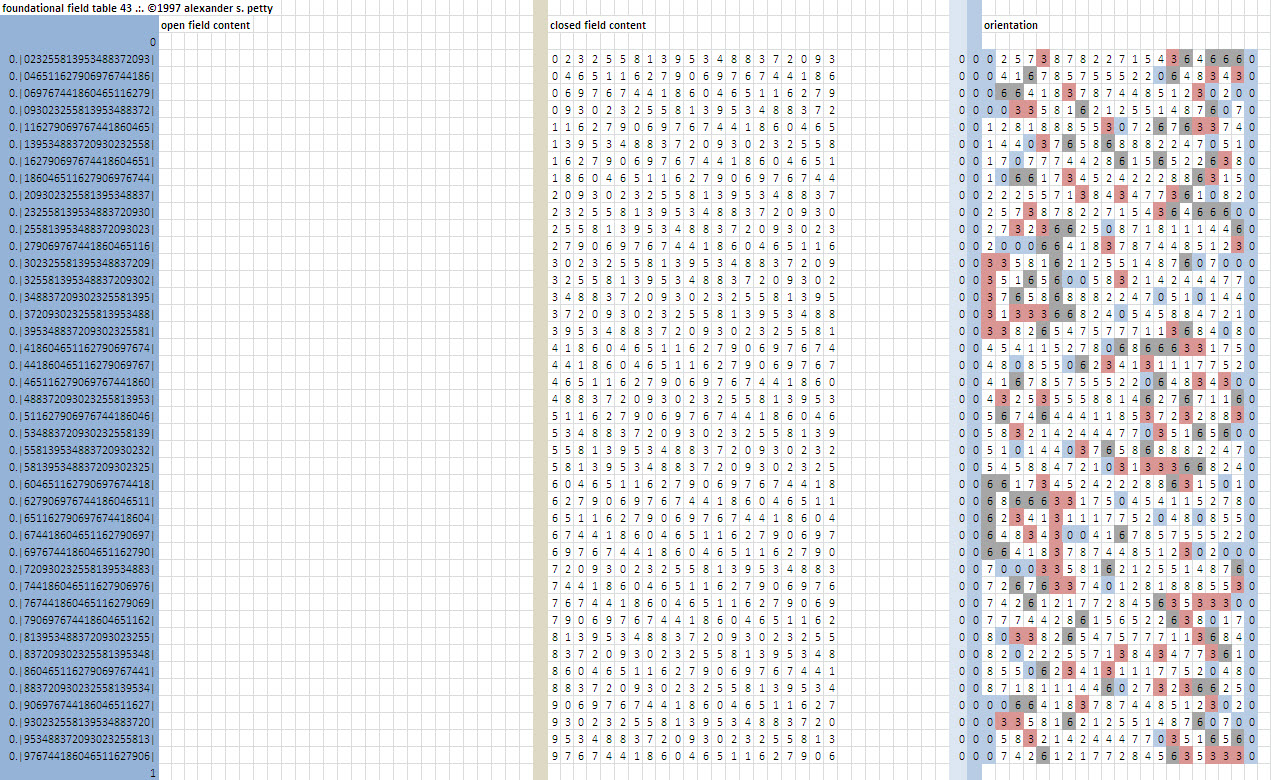
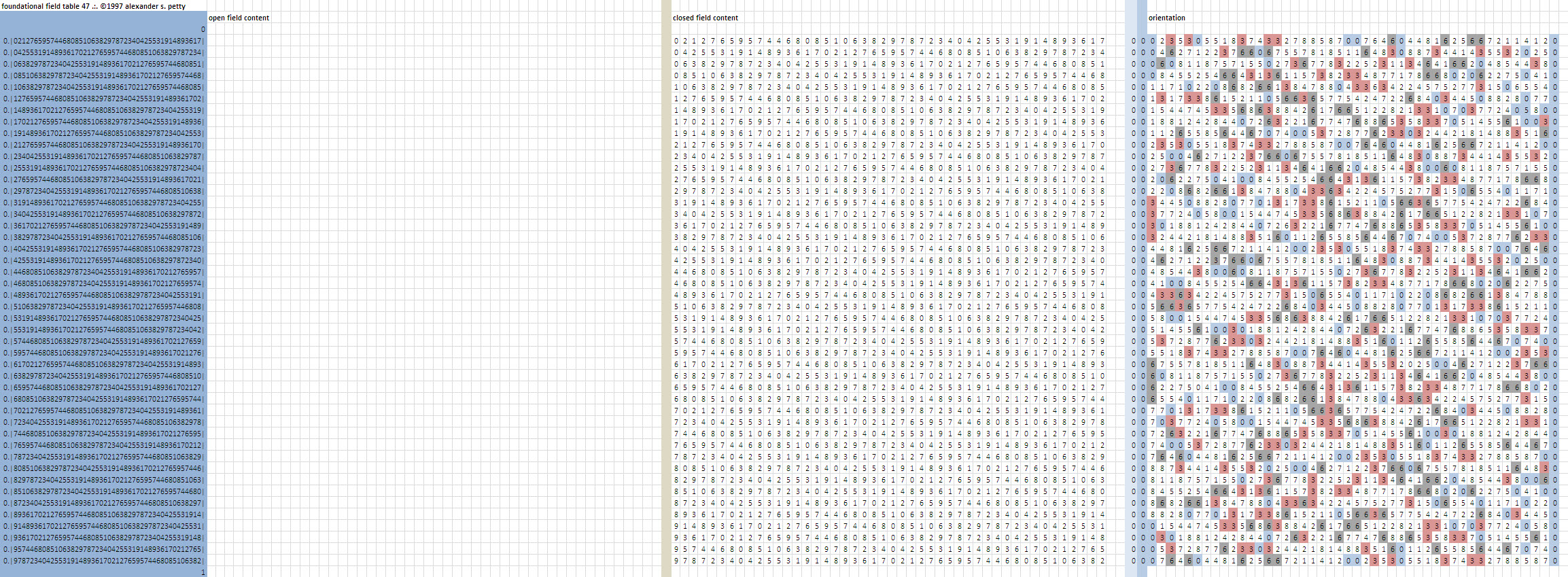
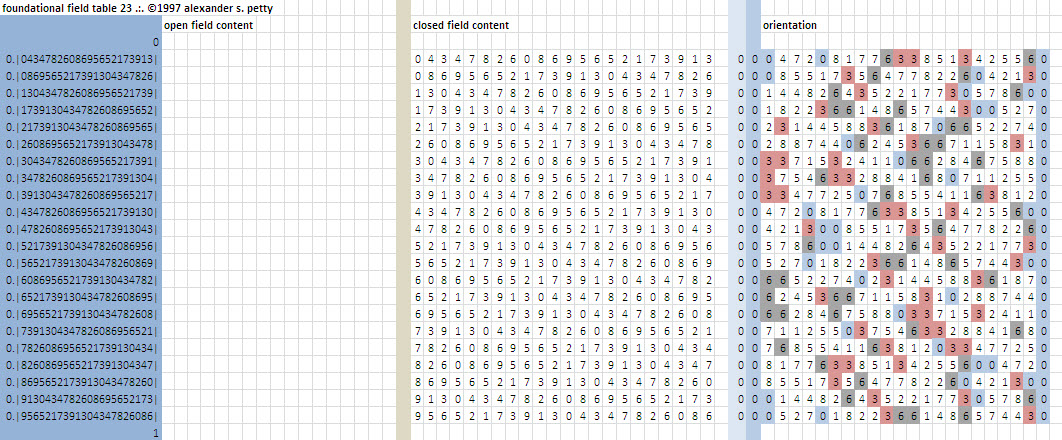
As the primes grow larger, the field tables become denser but the underlying geometric regularity persists. Each prime produces its own distinct pattern, and no two primes produce the same glyph.
The world of form
Not all numbers produce closed cycles. Some produce open, expanding patterns that spiral outward through the field.
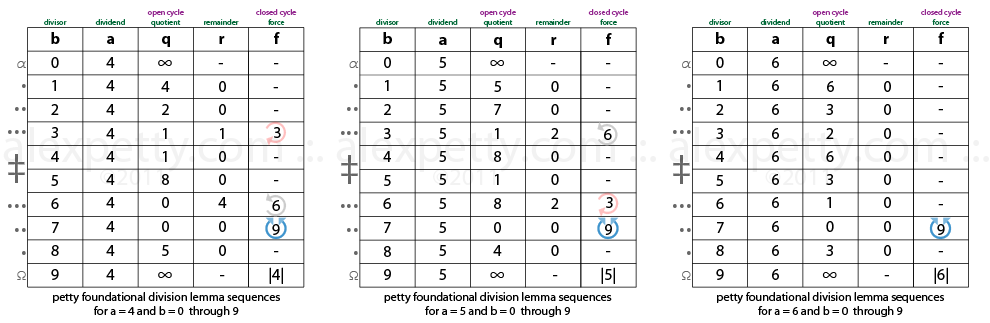
The field of four demonstrates this clearly.

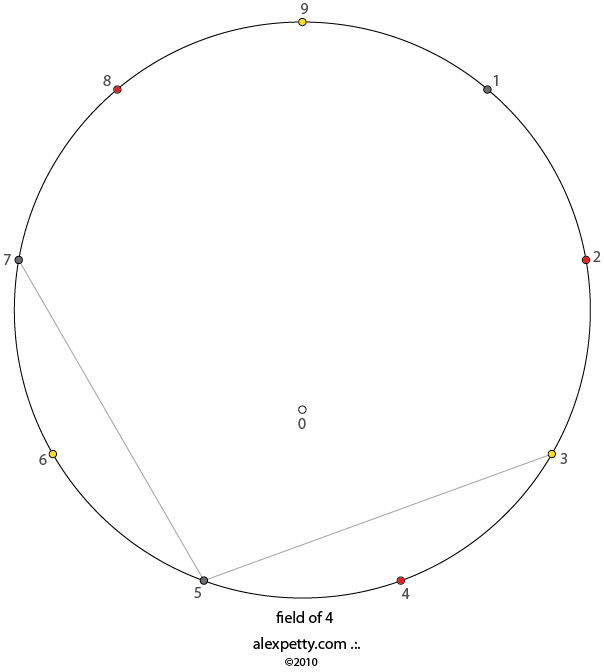
These structures often follow doubling sequences:
1 → 2 → 4 → 8 → 16 → 32 → 64
Under digital root reduction, this sequence produces the repeating cycle 1, 2, 4, 8, 7, 5, which then loops back to 1. The glyph traces this path through the circle.
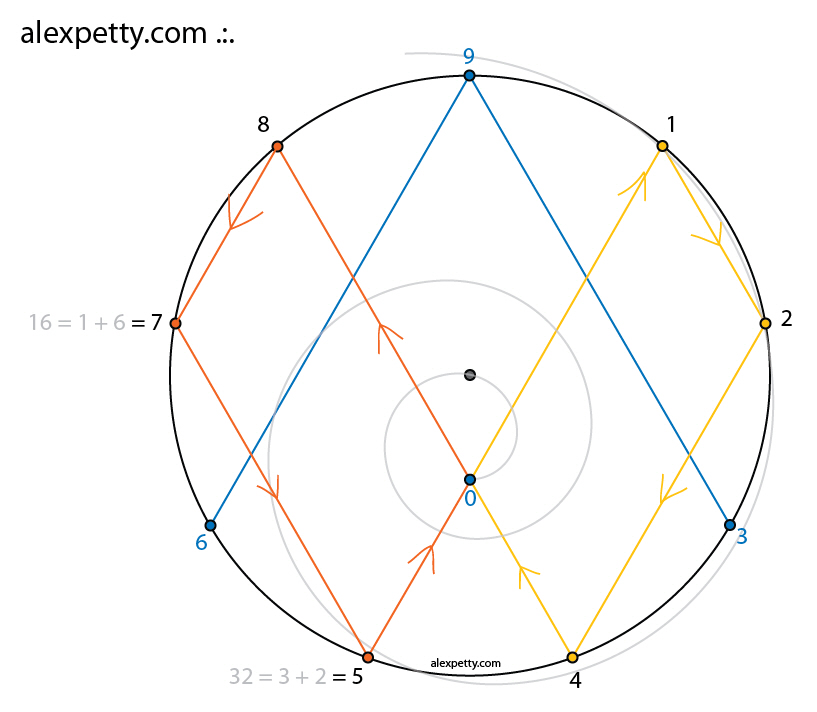
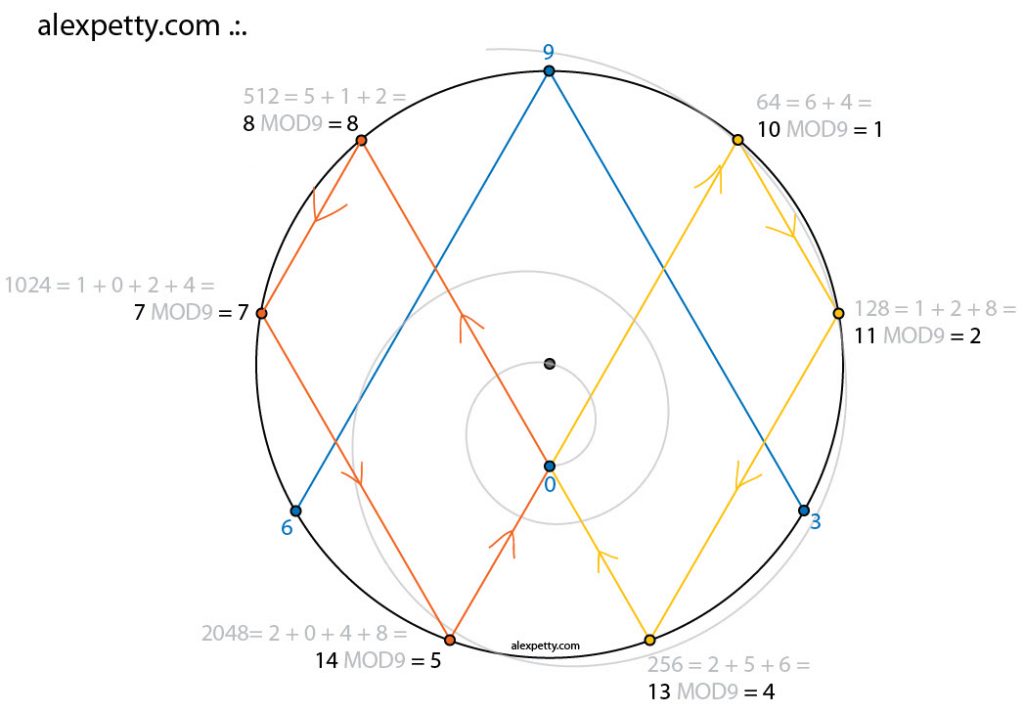
The same open, spiraling character appears in the fields of 8, 10, 14, 16, 20, and 22. These are the composite numbers whose digital roots fall outside the polar set {3, 6, 9}. They do not close into cycles. They grow.
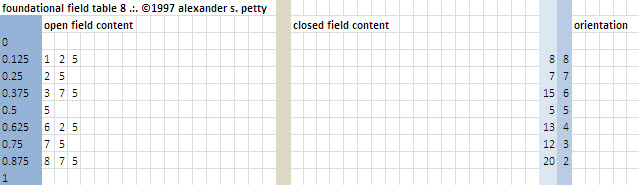
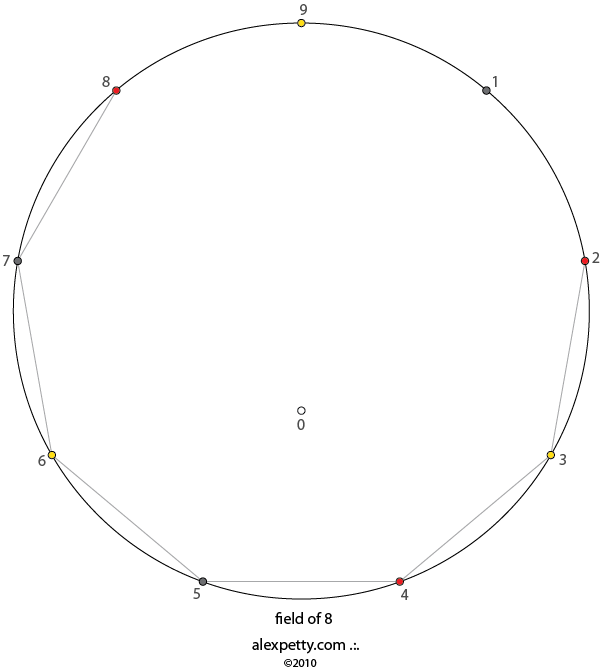
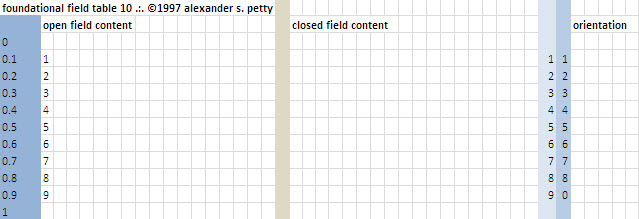
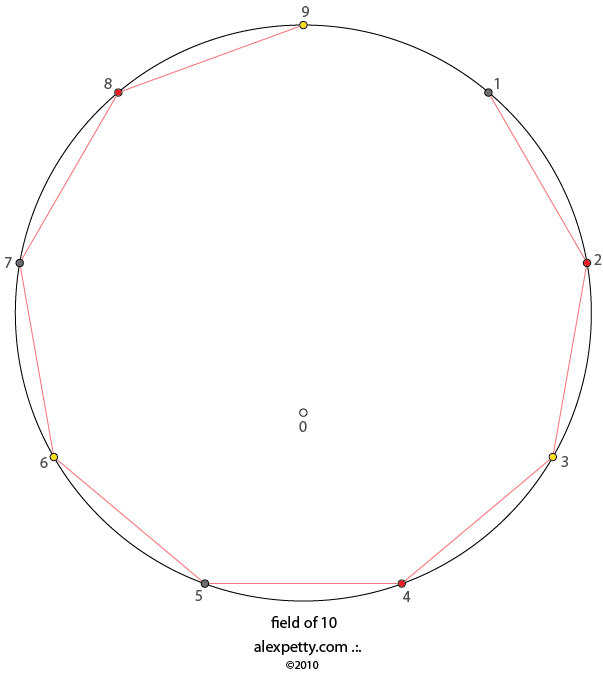
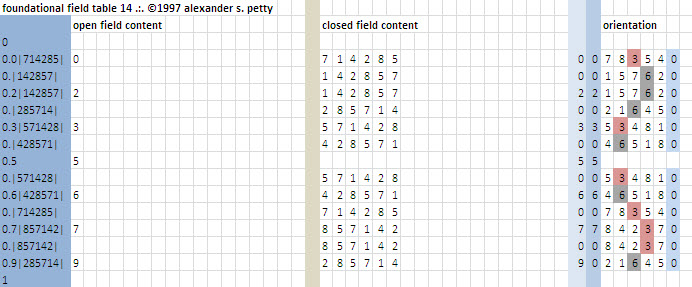
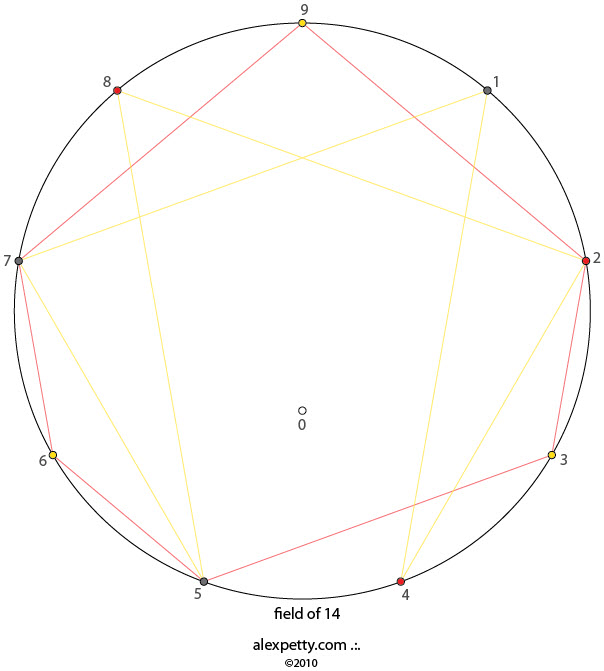
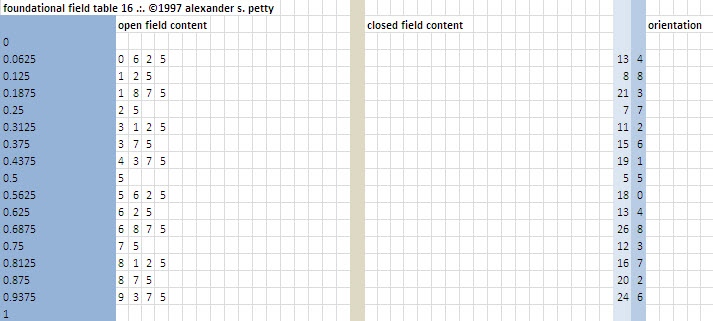
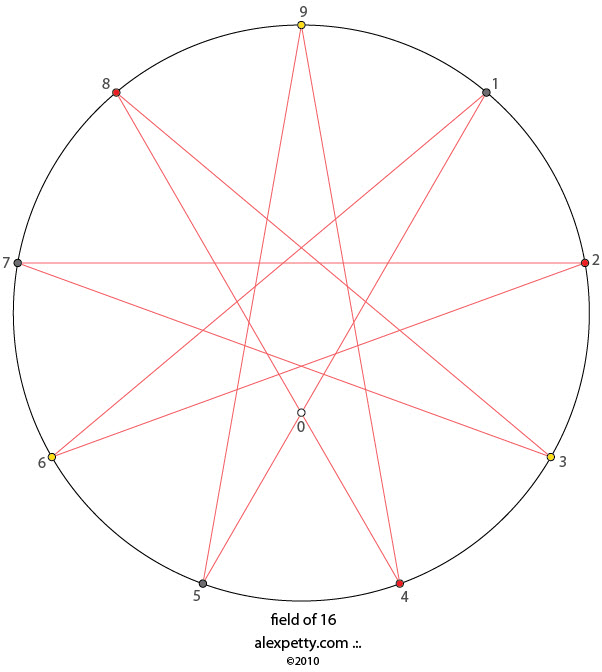
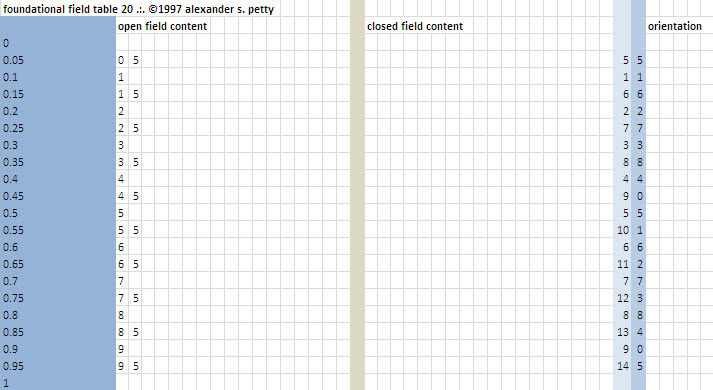
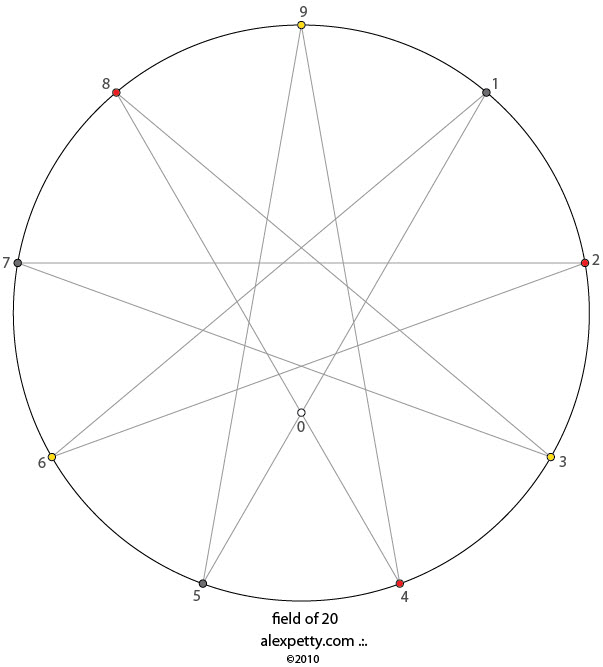
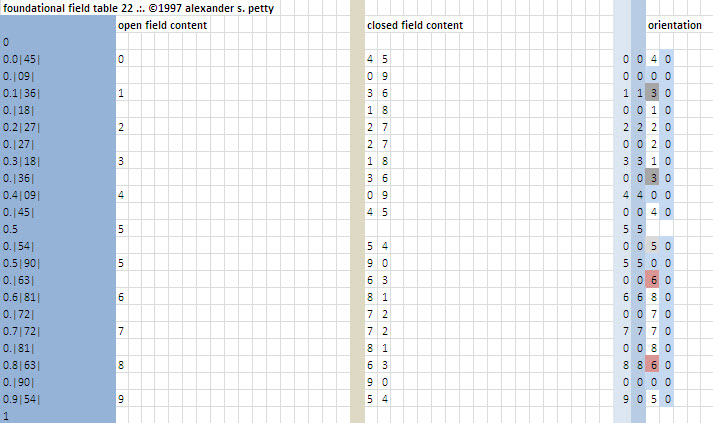
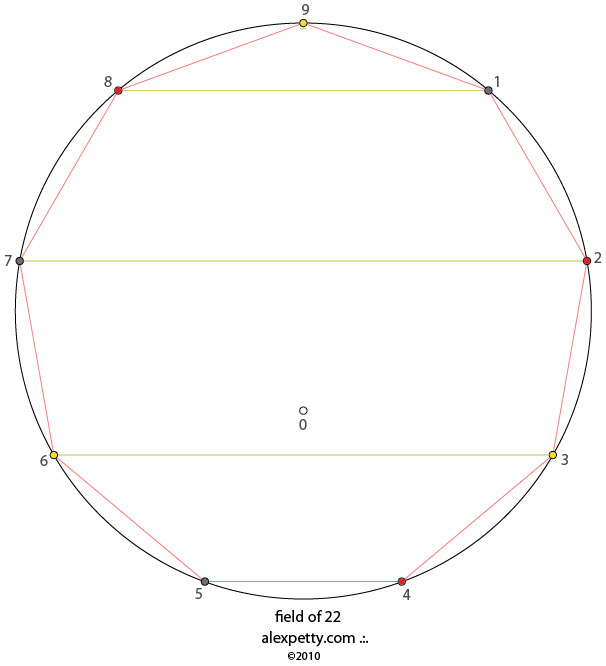
The three-way classification is not something I impose on the data. Numbers sort themselves into these roles consistently. The polar numbers {3, 6, 9} form closed cycles. The form numbers {4, 8, 10, ...} produce open spirals. The structural numbers {1, 2, 5} act as scaffolding. Primes stand apart from all three categories, each one producing an irreducible pattern that belongs to it alone.
These geometries are not accidents. They are the shapes of number itself, made visible by a simple change of representation.
.:.
A note from 2026
April 2026
This was my first attempt at a systematic visual catalog of what I now call fractional fields. The method was primitive compared to what nfield does today, but the impulse was the same. Plot the arithmetic of a number, all of it, and see what structure appears.
The field glyph of a prime turned out to be a direct visualization of the digit function $\delta(r) = \lfloor br/p \rfloor$ and its multiplicative orbit. The observation that primes produce irreducible patterns while composites decompose into simpler ones is the distinction between prime and composite fractional fields that Why the Golden Ratio Selects the Prime Three formalizes.
The two structures visible here, the polar scaffold and the doubling orbit, turned out to be independent of each other in a precise sense. The additive subgroup {3, 6, 9} and the multiplicative orbit {1, 2, 4, 8, 7, 5} live in different parts of the arithmetic. Knowing which one a number belongs to tells you nothing about its position in the other. That independence became important in the later work, though in 2010 I had no way to see why.
.:.