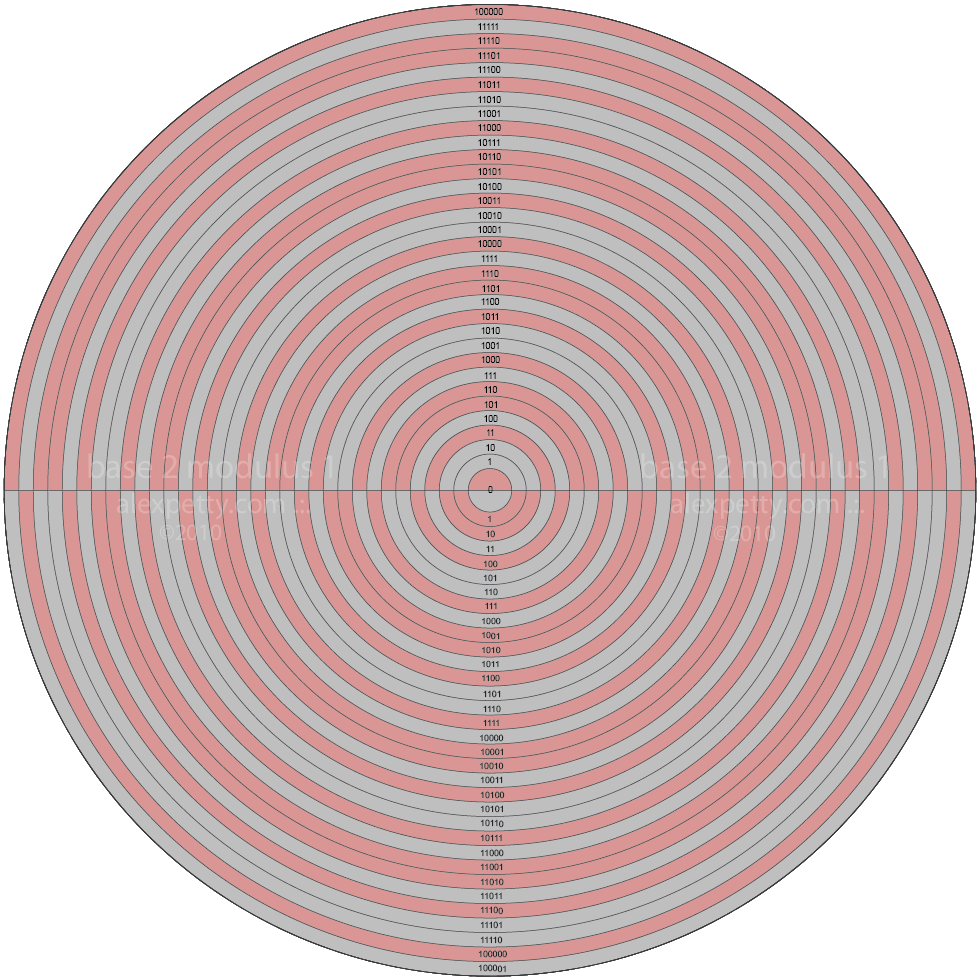
Long Division and Euclid's Lemma
The digit function is the floor quotient from Euclidean division. It maps remainders to digit bins. Everything in the collision program starts here.
March 2011
Long division looks like a mechanical process for dividing one number by another. It is more than that.
What we call long division is an implementation of the Division Algorithm, a procedure tracing back to ancient Greek mathematics and closely related to Euclid's Division Lemma. The lemma guarantees that any integer can be uniquely decomposed into a quotient and a remainder:
$$a = bq + r \qquad \text{with} \qquad 0 \le r < b$$
Long division is a window into the internal structure of integers.
Division as a structural process
When we perform long division we are progressively revealing the internal structure of the dividend.
The procedure works digit by digit. At each step we determine how many copies of the divisor fit into the portion of the number currently under consideration. Whatever cannot fit becomes the remainder, and it is carried forward into the next step. In this way, division recursively decomposes the number, layer by layer. Each step exposes another digit of the quotient and another piece of the number's structure.
What makes this especially interesting is that the process can continue indefinitely. If the remainder never becomes zero, we can append zeros and continue the procedure forever. The algorithm allows us to examine the ratio between two numbers to any arbitrary level of precision, without approximation, without rounding. Unlike floating point arithmetic, which introduces errors at the limits of its representation, long division gives us exact answers as far as we care to look.
Long division acts like a mathematical probe. It lets us explore the relationship between two numbers with whatever resolution we choose.
A quiet but powerful constraint
The division algorithm has a subtle property that is easy to miss.
At every stage of the procedure, the remainder is constrained within a bounded interval:
$$0 \le r < b$$
No matter how large the dividend becomes, the remainder can only take on a limited set of values. For a divisor of 7, the remainder is always one of {0, 1, 2, 3, 4, 5, 6}. For a divisor of 13, it is always one of {0, 1, ..., 12}.
This restriction is what makes the algorithm so stable. It guarantees that each step produces exactly one new digit in the quotient. And because Euclid proved that the quotient and remainder are unique for any given pair, the structure revealed by long division is not arbitrary. It is intrinsic to the numbers themselves.
This bounded remainder is also the reason that decimal expansions of rationals eventually repeat. There are only finitely many possible remainders. Once a remainder recurs, the entire sequence of digits that followed it the first time must follow it again. The repetend is born from the pigeonhole principle applied to the remainder sequence.
Mapping the quotient-remainder structure
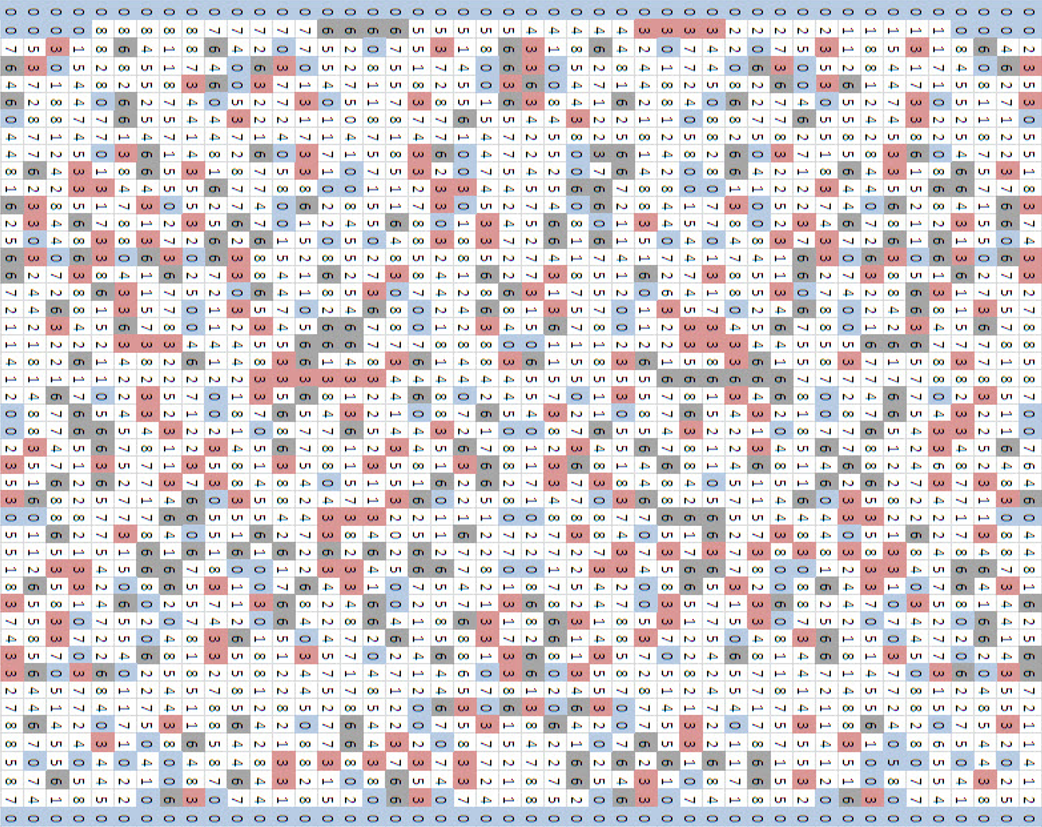
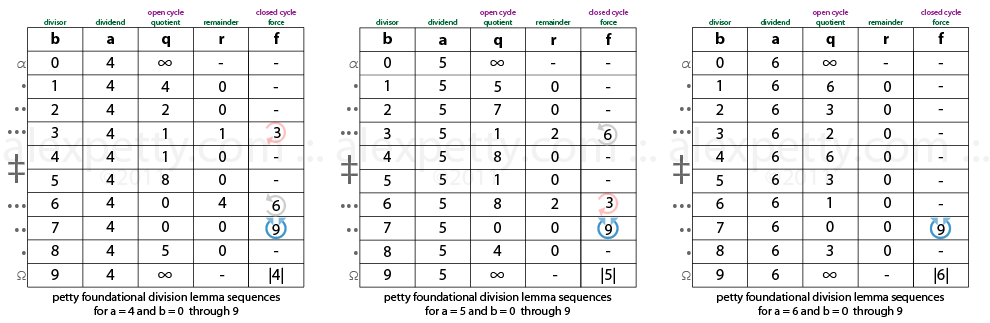
Instead of examining a single division problem, generate the full set of quotient-remainder results produced by Euclid's division lemma for many small integers. Let the dividend $a$ range from 1 through 32 and the divisor $b$ range from 0 through 9. For each pair $(a, b)$, the division lemma produces a unique pair $(q, r)$.
Plot these results in tabular form.
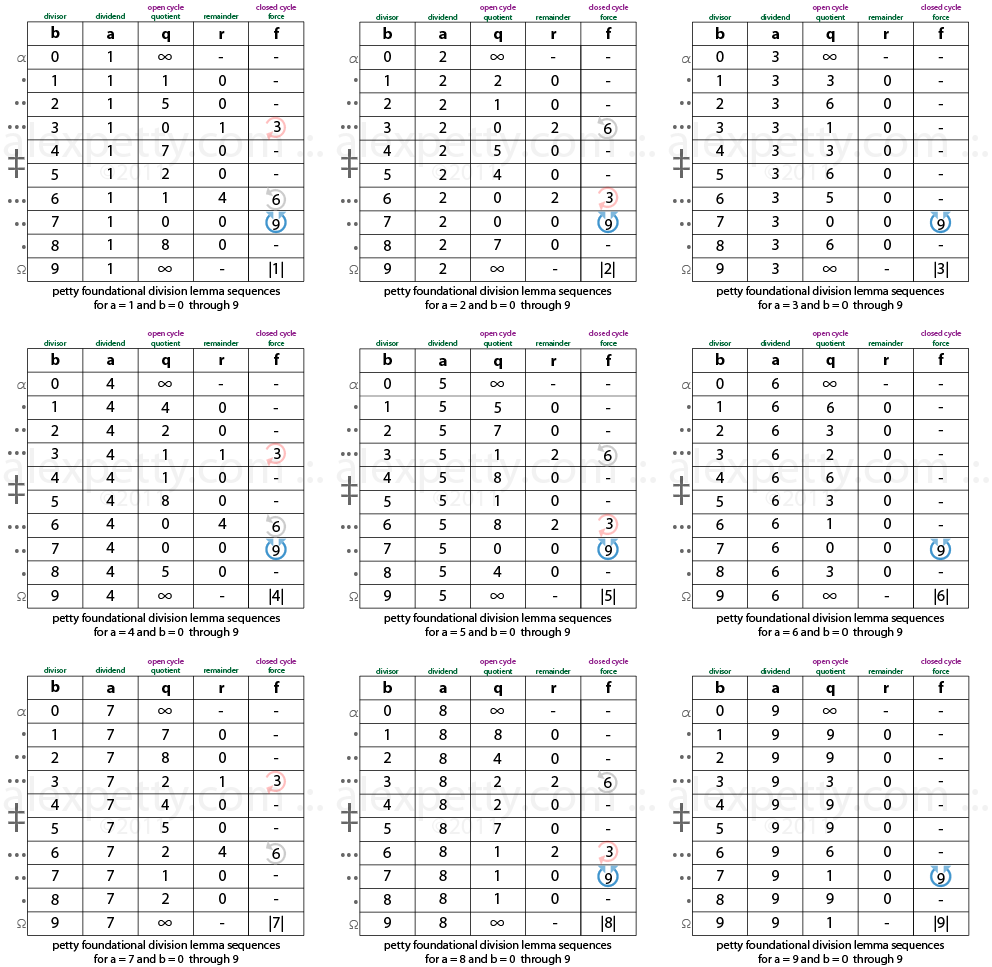
At first glance the chart looks like a simple table of arithmetic results. But when the values are examined collectively, regularities begin to appear. The quotients and remainders do not distribute randomly. They form repeating patterns that propagate across the table in recognizable ways.
The division algorithm is deterministic and the remainder is bounded, so the outputs must be structured. But seeing the structure laid out visually, as a field of values rather than individual computations, makes it tangible in a way the formula alone does not.
Compression and radial structure
One way to see deeper into these patterns is through digit-sum compression.
If we repeatedly sum the digits of a number until only a single digit remains, many values in the matrix collapse onto a small set of radial lines. For example:
$$546 \rightarrow 5+4+6 = 15 \rightarrow 1+5 = 6$$
The number 546 lies on the 6 radial. Numbers that appear very different at full resolution turn out to share the same compressed identity. This is the digital root, and it is equivalent to reduction modulo 9.
When the results of the division lemma are examined under this compression, the patterns in the chart become considerably easier to see.
The boundaries of the cycle
Within this compressed representation, 0 and 9 behave like boundary values.
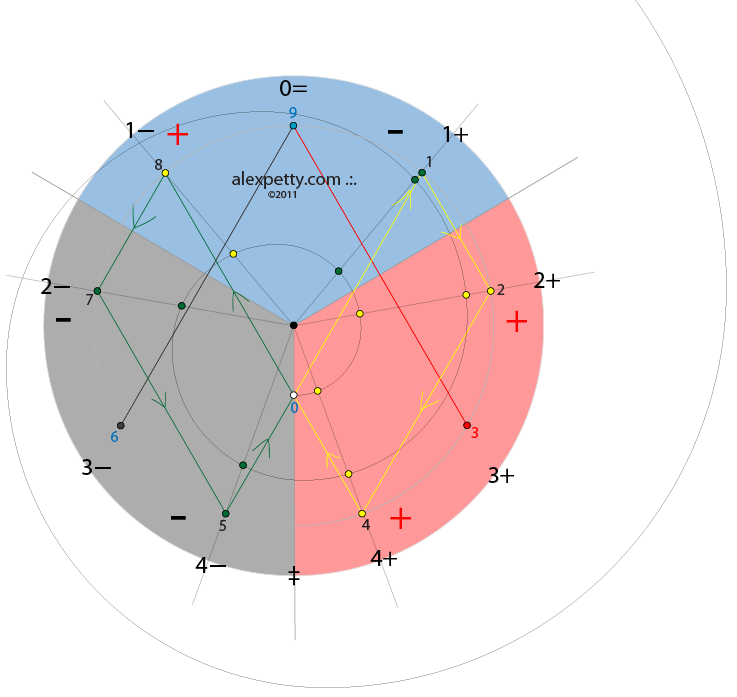
Zero is the origin of the number system. Nine is the completion of the cycle before the sequence rolls over into the next order of magnitude. Each time the sequence expands outward it eventually compresses back toward its radial origin. In a sense, the entire decimal system is a single structural cycle repeated at every scale.
Between these boundaries, certain digits play distinctive roles. The numbers 3, 6, and 9 appear as pivot points in cyclic behavior. The sequence 1, 2, 4, 8, 7, 5, the powers of 2 under digit-sum compression, forms a repeating cycle of length 6. These are the same structures visible in The Circle of Nine, emerging here from a completely different starting point.
One layer beneath another
Simple mathematical rules generate surprisingly rich structure.
The division algorithm reveals one layer by decomposing numbers into quotient-remainder pairs. Digit-sum compression reveals another by showing how large numbers collapse back onto a small set of generators. The fact that these two perspectives produce overlapping patterns suggests there is a single underlying organization connecting them.
I do not yet know how to formalize this connection. But I find it compelling that the most elementary operation in arithmetic, the one we learn before we learn anything else, contains this much structure when you look at it carefully enough.
.:.
A note from 2026
April 2026
Everything in the later work traces back to this exact observation.
The "mathematical probe" that long division provides is the digit function $\delta(r) = \lfloor br/p \rfloor$. Given a remainder $r$, it produces the next digit. That is all long division does at each step. The alignment formula, the digit-partitioning property, the collision invariant, all of them are built on top of this single map.
The bounded remainder constraint is what makes the digit function finite and deterministic. It also forces the remainder sequence into a cycle, and the cycle is the repetend. When the cycle visits every nonzero remainder, the prime's fractional field is fully coherent. When it visits only some of them, the field fractures into parallel orbits. That distinction, which primes fill the circle and which do not, was already visible in the tables drawn here. The language for it came later.
The experiment here, generating the full quotient-remainder table for many small integers, is the prototype of what nfield computes today. The same impulse. Do not look at one division. Look at all of them. The structure is in the collection, not in any single computation.
.:.