Why the Golden Ratio Selects the Prime Three
A cubic equation has a root in (0,1) for every prime. The golden ratio's minimal polynomial divides it at exactly one. The remainder names the prime 3.
January 2020, revised May 2026
There is a machine hiding inside long division. It unzips every number you feed it. Most people stop at the decimal. This is about what happens when you don't.
Take a number like 7. Divide 1 by it:
1/7 => 0.|142857|
2/7 => 0.|285714|
3/7 => 0.|428571|
4/7 => 0.|571428|
5/7 => 0.|714285|
6/7 => 0.|857142|
The pipes mark the repeating block. Look at what's inside them. The same six digits every time, started from a different position. 142857, rotated. Every fraction with denominator 7 carries the same pattern. The prime organizes its entire fractional field into a single repeating orbit.
Long division is a machine. You feed it a numerator and a denominator, and it produces digits. One at a time, forever if necessary. The digit it produces at each step depends on one thing, the remainder. The remainder $r$ enters the machine. The machine computes $\lfloor br/p \rfloor$ and outputs a digit. Then it passes along the new remainder, and the cycle continues. That function, $\delta(r) = \lfloor br/p \rfloor$, is the floor quotient from Euclidean division. I call it the digit function. Everything in this program grows from it.
Not all numbers do this. Divide by 12:
 1/12 => 0.08|3|    (mixed)
 2/12 => 0.1|6|     (mixed)
 3/12 => 0.25       (open)
 4/12 => 0.|3|      (closed)
 5/12 => 0.41|6|    (mixed)
 6/12 => 0.5        (open)
 7/12 => 0.58|3|    (mixed)
 8/12 => 0.|6|      (closed)
 9/12 => 0.75       (open)
10/12 => 0.8|3|     (mixed)
11/12 => 0.91|6|    (mixed)
Some fractions terminate. Some repeat immediately. Some do both, a non-repeating prefix followed by a repeating block. At 7, every fraction is a rotation of the same six digits. At 12, that unity is gone. The field fractures. Coherence is partial.
This is where the mathematics begins. Not with a theorem. With a question a computer can answer. How much of a number's fractional field holds together?
Measuring coherence
Fix a denominator $n$. For each fraction $k/n$, compare its decimal expansion to $1/n$'s expansion, digit by digit. Count the matches. Average over all $k$. Call the result $\alpha(n)$.
For multiples of 3, the answer has a formula:
where $m$ is a product of 2's and 5's, the prime factors of base 10, and nothing else. As $m$ grows, $\alpha$ approaches $2/3$. Two thirds of the fractional field aligns. The prime 3 imposes order on decimal arithmetic, and the amount of order it imposes is exactly $2/3$.
The formula falls out of the computation. The proof follows. What follows the proof is stranger.
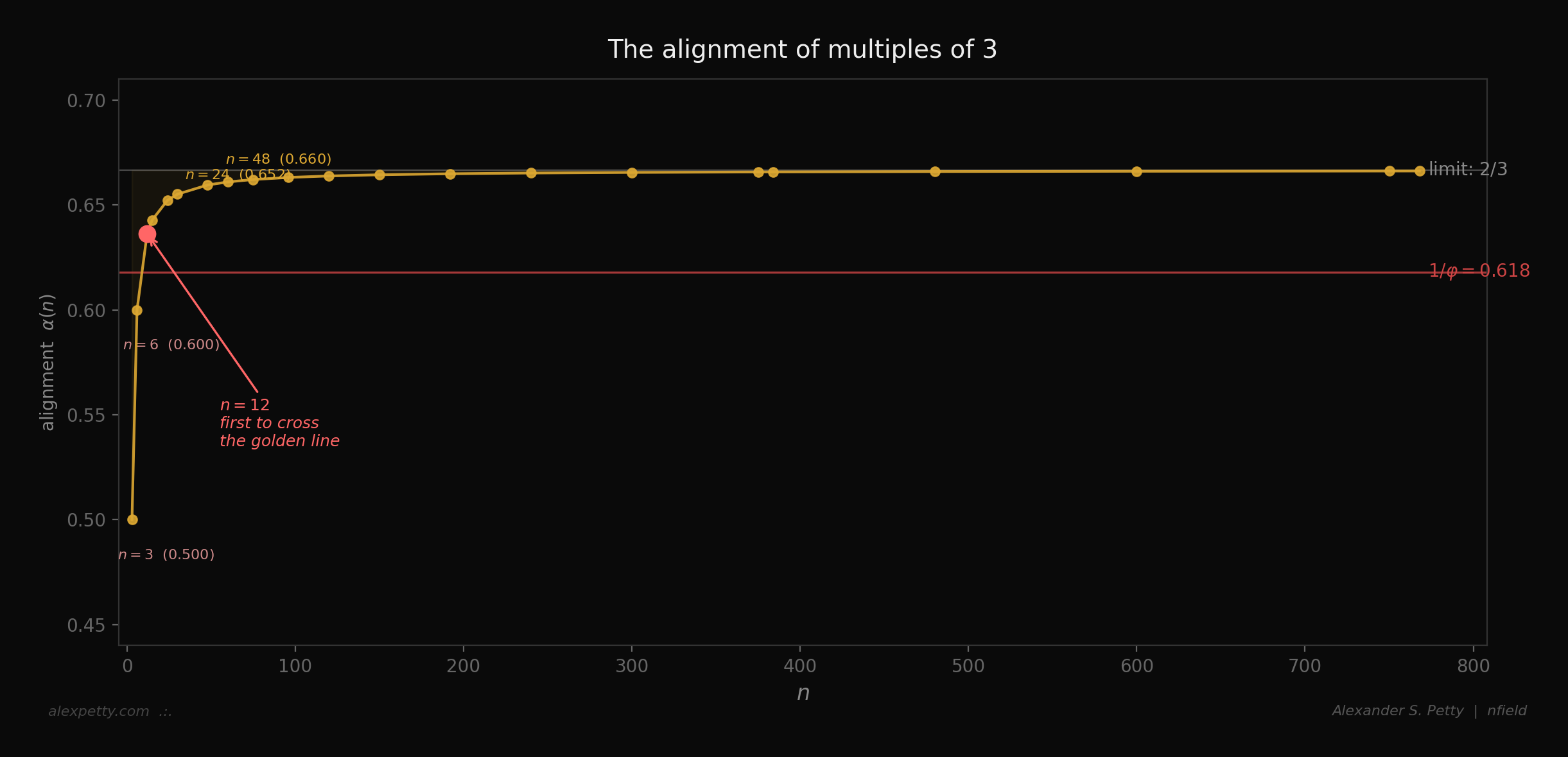
Each gold dot is a multiple of 3. The horizontal axis is $n$ itself. At $n = 3$, the alignment is $0.5$. At $n = 6$, it climbs to $0.6$. At $n = 12$, it crosses the red line, the reciprocal of the golden ratio at $1/\varphi \approx 0.618$, and it never comes back. The curve settles toward $2/3$. Every multiple of 3 past $n = 12$ sits above the golden threshold.
The threshold
The golden ratio $\varphi = (1 + \sqrt{5})/2$ is the most irrational number, in a precise sense. Its continued fraction converges more slowly than any other. Its reciprocal is $1/\varphi \approx 0.618$.
For which denominators does the alignment exceed $1/\varphi$?
The answer is $m \geq \varphi^2$.
That identity, $\varphi^2 = \varphi + 1$, is not assumed. It is the defining property of the golden ratio, and it falls out of the algebra when you solve the threshold inequality. The interaction between the formula $(2m-1)/(3m-1)$ and the number $1/\varphi$ produces the golden ratio's own signature equation.
The selection
Now generalize. Replace 3 with any prime $p$. The same counting argument gives the alignment formula
For the alignment to ever reach $1/\varphi$, you need $2/p > 1/\varphi$, which forces
Among primes, only 2 and 3 satisfy this. The prime 2 is trivial; every even denominator has a terminating component. So 3 is the unique prime where the golden threshold produces a nontrivial classification.
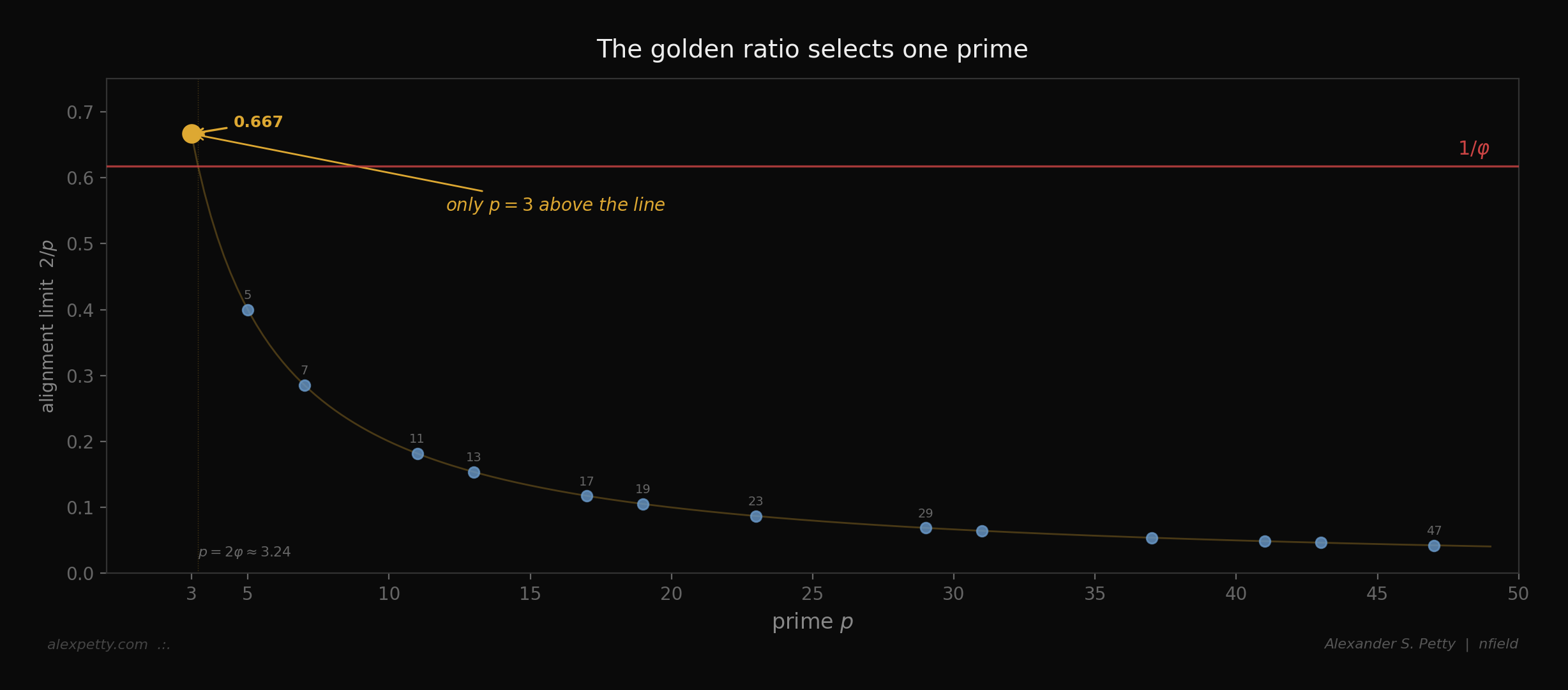
Each dot is a prime, plotted at its alignment limit $2/p$. The red line is $1/\varphi$. One dot sits above it. The rest fall away, faster and faster. The crossing point $p = 2\varphi \approx 3.24$ sits between two consecutive primes, where no prime can reach it.
The prime 3 is not assumed to be special. The golden ratio selects it. The selection mechanism is algebraic, not numerical. And it is not the last time the prime 3 distinguishes itself in this program. The boundary algebra of the collision table, built from the same digit function by a completely different route, selects it again.
The cubic
There is a deeper structure underneath.
The golden ratio shows up as a threshold. But why that threshold? What if the threshold is not imposed from outside but is itself determined by the alignment? What if the system sets its own boundary? That self-referential question produces a polynomial equation, a cubic, one for every prime:
Every prime $p \geq 3$ gives this equation a solution between 0 and 1. But for exactly three primes, the equation simplifies. At $p = 3$, it simplifies because the golden ratio's own defining equation is hiding inside it.
The golden ratio satisfies $\tau^2 + \tau - 1 = 0$. This polynomial divides the cubic when $p = 3$, and only when $p = 3$. The remainder of the division is
It vanishes if and only if $p = 3$. The number 3 is not put in by hand. The polynomial produces it.
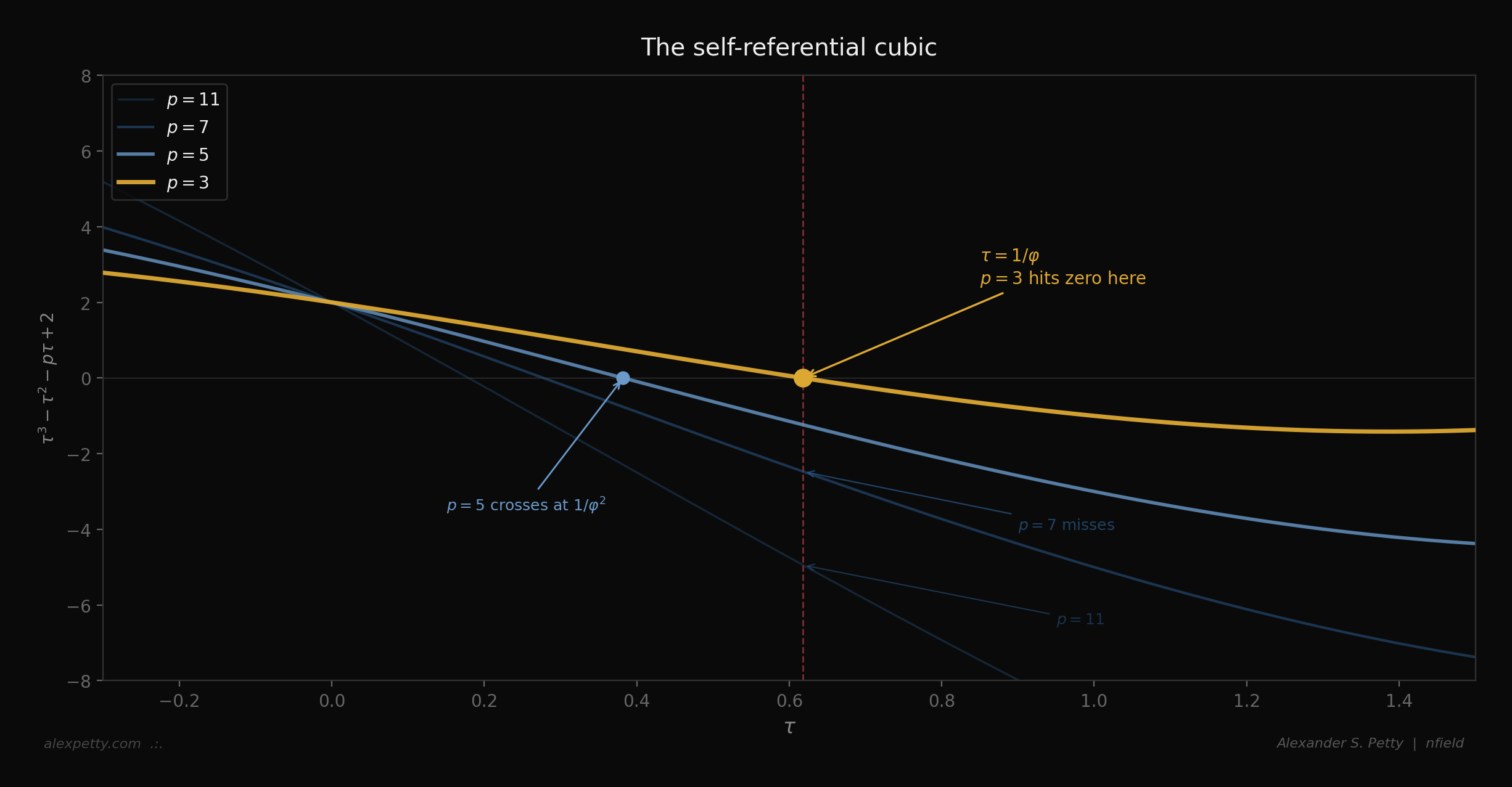
Three cubics, one for each prime. The gold curve is $p = 3$. The dashed red line marks $\tau = 1/\varphi$. At that point, the gold curve passes exactly through zero. The blue curves for $p = 5$ and $p = 7$ miss it. Only the $p = 3$ cubic has $1/\varphi$ as a root, because only at $p = 3$ does the golden ratio's own defining polynomial divide the cubic with no remainder.
At $p = 5$, the threshold is $1/\varphi^2$. Still the golden ratio, just squared. For $p \geq 7$, the threshold is a different kind of number entirely, one that cannot be built from the golden ratio at all.
Three primes, three tiers. One polynomial, one divisibility condition, one prime where the golden ratio's equation divides the cubic cleanly.
The key and the lock
In serious mathematics, phi has a reputation problem. It shows up in popular science as a mystical constant, pasted onto spirals and rectangles and flower petals, and professional mathematicians learn to look away. The association with numerology makes the number itself seem unserious.
But here phi is doing something precise. It is the root of the simplest nontrivial polynomial over the integers. It is the slowest-converging continued fraction. It is the threshold between order and disorder in quasicrystal tilings. These are not aesthetic observations. They are theorems.
Nobody had counted digit matches across an entire fractional field, written the formula, and asked what threshold it crosses. The alignment measure, the cubic it produces, and the divisibility that selects the prime 3 are consequences of that question. As far as I have been able to determine, the question had not been asked.
And in the digit function phi does something no one expected. Phi's minimal polynomial divides a cubic whose coefficients come from counting digit matches in long division. The remainder of that division names a specific prime. The most elementary operation in arithmetic, the one you learn before you learn anything else, produces the golden ratio's own defining equation.
The key fits the lock.
Try it yourself
Feed it a prime and watch what it builds.
./nfield field 7
  1/7 => 0.|142857|
  2/7 => 0.|285714|
  3/7 => 0.|428571|
  ...
One orbit. Total coherence. Now feed it 12.
./nfield field 12
  1/12 => 0.08|3|
  3/12 => 0.25
  4/12 => 0.|3|
  ...
The field fractures. That difference is what alignment measures. Now watch it climb at multiples of 3.
./nfield align 3       # 0.500
./nfield align 6       # 0.600
./nfield align 12      # 0.636
./nfield align 24      # 0.652
./nfield align 48      # 0.660
./nfield align 96      # 0.663  ... approaching 2/3
Now try the same at multiples of 7.
./nfield align 7        # 0.167
./nfield align 14       # 0.231
./nfield align 28       # 0.259
./nfield align 56       # 0.273
./nfield align 112      # 0.279
./nfield align 7000     # 0.286  ... never quite 2/7
The golden threshold is $1/\varphi \approx 0.618$. The 3 sequence clears it at $n = 12$ and never comes back. The 7 sequence tops out at $0.286$. The limit is always $2/p$, and it shrinks as the prime grows. Only 3 crosses the line.
./nfield align 30       # 3 * 10: 0.655, above the line
./nfield align 120      # 3 * 40: 0.664, closer to 2/3
./nfield align 70       # 7 * 10: 0.275, nowhere close
./nfield align 130      # 13 * 10: 0.173, further away
Code: github.com/alexspetty/nfield
Alexander S. Petty
January 2020 (revised May 2026)
.:.