The Three-Tier Theorem
Every positive integer falls into one of three tiers. The mirror bound from the nines complement forces everything with rough part past 7 below the golden line. The classification is unconditional.

October 2020, revised April 2026
Compute the alignment of every integer from 2 to 500 and plot the results.
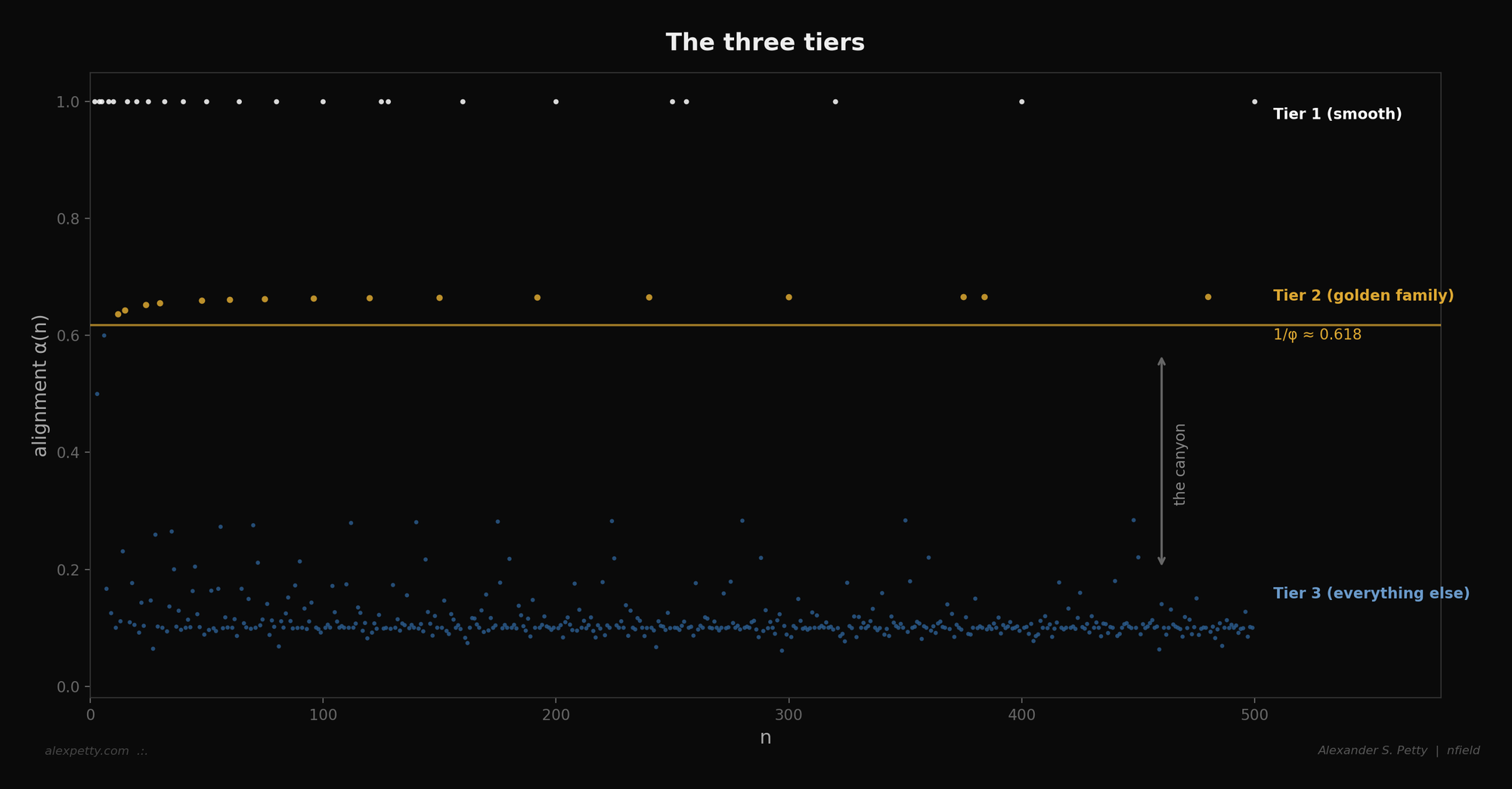
Three horizontal bands appear, separated by empty space. The top band is perfect alignment, the smooth numbers. The middle band hovers near $2/3$, a small family built from the prime 3. The bottom band spreads below $4/7$, everything else. Between the middle and the bottom, nothing. A canyon.
This is not a visual artifact. No integer lands in that gap. The separation is forced by a symmetry of repeating decimals that is older than modern mathematics.
The Alignment Limit for All Primes classified the primes. Only 3 crossed the golden threshold. But primes are a thin set. Most integers are composites. To classify every positive integer at once requires a different tool.
Tier 1: the smooth numbers
Some integers produce only terminating fractions. Divide anything by 8, or 25, or 200, and the decimal stops. No repeating block, no cycle. These are the smooth numbers, integers built entirely from the prime factors of the base. In base 10, smooth means a product of 2's and 5's.
./nfield field 8
  1/8 => 0.125
  3/8 => 0.375
  5/8 => 0.625
  7/8 => 0.875
Every decimal stops. Nothing repeats, so nothing can mismatch. The alignment is 1.
Tier 2: the golden family
The golden family consists of the integers of the form $n = 3m$, where $m$ is smooth and at least 4. They have repeating fractions, genuine disagreements between decimal patterns, and yet their alignment stays above $1/\varphi$.
The smallest example is $n = 12$. Its field has three flavors of fraction at once. Terminating, mixed, and pure repeating.
./nfield field 12
  1/12 => 0.08|3|
  2/12 => 0.1|6|
  3/12 => 0.25
  4/12 => 0.|3|
  5/12 => 0.41|6|
  6/12 => 0.5
  7/12 => 0.58|3|
  8/12 => 0.|6|
  9/12 => 0.75
 10/12 => 0.8|3|
 11/12 => 0.91|6|
Four of the eleven fractions repeat the digit 3 inside their pipes, four repeat 6, three terminate. The alignment of 12 is $0.636$.
./nfield align 12       # 0.636
./nfield align 24       # 0.652
./nfield align 60       # 0.661
./nfield align 120      # 0.665
Each value is above $0.618$. Each one climbs slowly toward $2/3$.
The golden family is small. It is 12, 15, 24, 30, 48, 60, and so on. Three times a smooth number, with the smooth factor at least 4. A thin, precise set of integers, distinguished from every other integer by the golden threshold.
Tier 3: everything else
Every prime from 5 onward. Every composite whose rough part is anything other than 3. Every number outside the smooth family and the golden family.
./nfield align 7        # 0.167
./nfield align 13       # 0.111
./nfield align 77       # 0.088
./nfield align 91       # 0.100
The chart at the top of this post shows all of them. White at the top, the smooth numbers. Gold above the line, the golden family. Blue below, everything else. Between the gold and the blue, the canyon.
The mirror bound
The proof rests on a symmetry of repeating decimals that is older than modern mathematics.
Every non-terminating fraction $k/n$ has a partner, $(n-k)/n$. The repeating digits of $k/n$ and its partner sum to 9 at every position. If $k/n$ has the digit 3 at some position, then $(n-k)/n$ has 6 there. If $k/n$ has 1, the partner has 8. They are mirror images in the digit system.
This is the nines complement. It is the same trick Pascal built into his mechanical calculator in 1642. Subtraction by complement. The decimal system has been carrying this symmetry for four centuries. The ingredients here are centuries old. The classification they produce, as far as I have been able to determine, is new.
Within each complement pair, at most one fraction can match the digit of $1/n$ at any position. The other is forced to differ. This bounds the average alignment over the non-terminating fractions by $1/2$. Add back the terminating fractions, which always contribute alignment 1, and the total alignment of $n$ satisfies
where $t$ is the rough part of $n$.
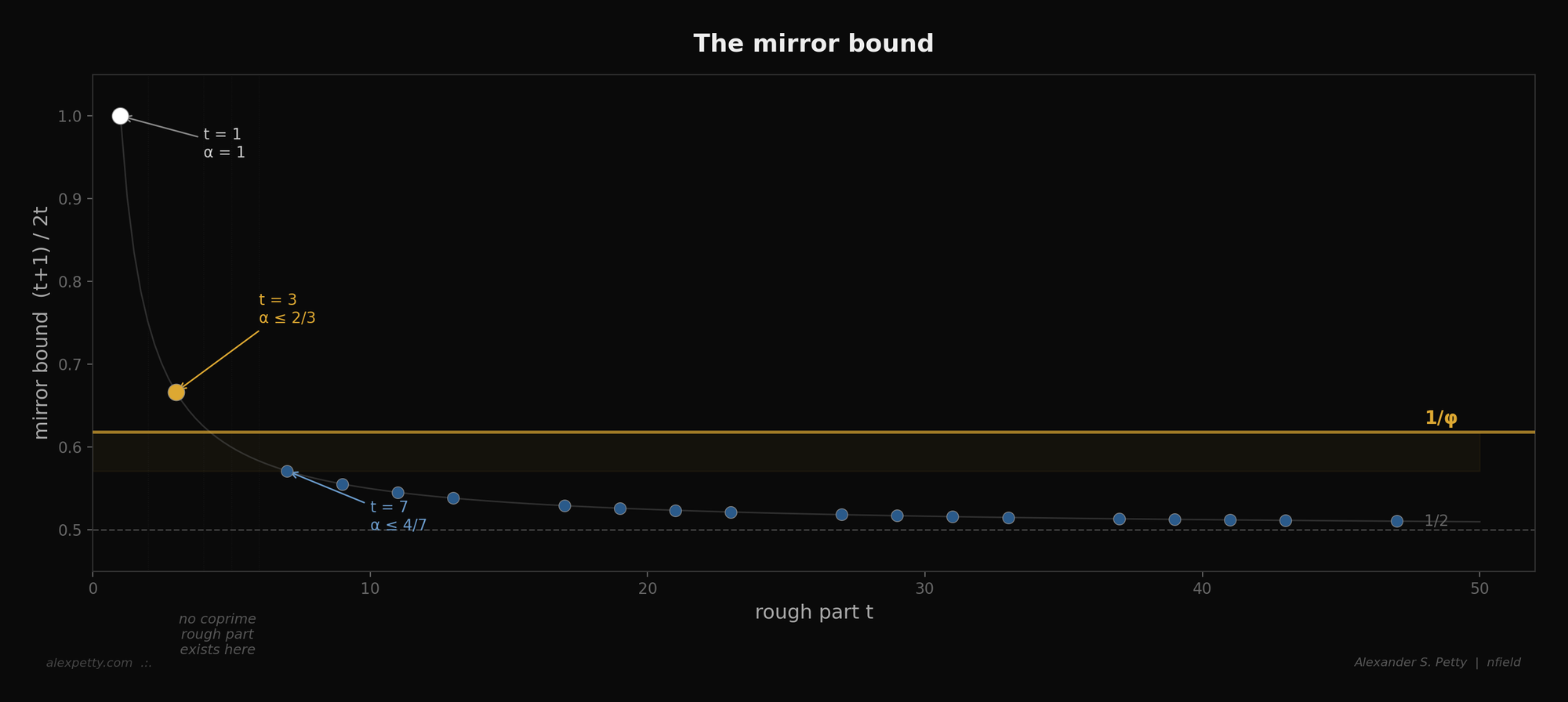
The curve is the mirror bound $(t+1)/(2t)$ as a function of the rough part $t$. At $t = 1$, the bound is 1. At $t = 3$, it is $2/3$, above the golden line. At $t = 7$, it drops to $4/7 \approx 0.571$, below the line. And it never comes back.
The gap
The whole proof turns on a gap.
The rough part of any integer in base 10 is coprime to 10. That means 4, 5, and 6 cannot appear as rough parts, because each shares a factor with the base. The smallest admissible rough part after 3 is 7.
Between 3 and 7, three integers are excluded. And in that empty corridor, the golden ratio sits.
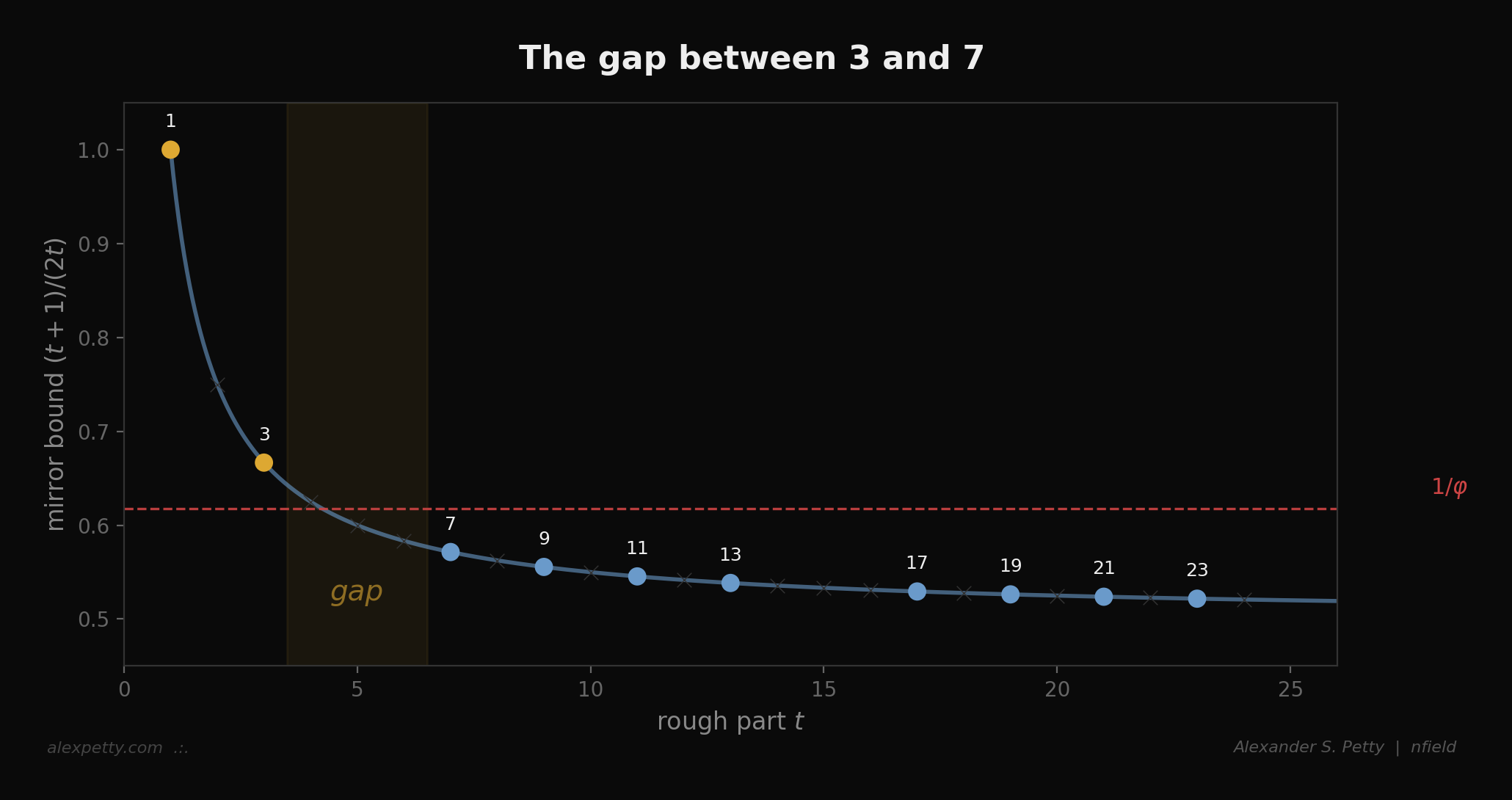
The curve is the mirror bound. The gold dots at $t = 1$ and $t = 3$ sit above the red line. The blue dots from $t = 7$ onward sit below. The gray crosses mark the excluded values 4, 5, and 6, each sharing a factor with the base. The shaded region is the gap. No admissible rough part can land inside it.
At $t = 3$, the mirror bound is $2/3 \approx 0.667$. Above $1/\varphi \approx 0.618$.
At $t = 7$, the mirror bound is $4/7 \approx 0.571$. Below $1/\varphi$.
The golden threshold falls in the gap. No admissible rough part can land on it or near it. The separation between Tier 2 and Tier 3 is not a close call. It is forced by the arithmetic of the base.
This is why the classification is unconditional. It does not depend on unproved conjectures or asymptotic estimates. It depends on the fact that $\gcd(4, 10) = 2$, $\gcd(5, 10) = 5$, and $\gcd(6, 10) = 2$. Three small greatest common divisors, and the entire classification of positive integers follows.
The rough part and the smooth part
Every positive integer splits uniquely into two pieces. The smooth part absorbs the prime factors the base contains. The rough part is everything else. In base 10, the integer $60 = 20 \times 3$ has smooth part 20 and rough part 3. The integer $77 = 1 \times 77$ has smooth part 1 and rough part 77. The integer 8 has smooth part 8 and rough part 1.
The smooth part controls the resolution of the field. It tells you how finely the field is sampled. The rough part controls the structure. It tells you which prime geometry governs the repeating digits.
The three tiers are determined entirely by the rough part. A quantity defined by comparing decimal expansions, digit by digit, across all fractions of a denominator, ends up depending on one arithmetic datum. The part of the denominator the base does not already own.
The nines complement is four centuries old. Smooth numbers are standard. The mirror bound uses only the pigeonhole principle. But the three-tier classification itself, the empty corridor between 3 and 7 containing the golden ratio, and the unconditional theorem that every positive integer falls into one of three bands separated by forced gaps, these had not been stated. The proof is elementary. The result, as far as I have been able to determine, is new.
The complement symmetry that powers this classification, where $k/n$ and $(n-k)/n$ produce mirror digits, is the same involution that appears later in the collision table as the antisymmetry between complementary residue classes. Different setting, same mirror. It keeps showing up because it is built into the floor function that generates every digit.
Try it yourself
Start with the smooth numbers. No rough prime, no repeating block, perfect alignment.
./nfield align 8        # 1.000
./nfield align 25       # 1.000
./nfield align 200      # 1.000
Now the golden family. Rough part is 3 in every case.
./nfield align 12       # 0.636   (= 3 x 4)
./nfield align 60       # 0.661   (= 3 x 20)
./nfield align 120      # 0.664   (= 3 x 40)
All above $0.618$. All climbing toward $2/3$. Now try anything with a different rough prime.
./nfield align 7        # 0.167
./nfield align 13       # 0.111
./nfield align 77       # 0.088   (= 7 x 11)
./nfield align 91       # 0.100   (= 7 x 13)
./nfield align 1001     # 0.099   (= 7 x 11 x 13)
Divide out the factors of 2 and 5. If 3 is all that remains, the alignment is above the golden line. If anything else remains, it is below. Every time.
Code: github.com/alexspetty/nfield
Alexander S. Petty
October 2020 (revised April 2026)
.:.