The Alignment Limit for All Primes
Past the digit-partitioning boundary, the alignment splits into lanes. Different smooth factors choose different lanes, and the limit may not exist as a single number. But no prime past 3 reaches the golden threshold.

July 2020, revised April 2026
The alignment formula from the digit-partitioning primes has a simple shape. For each prime, one number to aim at. As the smooth factor grows, the alignment moves toward it. At $p = 3$ it climbs toward $2/3$. At $p = 7$, toward $2/7$. One prime, one limit. The picture is clean.
Now go past the last seat, into the territory where collisions begin. Take $p = 53$. Compute the alignment for increasing smooth factors and watch what happens.
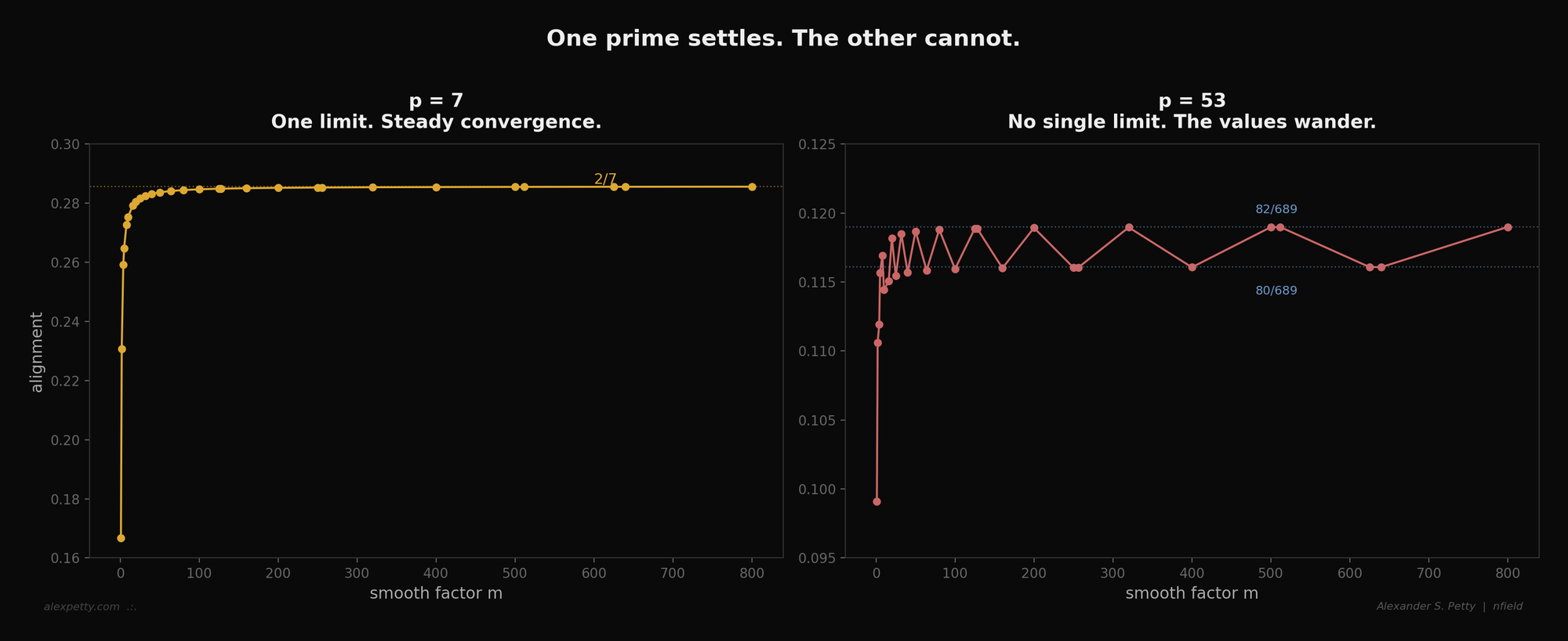
The values do not converge. They oscillate. Not randomly, not in a noisy scatter, but in two narrow bands, one near $80/689$ and the other near $82/689$. The alignment jumps between them depending on which smooth factor you feed it. At $p = 7$, the curve settles to a single horizontal line. At $p = 53$, it refuses.
This is not a numerical artifact. It is a structural feature of the prime. Something about 53 is fundamentally different from 7, and the alignment formula cannot hide it.
Lanes
The difference is in the orbits.
When you do long division by 7 in base 10, the remainders cycle through every nonzero residue. 1, 3, 2, 6, 4, 5, back to 1. Six steps, six remainders, every one visited. The fractional field of 7 is a single loop.
Gauss knew this. In the 1790s, before he was twenty, he compiled tables of decimal period lengths for hundreds of primes. The period of $1/p$ is the multiplicative order of 10 modulo $p$, the number of steps before the remainder returns to 1. At $p = 7$, the order is 6, which is $p - 1$. The orbit fills the whole space. Gauss called such primes primitive roots of 10.
At $p = 53$, the order is only 13. The orbit visits 13 of the 52 possible remainders and then repeats. The other 39 remainders split into three more groups of 13, each tracing its own parallel path, starting somewhere else.
Four orbits. Four lanes through the same residue space.
The smooth factor $m$ determines which lane you start in. Change $m$ and you may change lanes. Different lane, different remainders visited, different seats occupied, different alignment. The oscillation at $p = 53$ is not noise. It is the alignment formula telling you which lane you are in.
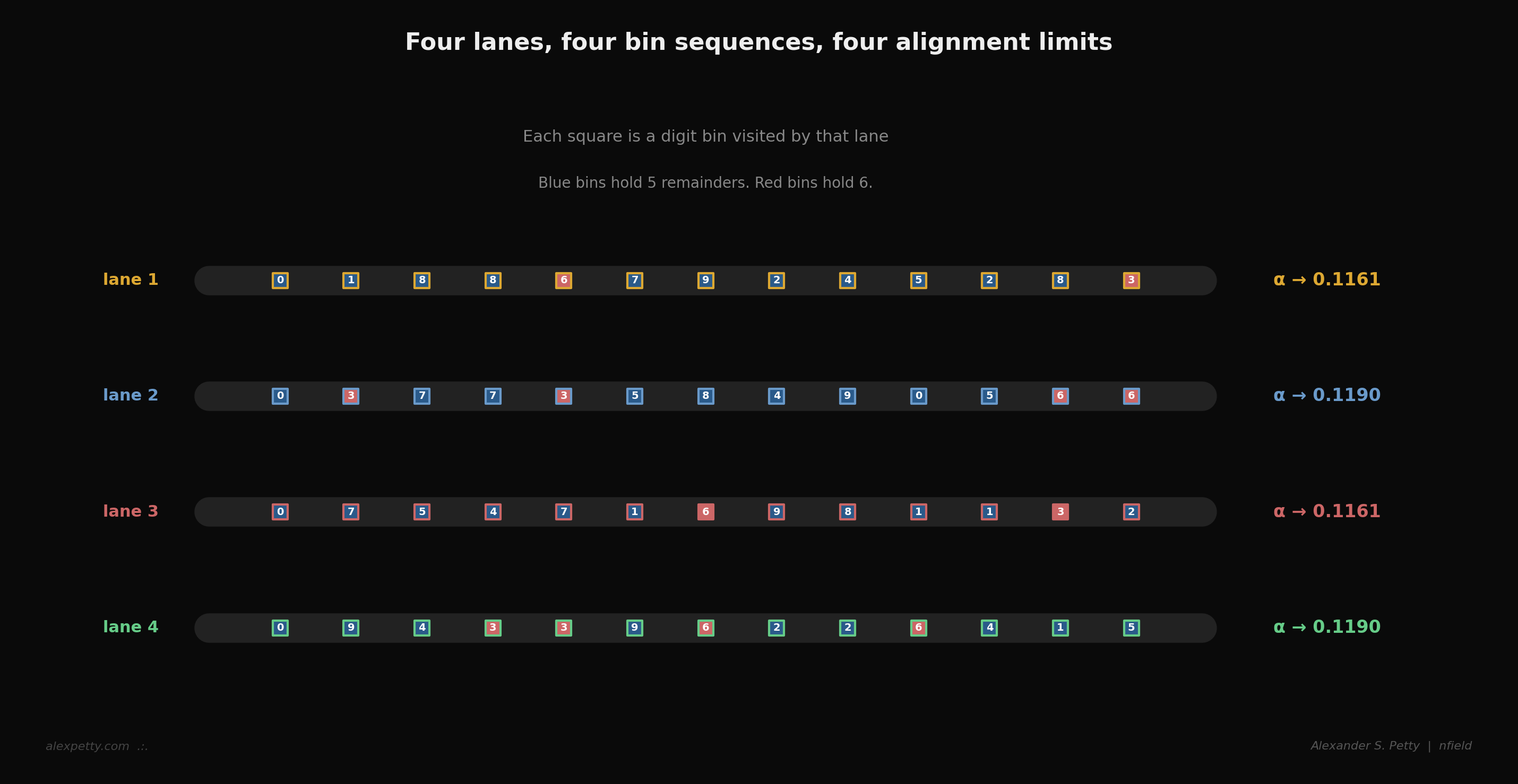
Each square is a seat visited by that lane. The prime 53 has 52 remainders sorted into 10 seats. Since $52 = 5 \times 10 + 2$, eight seats hold 5 remainders and two hold 6. Lanes 1 and 3 pass through the same mix of seats and produce $0.1161$. Lanes 2 and 4 pass through a different mix and produce $0.1190$. Four lanes, but only two distinct alignment values. The chart splits into exactly two bands.
Why two and not four? Because the coset structure respects the seat geometry. Two pairs of lanes see the same distribution of crowding. The oscillation is discrete and structured, not continuous, and the number of distinct limits is governed by how the lanes partition the seats.
Whether infinitely many primes have full-length orbits, giving a single lane and a single limit, is still an open question. Emil Artin conjectured in 1927 that they do. The conjecture is still unproved. The one-lane primes are the ones where none of this lane splitting happens.
The formula
The alignment formula generalizes to handle all of this. For any prime $p$, any base $b$, and any smooth $m$:
$L$ is the orbit length, the number of steps before long division repeats. $T(C_m)$ is the total seat count along the lane that $m$ puts you in. Add up the size of every seat the lane passes through. A lane through crowded seats gets a higher $T$. A lane through sparse seats gets a lower one.
At the digit-partitioning primes, the formula collapses to the simple version. Either there is only one lane, or every seat holds one remainder and every lane sees the same crowding. Both collapses give $(2m-1)/(pm-1)$. Past the last seat, the seats are uneven and the lanes diverge. One formula handles both worlds.
To see it work, take lane 1 at $p = 53$. The orbit length is $L = 13$. The lane visits seats of sizes 5, 5, 5, 6, 5, 5, 5, 5, 6, 5, 5, 5, 5. The total is $T = 67$. Plug these into the formula and you get the alignment approaching $67/520 \approx 0.1288$. Lane 2 visits a different sequence of seats with total $T = 69$, giving $0.1327$. The oscillation chart is the formula, sampled lane by lane.
The golden bound
The lanes complicate the exact alignment. They do not complicate the bound.
For any lane, any $m$, and any prime $p \ge 5$:
The argument is short. Each remainder contributes at most $\lceil(p-1)/b\rceil$ to the seat sum, so the alignment cannot exceed $(p+1)/(2p)$. That falls below $1/\varphi$ for all $p \ge 5$.
The closest miss is $p = 5$, which tops out at $0.6$, falling $0.018$ short of the golden line. Every prime above 5 backs off further.
No matter which lane. No matter how large $m$ grows. No prime beyond 3 reaches the golden threshold.
It is worth pausing on why the golden ratio keeps showing up as the natural boundary here. Hurwitz proved in 1891 that the best constant in Dirichlet's approximation theorem is $1/\sqrt{5}$, and $\sqrt{5} = \varphi + 1/\varphi$. The golden ratio is the most irrational number in a precise, classical sense. Its continued fraction converges more slowly than any other. Why the Golden Ratio Selects the Prime Three showed that the golden ratio selects the prime 3. Hurwitz tells you why it was always going to be the selector. It is the universal boundary of irrationality. The digit function did not choose phi. Phi was already there, waiting at the gate.
What about composites?
The formula handles prime denominators. Multiply 7 by 13 and you get 91, a composite, and the formula has nothing to say about it.
So compute the alignment of composites directly.
$\alpha(91) = 0.233$
$\alpha(143) = 0.211$
$\alpha(1001) = 0.250$
All below the golden line. Try thousands more. They all fall below.
Now look at which integers sit above.
$\alpha(96) = 0.663$
$\alpha(120) = 0.664$
$\alpha(75) = 0.662$
All above. What do they have in common?
Factor them.
$96 = 2^5 \times 3$
$120 = 2^3 \times 3 \times 5$
$75 = 3 \times 5^2$
The primes 2 and 5 belong to the base. In base 10, they are the primes that produce terminating decimals. Divide them out. What remains is the rough part. The rough part of 96 is 3. The rough part of 120 is 3. The rough part of 75 is 3.
Now look at the ones that fall below.
$70 = 2 \times 5 \times 7$. Rough part: 7. $\alpha(70) = 0.275$.
$130 = 2 \times 5 \times 13$. Rough part: 13. $\alpha(130) = 0.173$.
$50 = 2 \times 5^2$. Rough part: 1. $\alpha(50) = 0.510$.
Even 50, whose alignment at $0.510$ gets closer than most, cannot reach the golden threshold at $1/\varphi \approx 0.618$.
The pattern holds without exception. Every integer whose rough part is 3 sits above the golden line. Every integer whose rough part is anything else sits below. No matter how large, no matter how many factors of 2 and 5 you pack in, the rough part decides.
Every integer above the golden line carries 3 at its core. No other prime puts you there.
Gauss tabulated period lengths. Artin conjectured about primitive roots. Hurwitz proved the golden ratio is the hardest threshold to cross. But nobody had written the lane-splitting alignment formula, proved the golden bound that excludes every prime past 3, or classified composites by their rough part. The question that produced these results had not been asked.
Try it yourself
At $p = 53$, the alignment oscillates between lanes.
./nfield align 53       # 0.0991
./nfield align 106      # 0.1106  (m=2)
./nfield align 212      # 0.1119  (m=4)
./nfield align 265      # 0.1157  (m=5, different lane)
./nfield align 530      # 0.1144  (m=10, back again)
Now try $p = 3$.
./nfield align 3        # 1.000
./nfield align 6        # 0.600
./nfield align 12       # 0.636
./nfield align 24       # 0.652
./nfield align 96       # 0.663
One lane. Steady climb to $2/3 \approx 0.667$. Above the golden threshold. The prime 53 never comes close.
./nfield align 530      # p=53: 0.114
./nfield align 120      # p=3:  0.664
Now verify the composite investigation. Rough part 3, above the line.
./nfield align 96       # 2^5 * 3:       0.663, above
./nfield align 120      # 2^3 * 3 * 5:   0.664, above
./nfield align 75       # 3 * 5^2:       0.662, above
Rough part anything else, below.
./nfield align 91       # 7 * 13:        0.233, below
./nfield align 143      # 11 * 13:       0.211, below
./nfield align 70       # 2 * 5 * 7:     0.275, below
./nfield align 130      # 2 * 5 * 13:    0.173, below
./nfield align 50       # 2 * 5^2:       0.510, below
./nfield align 1001     # 7 * 11 * 13:   0.250, below
Code: github.com/alexspetty/nfield
Alexander S. Petty
July 2020 (revised April 2026)
.:.