The Golden Ratio
The simplest self-referential equation produces the slowest-converging continued fraction and the threshold that separates the prime 3 from all others.
January 2010
The golden ratio appears everywhere in nature, and yet mathematics has never placed it at the center of anything. A number whose outward expression is that perfect, showing up in growth and form across every scale, and it sits at the margins of the subject. I do not understand that.
These are notes and visualizations from studying it.
What is phi?
Phi is defined by the relationship
$$\varphi = \frac{1 + \sqrt{5}}{2}$$
Its approximate value is 1.618033...
What makes this number interesting is how it relates to itself. If you add 1 to φ, you get φ². If you subtract 1 from φ, you get 1/φ. In algebraic form:
$$\varphi^2 = \varphi + 1$$
and
$$\varphi - 1 = \frac{1}{\varphi}$$
Most numbers do not behave this way. Most numbers, when you square them or invert them, produce something unrelated to the original. Phi is different. Its square and its reciprocal are both simple transformations of itself. It is a number whose algebra always refers back to itself. Square it, invert it, subtract it. You get phi again. It seems to suggest that there is something in the structure of number that cannot be destroyed. You can change its form, but whatever phi is, it comes back. I find that strange and beautiful. No one has explained why, not really. The only account of phi's persistence is the equation phi already satisfies. It is its own explanation and no one else's.
That self-referential quality is the reason phi keeps showing up in so many different places. It is not just a particular value. It is a relationship that regenerates itself under the most basic operations.
Constructing phi geometrically
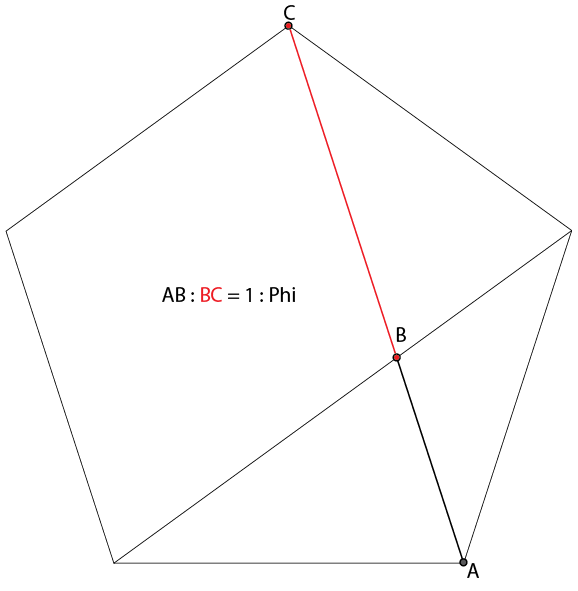
Phi can be constructed using simple geometry. One of the easiest ways is through a regular pentagon.
Draw a regular pentagon and connect two of its non-adjacent corners as shown below.
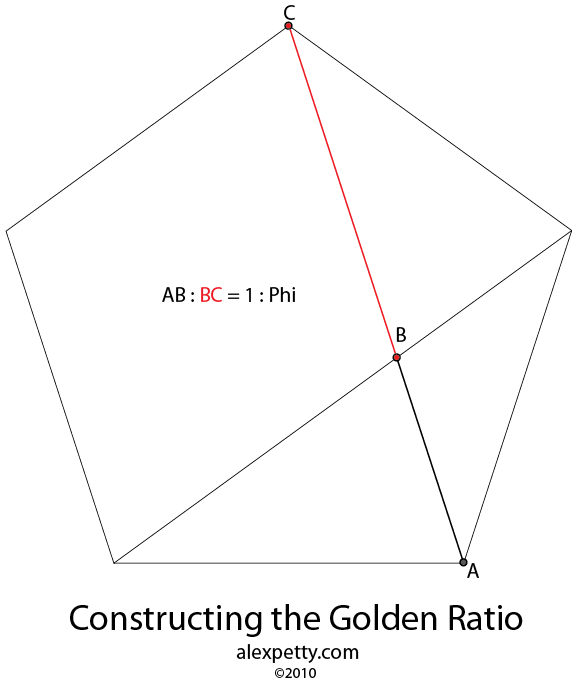
The ratio of lengths AB to BC in this construction is φ.
The pentagon is the simplest polygon that contains the golden ratio in its internal geometry. Every diagonal of a regular pentagon divides every other diagonal in the golden ratio. This is not a coincidence. It is a consequence of the fact that the interior angles of a pentagon (108°) are related to φ through the same quadratic equation that defines it.
The golden triangle
Another useful figure is the golden triangle, an isosceles triangle whose sides are in the golden ratio.
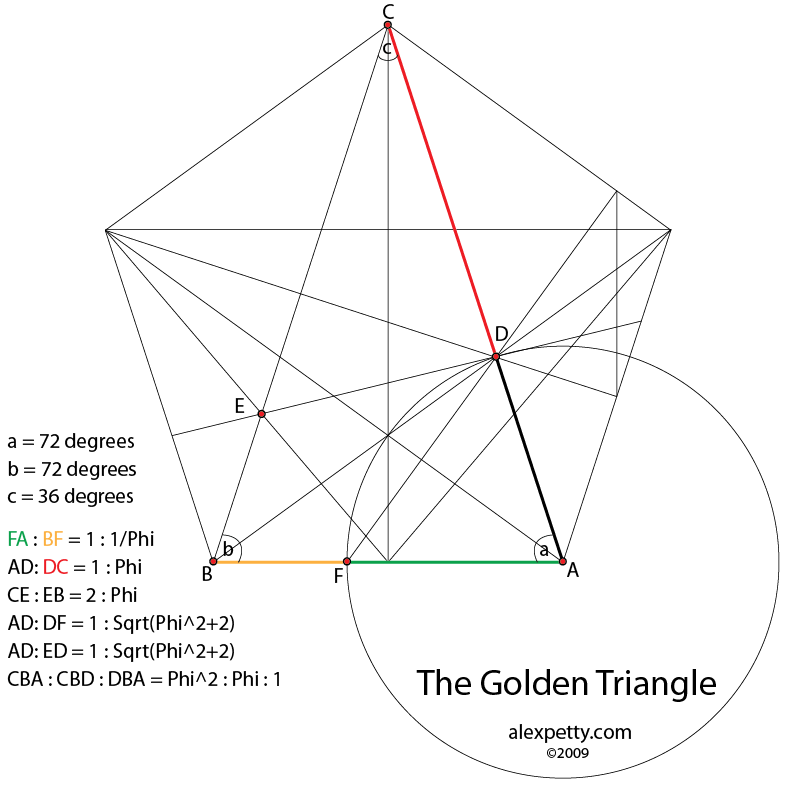
In this geometry the angles have consistent relationships, and many intersections divide segments according to the golden ratio. Most importantly, repeated subdivision of a golden triangle produces smaller golden triangles. The figure contains copies of itself at every scale.
This recursive property is one reason φ appears so frequently in pentagonal geometry. The pentagon, the pentagram, and the golden triangle are all different views of the same underlying self-similar structure.
Phi-based geometric relationships
Additional constructions based on φ reveal many repeating relationships between angles and line segments.
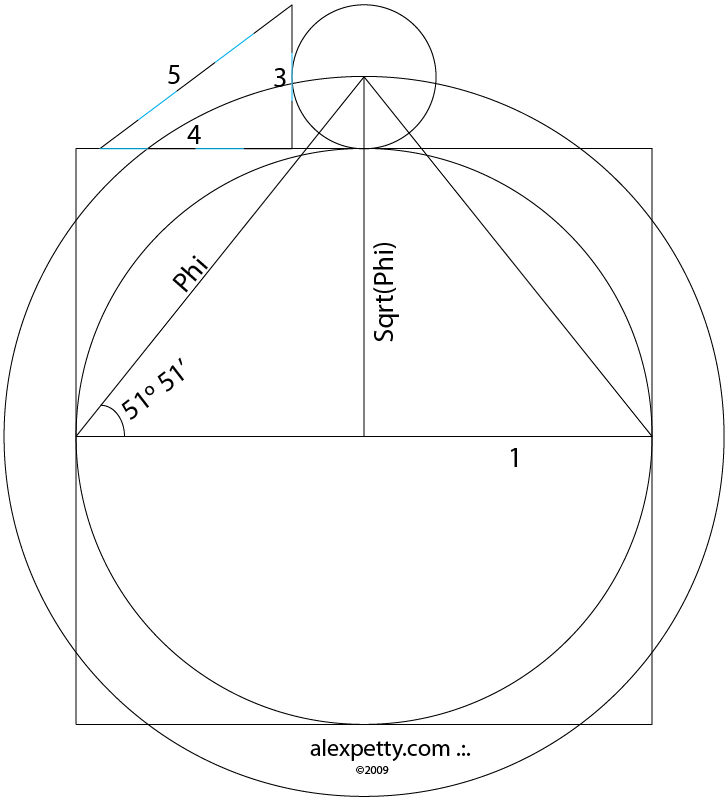
These geometric connections help explain why the golden ratio appears in structures built from pentagons and star polygons. The relationships are not approximate. They are exact, and they follow directly from the equation φ² = φ + 1.
Deriving phi algebraically
The golden ratio can be derived from a simple question about proportion.
If a line segment is divided so that the ratio of the whole to the larger part equals the ratio of the larger part to the smaller part, what is that ratio?
Setting up the equation gives
$$x^2 = x + 1$$
Solving produces two roots. The positive root is φ. The negative root is −1/φ.
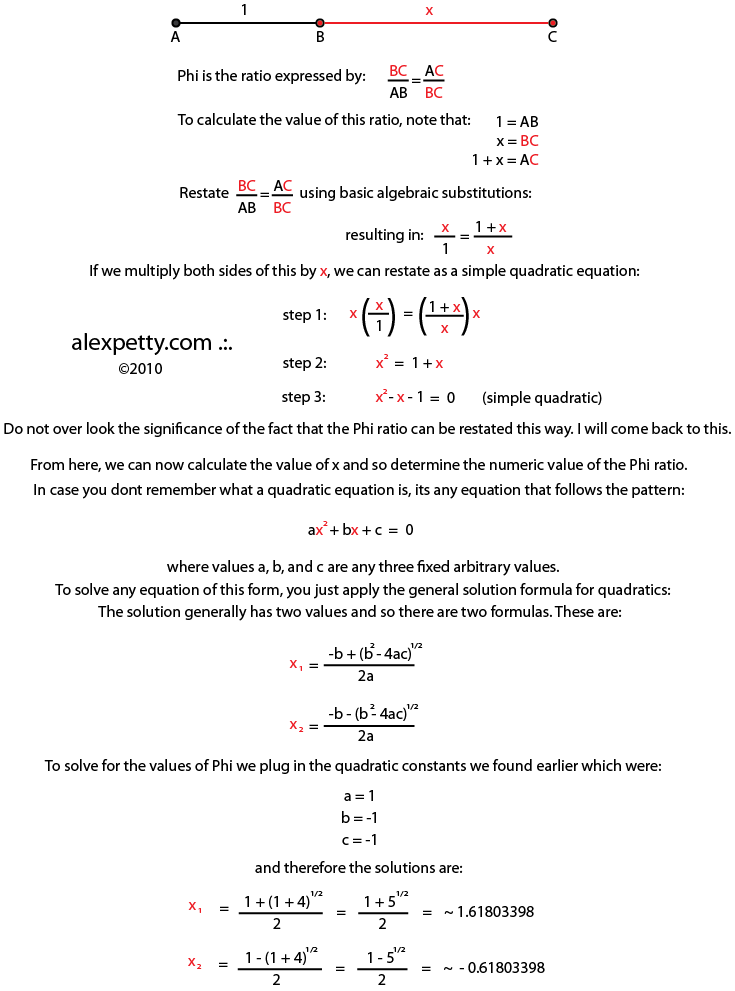
This equation, x² − x − 1 = 0, is the minimal polynomial of the golden ratio. It is the simplest equation that φ satisfies, and everything about φ can be derived from it. The self-referential properties, the geometric constructions, the Fibonacci connection. All of it traces back to this single quadratic.
Viewing numbers within the unit interval
Phi comes from dividing a line segment. What happens when you divide the interval between 0 and 1 with actual integers? Each one carves the interval differently, and the results are worth looking at.
For example, dividing the interval into five equal parts gives
0.0, 0.2, 0.4, 0.6, 0.8, 1.0
Dividing it into seven parts gives
0.000000, 0.142857, 0.285714, 0.428571,
0.571428, 0.714285, 0.857142, 1.000000
Look at the seven-part division carefully. The six interior values are all cyclic permutations of the same six digits: 142857. This is the repetend of 1/7, and every fraction k/7 is a rotation of it.
Thinking about numbers this way, as the full set of fractions with a common denominator spread across the unit interval, can reveal patterns that are invisible when you look at individual fractions in isolation. The number 7 does not just produce the repetend 142857. It produces an entire field of six rotations of that repetend, organized symmetrically within [0, 1].
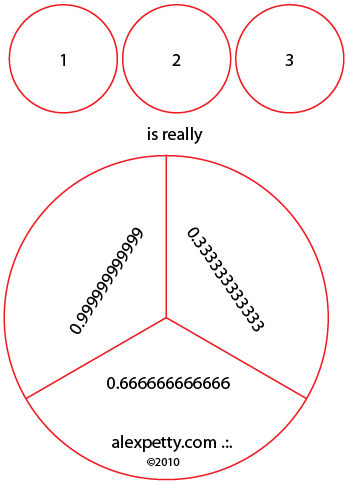
Every integer $n$ defines its own partition of the unit interval into $n - 1$ interior points. Each of those points is a fraction $k/n$, and each has its own decimal expansion. The collection of all those expansions is a deterministic inner architecture. Every number carries its own blueprint, fully determined, waiting to be read and understood.
Phi and the Fibonacci sequence
Phi itself is irrational. It has no repetend, no clean internal blueprint the way an integer does. And yet it governs the relationship between integers that do. The Fibonacci sequence is the simplest example.
1, 1, 2, 3, 5, 8, 13, 21, 34, 55, 89, 144, 233, ...
Each number is the sum of the previous two. The rule is as simple as arithmetic gets: add the last two, write down the result, repeat.
Examine the ratios between successive Fibonacci numbers.
1/1   = 1.000000
2/1   = 2.000000
3/2   = 1.500000
5/3   = 1.666666
8/5   = 1.600000
13/8  = 1.625000
21/13 = 1.615385
34/21 = 1.619048
55/34 = 1.617647
89/55 = 1.618026
144/89  = 1.617978
233/144 = 1.618056
The ratios oscillate above and below φ, converging toward it from both sides, the way an oscillator swings until it dampens toward rest. The simplest possible recurrence relation settles on the golden ratio.
Convergence toward phi
The chart below illustrates how the ratios of successive Fibonacci numbers converge toward φ.
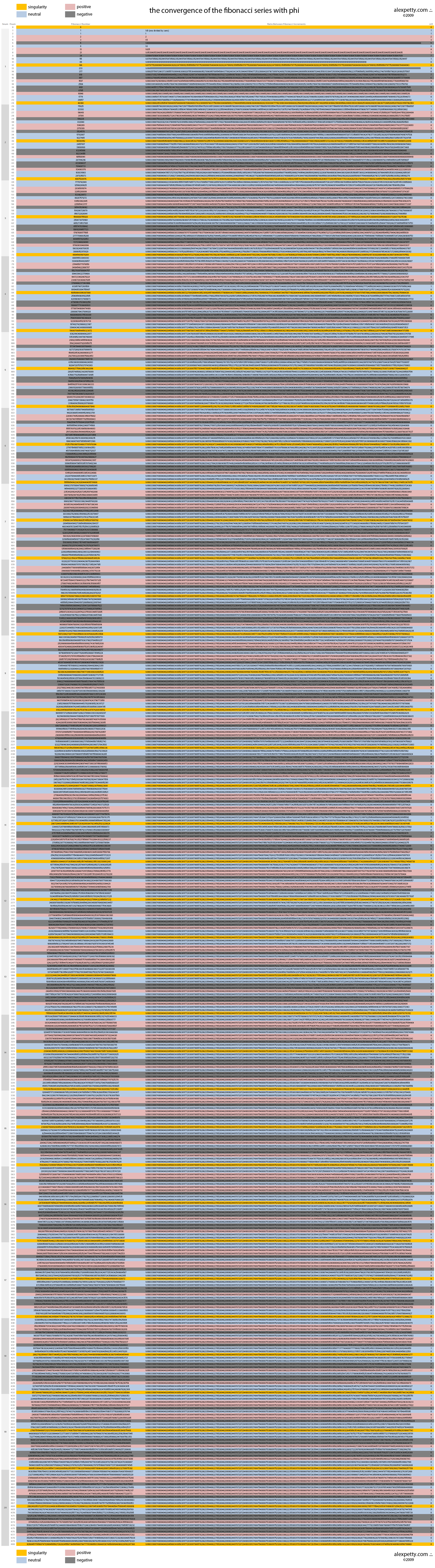
The oscillation is visible. Each ratio overshoots φ, then undershoots, then overshoots again, with the amplitude decreasing each time.
Error term of the convergence
The following diagram shows how the error between the Fibonacci ratio and φ decreases as the sequence grows.

The error decreases geometrically. Each step reduces the error by a factor that itself converges to 1/φ². This is not a coincidence. It is the self-referential structure of φ expressing itself in yet another form.
Fibonacci points on a cycle
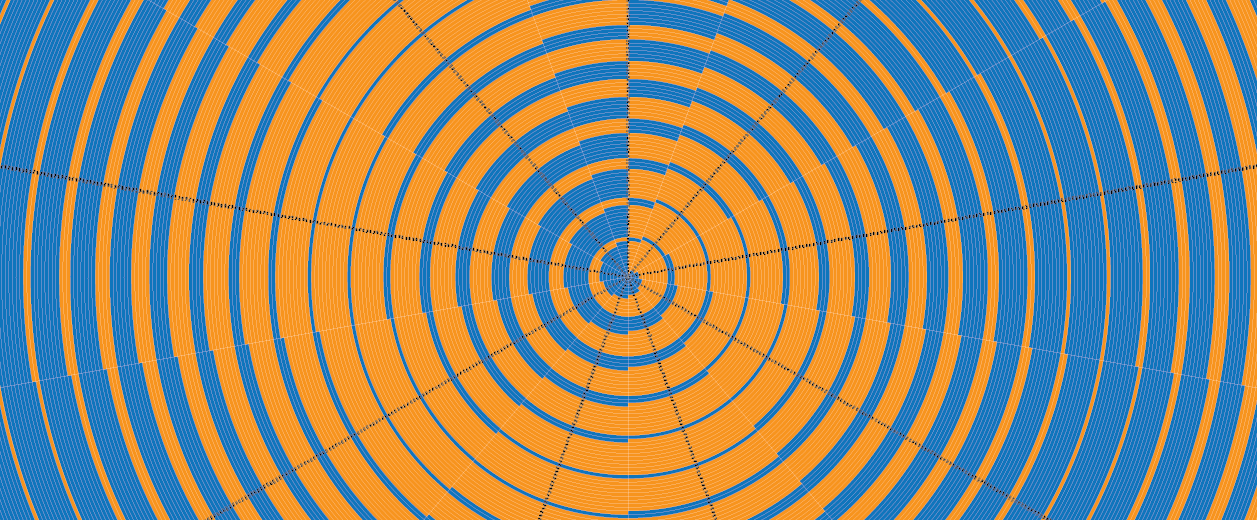
Another way to visualize the Fibonacci sequence is to plot its values on a repeating cycle.
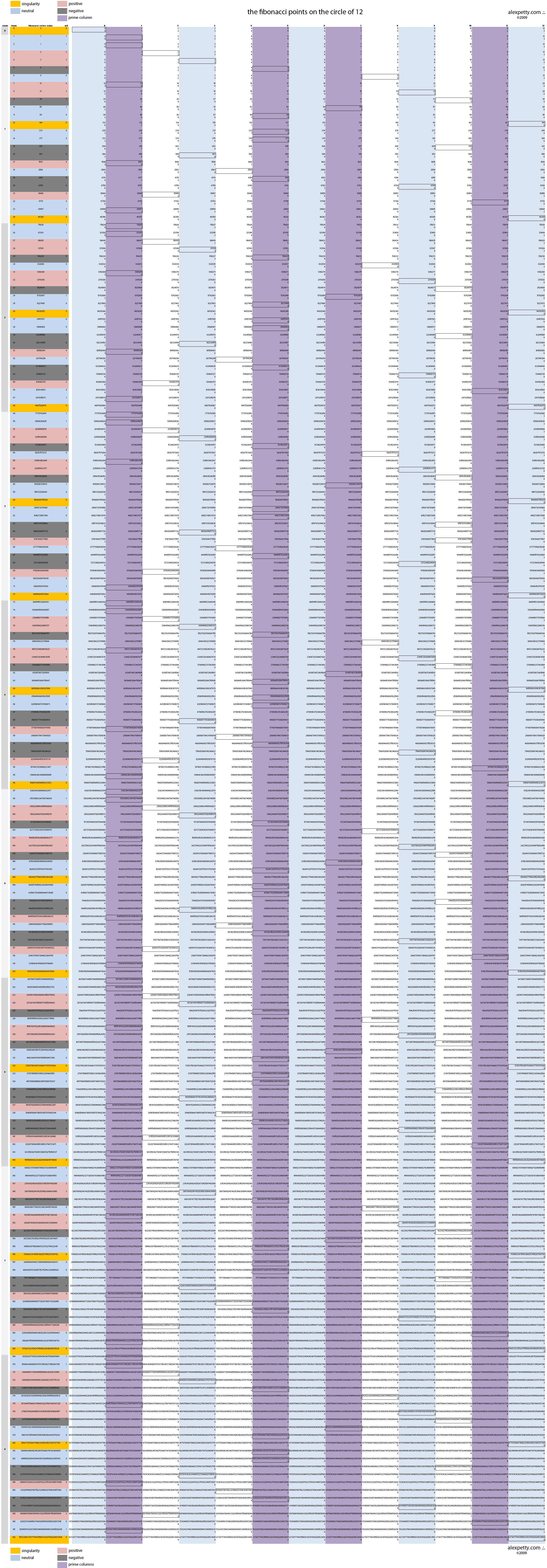
With less data the pattern becomes clearer.

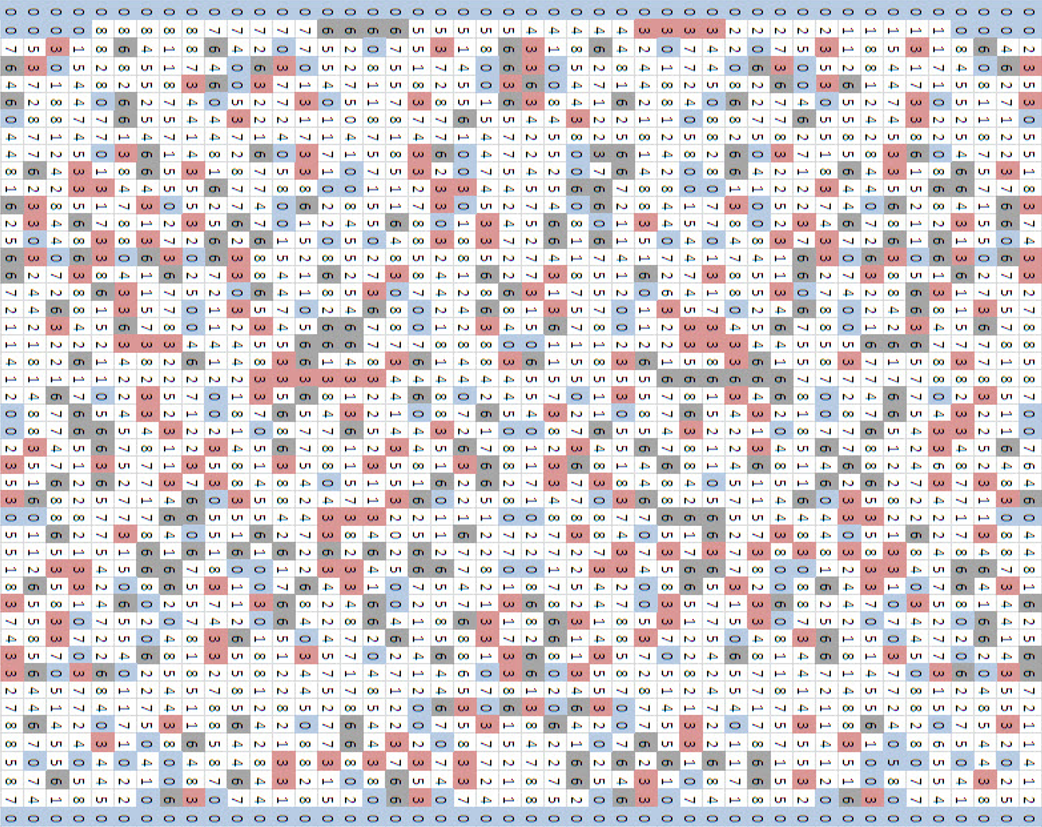
The Fibonacci sequence, when reduced modulo a fixed number, always produces a periodic pattern. The period depends on the modulus, but the periodicity itself is guaranteed. This connects back to the mod-9 observations in The Circle of Nine, where the Fibonacci sequence reduced modulo 9 produces a cycle of length 24 with a fixed polarity pattern.
The open question
Phi arises from the simplest quadratic equation, governs the growth of the simplest recurrence, and organizes the geometry of the simplest regular polygon. One number, three different entry points, the same structure every time. I do not think that is an accident, but I do not yet know what it is. I suspect there is more to find.
.:.
A note from 2026
April 2026
The self-referential property $\varphi^2 = \varphi + 1$ described here turned out to be the mechanism through which the golden ratio selects the prime $3$. The alignment formula $\alpha = (2m - 1)/(3m - 1)$ exceeds $1/\varphi$ precisely when $m \ge \varphi^2$, and this threshold emerges from the algebra of $\varphi$ itself, not from any external assumption. The minimal polynomial $x^2 - x - 1$ divides the self-referential cubic $\tau^3 - \tau^2 - 3\tau + 2 = 0$ with remainder $(3 - p)\tau$, which vanishes only at $p = 3$. The golden ratio selects the prime. The details are in Why the Golden Ratio Selects the Prime Three.
The unit interval section, where I looked at the fractions ${k/n}$ as a portrait of $n$, was the beginning of the fractional field that the alignment measure quantifies. The "complete arithmetic portrait" described here is what the later work formalizes and measures.
"I suspect there is more to find." There was.
.:.