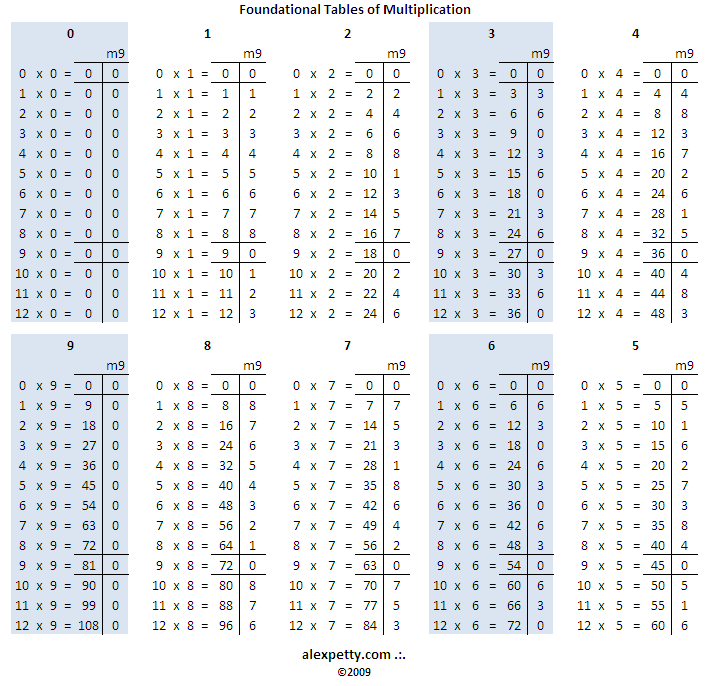
Foundational Tables of Multiplication
Multiplication tables on the circle of nine reveal mirror symmetries that persist at every scale. The palindromic structure is built into the place-value system.
January 2010
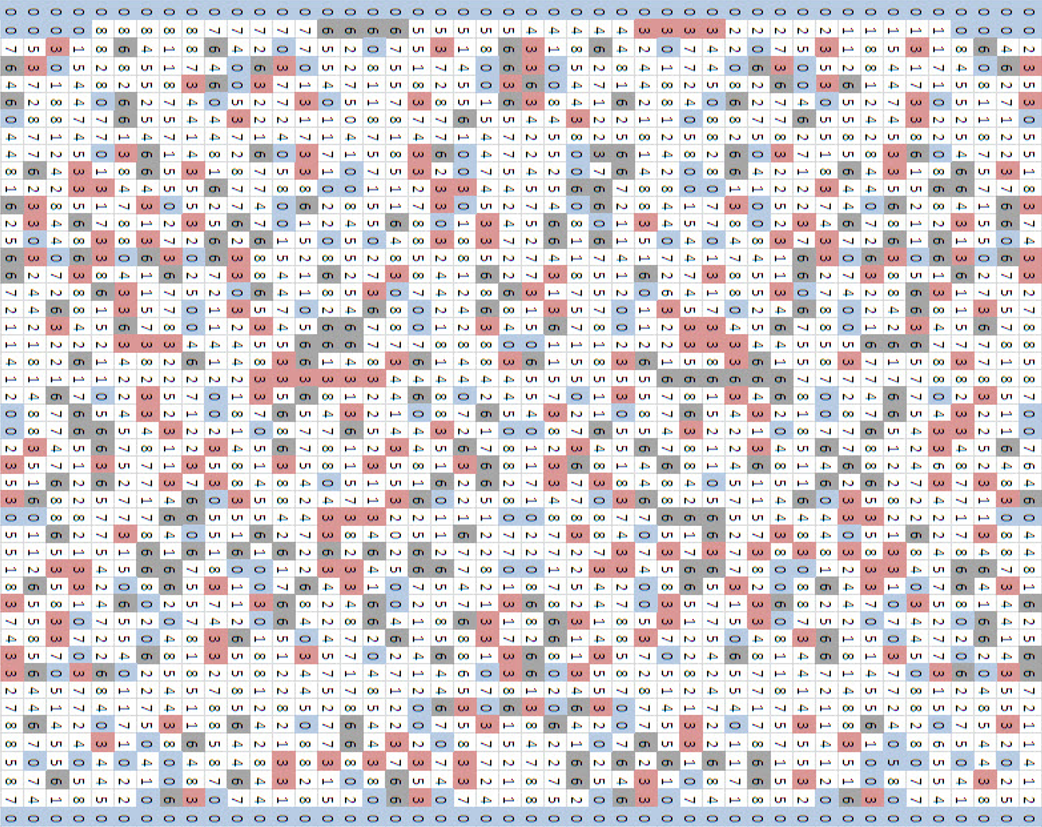
Multiplication tables are usually displayed as a rectangular grid.
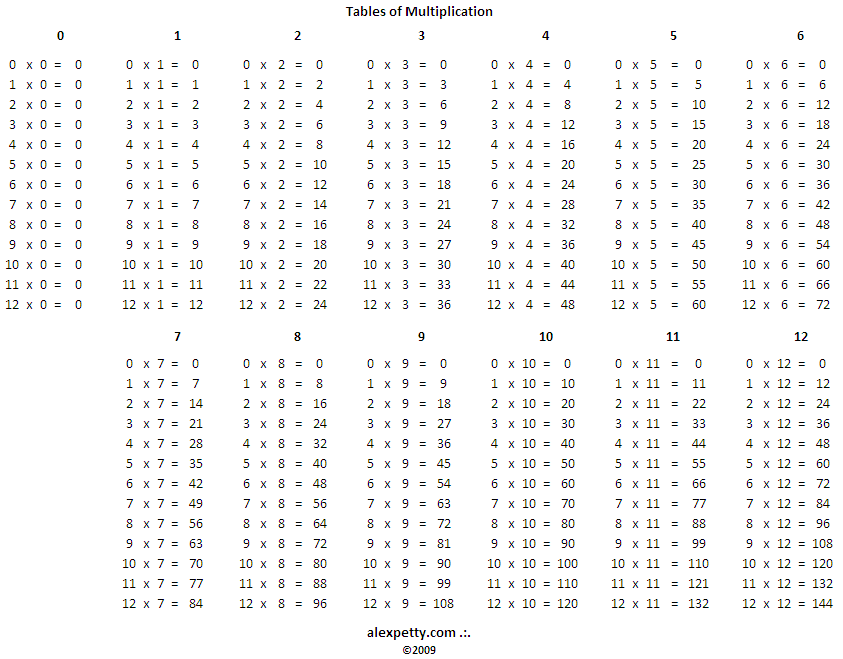
The grid shows growth relationships between numbers. But it hides something. Every multiplication table, extended far enough, repeats. The grid does not show the repetition. It just keeps growing to the right.
A circle shows what the grid cannot.
The number line and the spiral
The standard model for the integers is the number line, where numbers sit along a single axis.

The number line is useful for addition, subtraction, and ordering. But multiplication has a cyclic structure that the line hides. A spiral bridges the two. A number line that curves back on itself at regular intervals, combining linear order with modular periodicity.
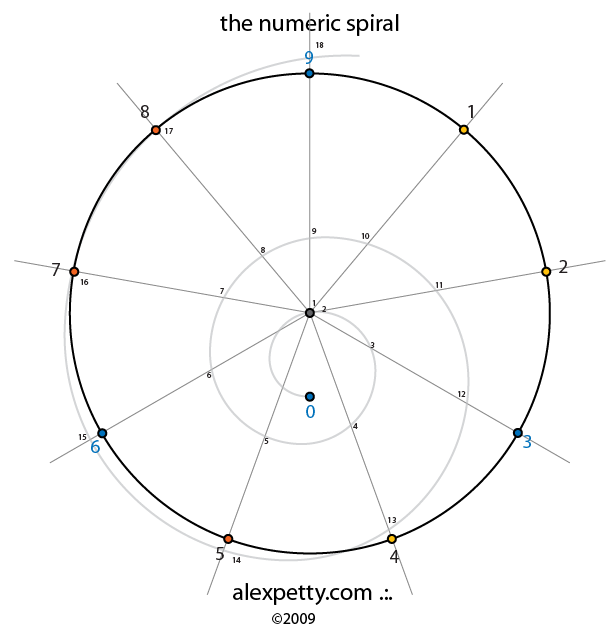
Multiplication on a circular system
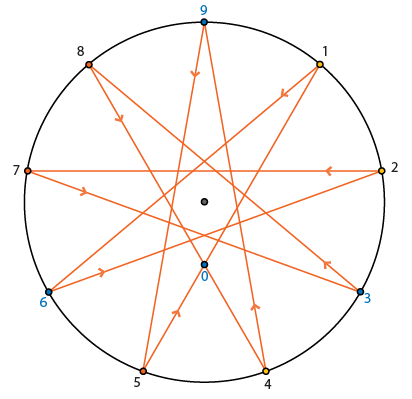
Take the same multiplication tables and plot them on a circle divided into nine radial positions. The sequences trace distinct paths.
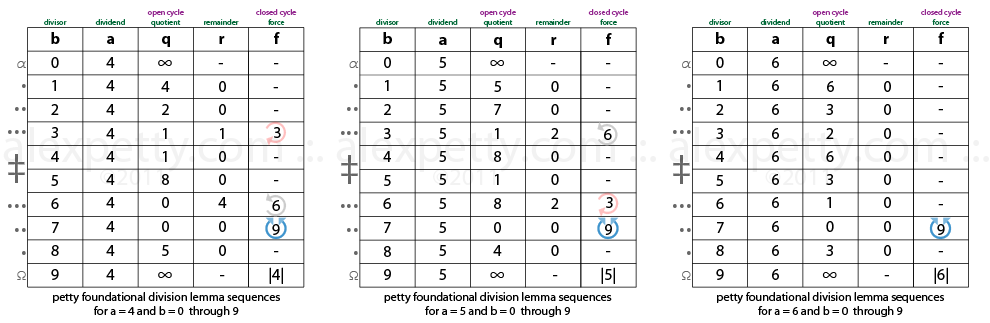
Each multiplication table generates its own repeating cycle. The cycle lengths vary. Some tables produce short loops, others visit many positions before returning to their starting point. But every table eventually returns. That is the nature of modular arithmetic.
From this representation a general structural diagram emerges, showing how all multiplication sequences move through the circular system.
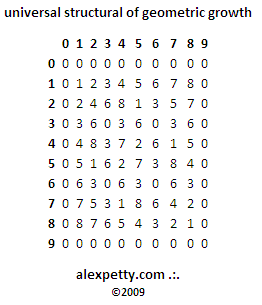
Flow signatures of the multiplication tables
When plotted on the circle of nine, each digit from 1 through 9 produces a characteristic trajectory. Some are simple. Some are surprisingly complex. Together they reveal the full geometry of multiplication in the decimal system.
The one's table
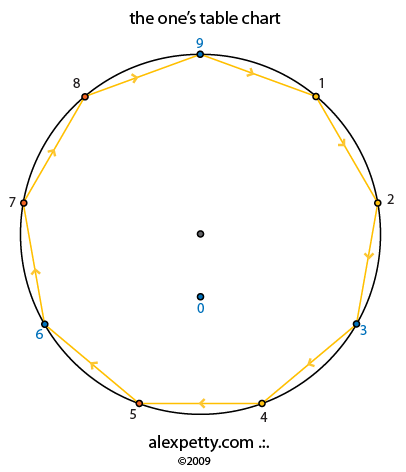
The identity. Every multiple of 1 is itself. The sequence walks around the circle visiting every position in order: 1, 2, 3, 4, 5, 6, 7, 8, 9, 1, 2, 3, ...
The two's table
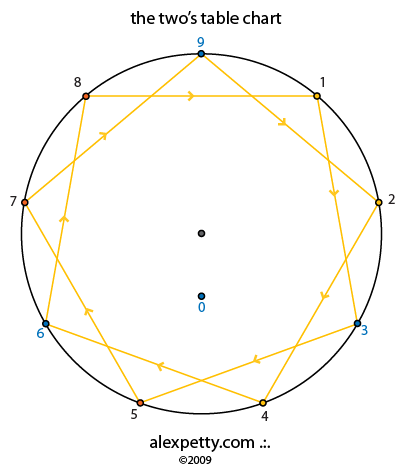
The doubling sequence. Under digital root reduction it produces the cycle 2, 4, 8, 7, 5, 1, then repeats. Six distinct positions before the pattern closes. This is the same cycle visible in the field glyph of 4 and in the vortex diagrams.
The three's table
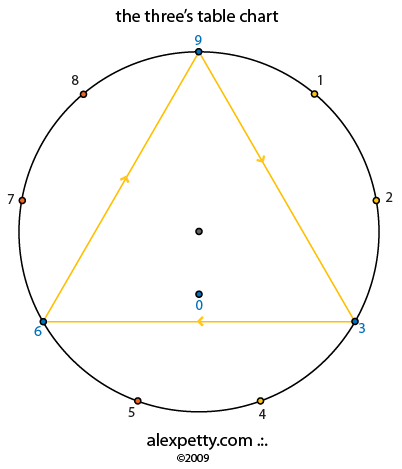
The multiples of three form a repeating triangular path: 3, 6, 9, 3, 6, 9, ... Only three positions, cycling forever. This is the closed polar loop from The Circle of Nine.
The four's table
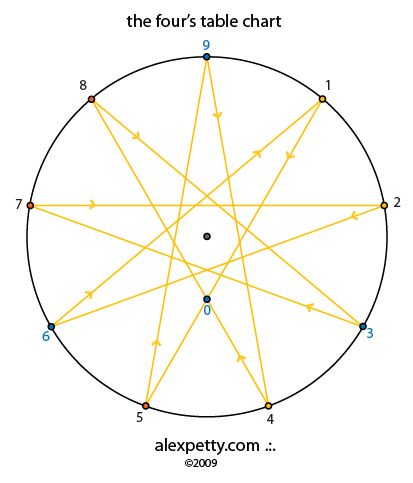
The four's table traces the same six positions as the two's table, but in a different order: 4, 8, 3, 7, 2, 6. The doubling cycle entered at a different point.
The five's table
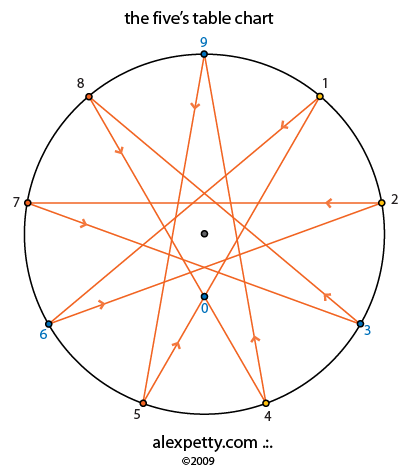
Five is the turning point. Up to this point the multiplication cycles trace the circle in one direction. Beyond five they reverse and begin tracing the circle in the opposite orientation. 5 is one less than half of the cycle length (9), and in modular arithmetic, multiplication by $n$ and multiplication by (modulus $- n$) produce mirror-image paths.
The six's table
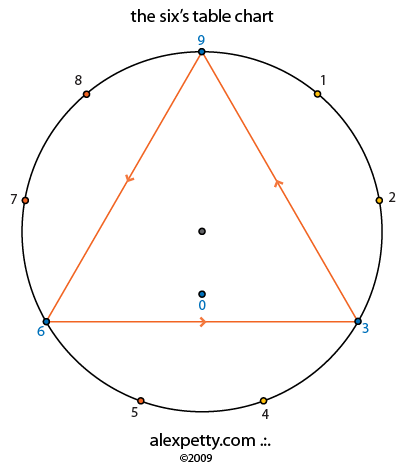
The six sequence mirrors the three sequence but travels in the opposite direction: 6, 3, 9, 6, 3, 9, ... The same triangle, reversed. Three and six are complements, and their multiplication paths are complements too.
The seven's table
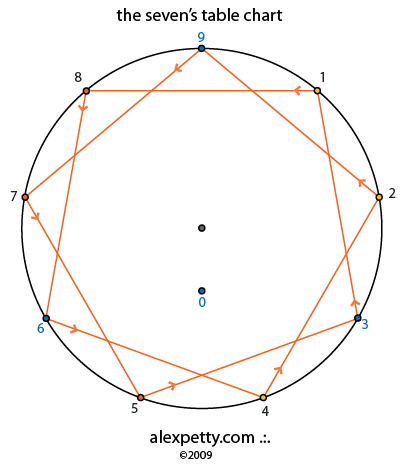
Seven mirrors two. The cycle visits the same six positions as the doubling sequence, but in reverse order.
The eight's table
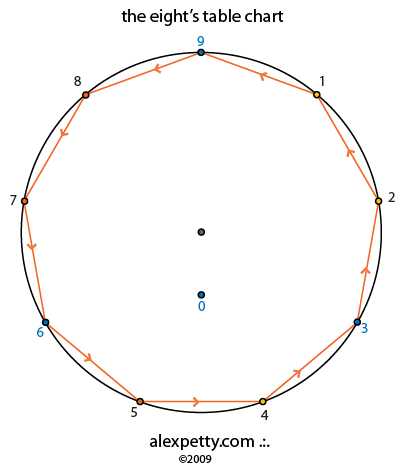
Eight mirrors one. Its sequence walks around the circle visiting every position, but in the opposite direction: 8, 7, 6, 5, 4, 3, 2, 1, 9, 8, 7, ...
The nine's table
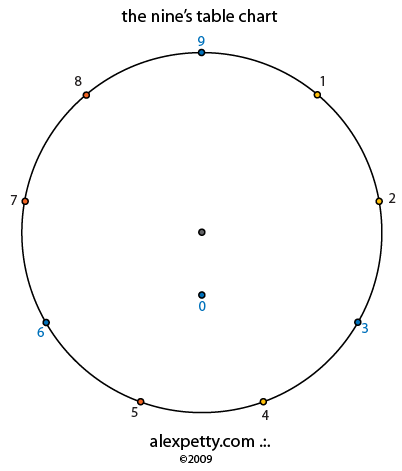
Under modulus-9 arithmetic, all multiples of nine reduce to 9 (equivalently, to 0). The sequence maps repeatedly to the center of the circle. Nine is the identity element of the digital root system. It absorbs everything.
The mirror structure
The multiplication tables come in complementary pairs.
- 1 and 8 (full circle, opposite directions)
- 2 and 7 (six-position cycle, opposite directions)
- 3 and 6 (triangular loop, opposite directions)
- 4 and 5 (six-position cycle, opposite directions)
- 9 stands alone (collapses to the center)
Each pair sums to 9. The second half of the multiplication tables is a mirror image of the first half. Multiplication by $k$ mod 9 and multiplication by (9 $- k$) mod 9 produce sequences that are reversals of each other.
Universal structure
All of these patterns arise from the same underlying network of multiplicative cycles.
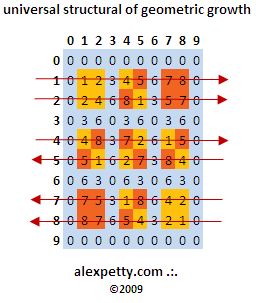
The multiplication sequences form a network of repeating loops. The network has a definite architecture. The 3-6-9 triangle at the center, the 1-2-4-8-7-5 hexagon around it, and the reversal symmetry connecting opposite sides.
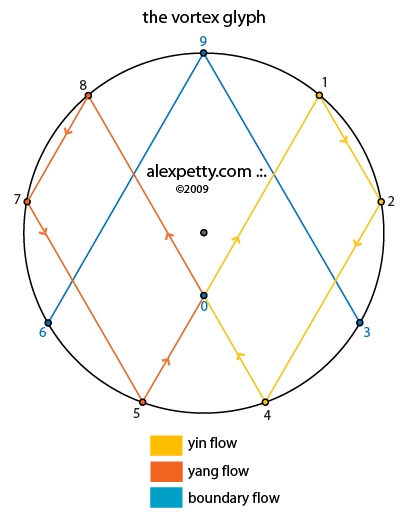
This summary diagram captures the same relationships in compressed form. The same glyph keeps appearing throughout these investigations, arising here from a completely different starting point. Not from modular reduction of integers, but from the cyclic structure of multiplication itself.
Numeric relationships
The circular representation reveals several symmetries at a glance.
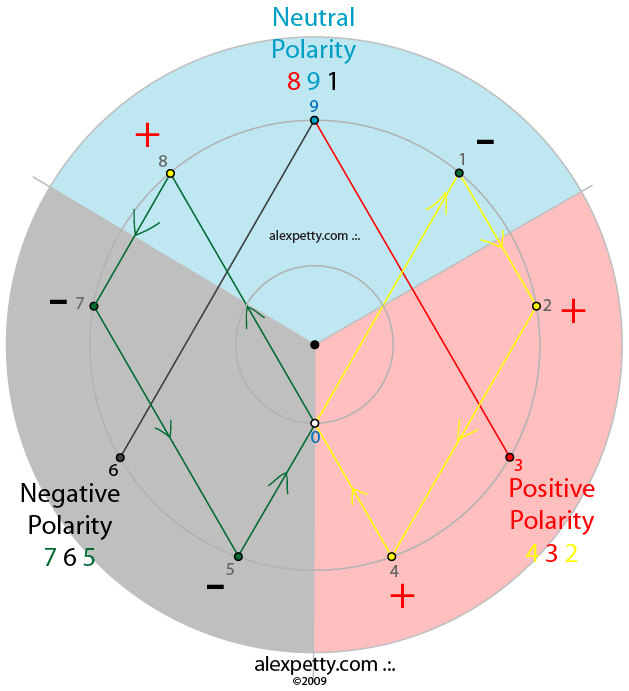
The sequences generated by 3 and 6 mirror each other. The digit 9 acts as the identity element. And the six-position doubling cycle 1, 2, 4, 8, 7, 5 forms the backbone of the system, the longest possible orbit for a single multiplication table in mod-9 arithmetic.
Doubling and halving cycles
Follow the digital roots produced by repeated doubling.
Doubling:
1 → 2 → 4 → 8 → 7 → 5 → 1
The sequence repeats after six steps. Every power of 2, no matter how large, has a digital root drawn from this set of six values.
Halving:
1 → 5 → 7 → 8 → 4 → 2 → 1
The halving cycle is the doubling cycle reversed. Doubling is multiplication by 2, halving is multiplication by 5 (since 2 × 5 = 10 ≡ 1 mod 9), and 2 and 7 are complements while 5 and 4 are complements.
Multiplication tables on a rectangular grid look like growth without structure. On a circle, the growth reveals itself as motion through a repeating geometric pattern.
The mirror structure is what stands out. The first half of the multiplication tables and the second half are reflections of each other, connected by the complement relationship $k + (9 - k) = 9$. This is the same complement symmetry visible in the palindromic oscillations of the foundational arithmetic table and in the polarity assignments. It keeps showing up because it is built into the structure of the decimal system at the deepest level.
There is nothing inherently special about base 10 here. Any base produces its own modular cycles and geometric patterns. The symmetries arise from the relationship between a base and its modulus, not from the specific digits involved.
.:.
A note from 2026
April 2026
The mirror structure described here, where multiplication by $k$ and multiplication by (modulus $- k$) produce reversed paths, is the complement map $a \mapsto m - a$ that became the foundation of the later work. In the fractional field ${k/n}$ studied in Why the Golden Ratio Selects the Prime Three, the fraction $k/n$ and its complement $(n-k)/n$ sum to $1$, and their decimal expansions are digit-by-digit mirror images. The same pairing, lifted to residue classes, forces an exact antisymmetry on the collision invariant.
The two structures visible on the circle of nine, the 3-6-9 triangle and the 1-2-4-8-7-5 hexagon, turned out to be genuinely distinct objects. The triangle is closed under addition mod $9$. The hexagon is the orbit of repeated doubling mod $9$. They live in different parts of the arithmetic, and their independence is what prevents certain patterns from accumulating coherently across primes.
The six-step doubling cycle also reappears in the later work in a more precise form. How many steps before a multiplication sequence returns to its starting point governs the length of a prime's repeating decimal and controls the alignment limit studied in The Alignment Limit for All Primes.
The patterns on the circle of nine are not special to base ten. They are universal.
.:.