On Numeric Polarity and the Distribution of Primes
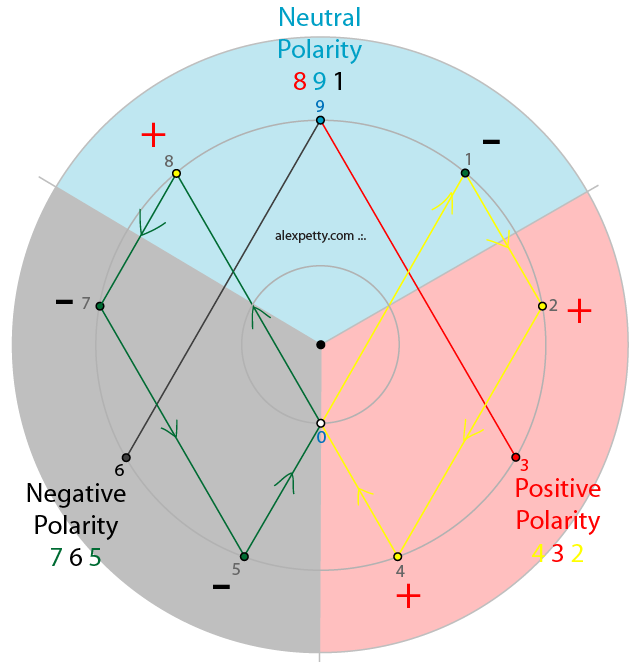
In 2009, I drew a circle with nine positions and watched where the primes landed. The classes paired. The complements avoided each other. I called it polarity.
November 2009
My view of numbers has shifted over time.
They no longer appear to me as abstractions invented to describe the physical world. They appear closer to the most basic level of structure through which the world becomes measurable and distinct. Not labels we paste onto things, but something already present in the architecture.
I do not know how to prove this. But when I take this view seriously and look at the integers through it, patterns appear that I would not have noticed otherwise.
Numbers as structure
Begin with unity.
In a state of complete stillness there is no separation. There is only an undivided field.

The moment distinction appears, plurality appears with it. And the simplest representation of distinction is number. Two sides of the same boundary.
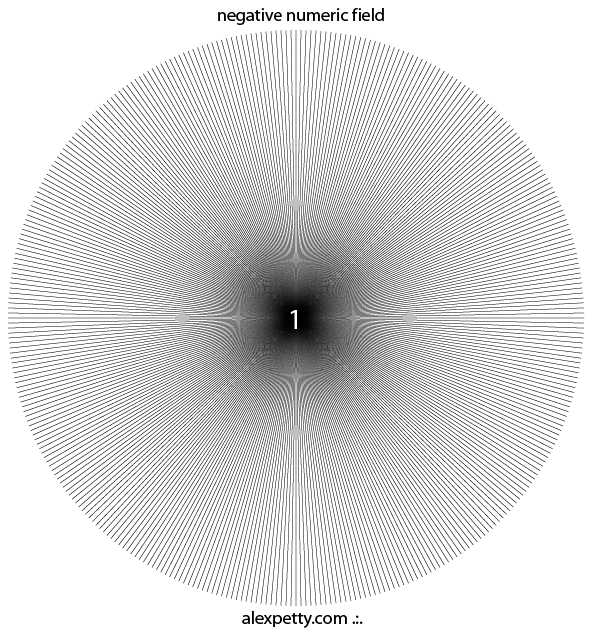
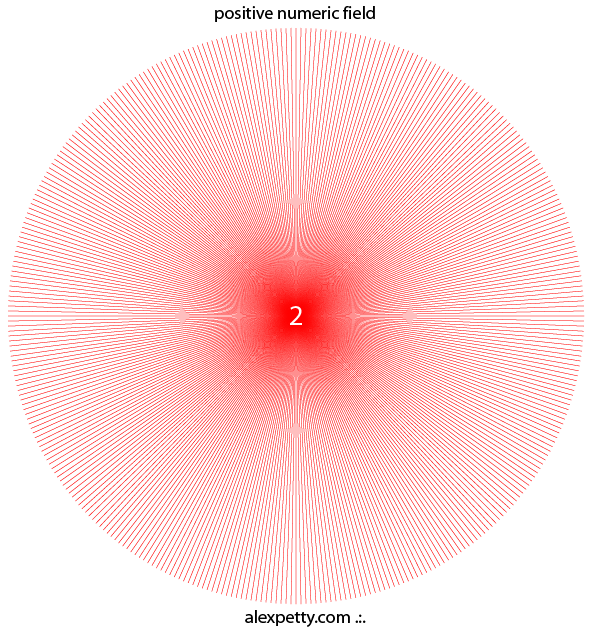
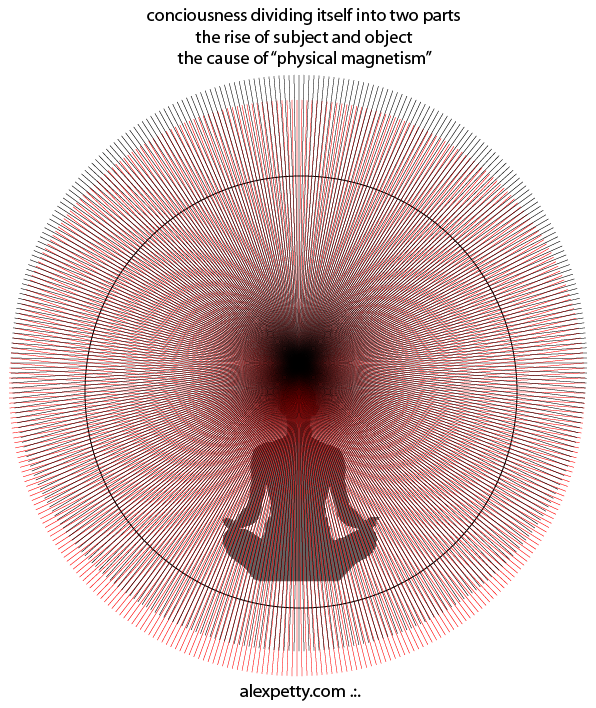
From this point of view, numbers form a kind of structural field. Interactions within that field naturally produce polarity. And polarity, wherever it appears, tends to produce motion.
A ninefold cycle
One such pattern is the cycle of nine.
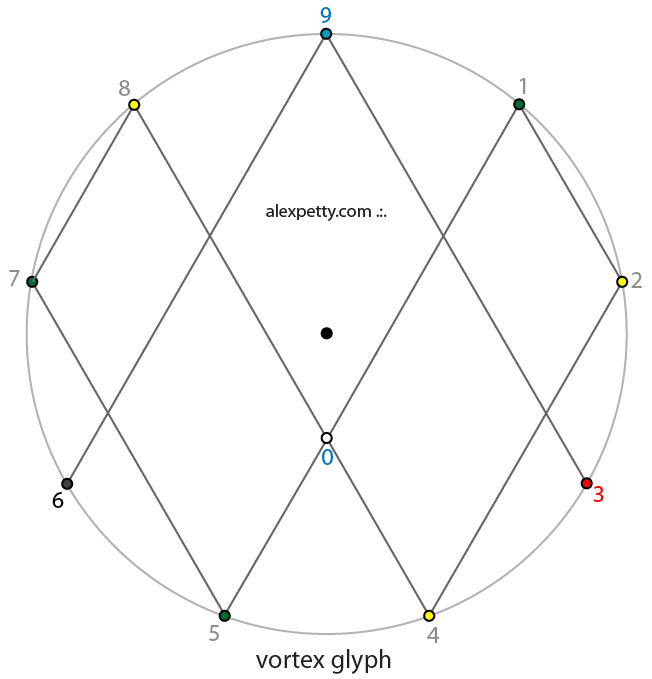
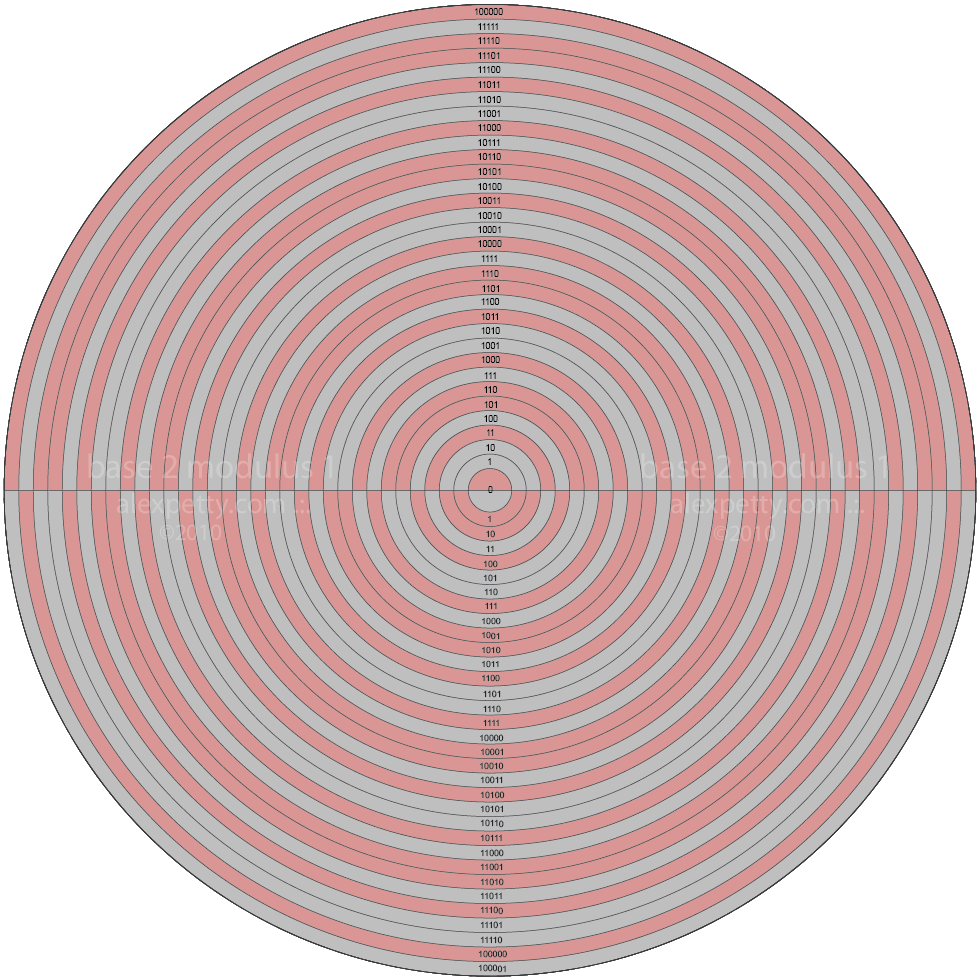
Arrange the integers around a circle with nine positions. 1 through 9 occupy the first ring, then 10 falls on 1 again, 11 on 2, 12 on 3, and so on. This is arithmetic modulo 9, but the circular layout makes certain relationships visible that the linear number line hides.
Within the cycle, 3 and 6 appear as opposing poles. The number 9 occupies a special position. In modular arithmetic it returns values into the system without changing their digital root. Add 9 to any number and its position on the circle does not move. It is a kind of arithmetic identity. Not zero, but something that behaves like zero within this structure.
Stillness and motion
The 3-6-9 radials do not merely exclude primes. They seem to form a static scaffold through the number field, and the relationship between them is not arbitrary. 3 and 6 are complements: 3 + 6 = 9. In decimal, 1/3 + 2/3 = 1, and the repeating expansions 0.333... and 0.666... sum to 0.999... = 1. The number 9 is their sum and the identity of the cycle. Together, 3, 6, and 9 form something like a dipole with an identity axis, a structure that the remaining integers, including all primes beyond 3, move around.
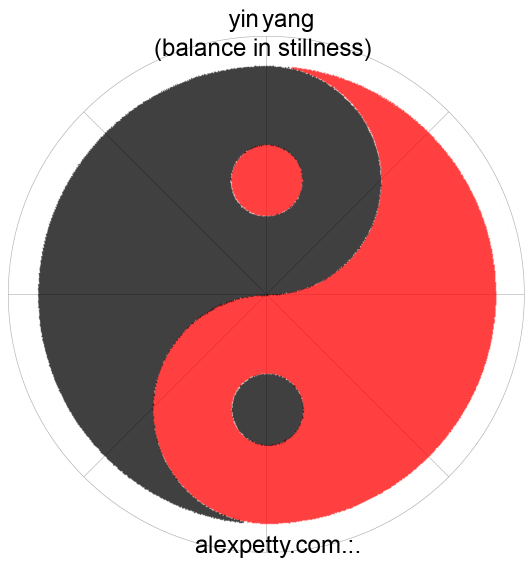
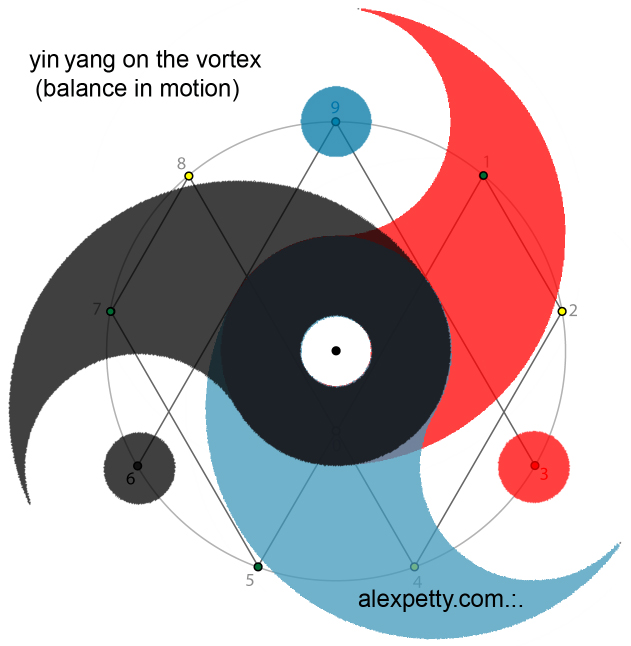
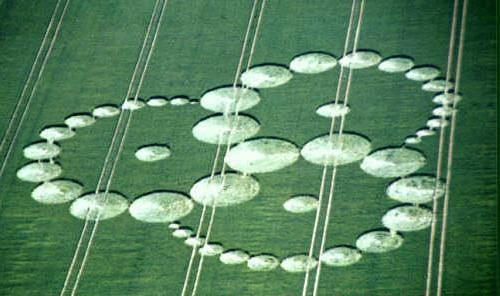
The spinning circle is a representation of a base-3 number system. Nine positions, three static, six in motion. The 3-6-9 positions appear to be closed under addition modulo 9: 3+3=6, 3+6=9, 6+6=3, and so on. The primes, which are excluded from this scaffold, flow through the complementary positions. What I keep seeing is this: the static positions seem to create the channels. The primes fill them.
A polarity assignment
Here is a simple way to classify the positions within the cycle.
Even numbers appear structurally paired. Odd numbers appear unpaired. Using that observation, the following grouping can be explored.
Positive side: 2 and 4.
Negative side: 5 and 7.
The positions 3, 6, and 9 stand apart from both groups.
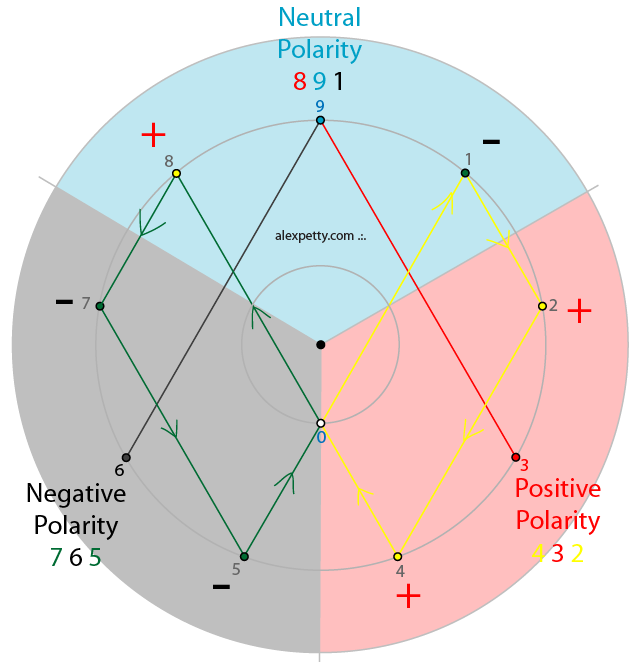
Now look at the radial lines passing through 3, 6, and 9.
Along the radial passing through 3, there are no primes. Along the radial passing through 6, there are no primes. Along the radial passing through 9, there are no primes either. The only exception is 3 itself.
Every other prime lands on one of the remaining six positions. This means every prime greater than 3 satisfies $p \equiv 1, 2, 4, 5, 7,$ or $8 \pmod 9$, which is equivalent to $p \equiv 1$ or $5 \pmod 6$. This is a known fact. But seeing it on the circle, as three empty radials cutting through the field of primes, gives it a different character. The exclusion zones are visible.
Primes on the circle of nine
The first primes appear in the pattern below.
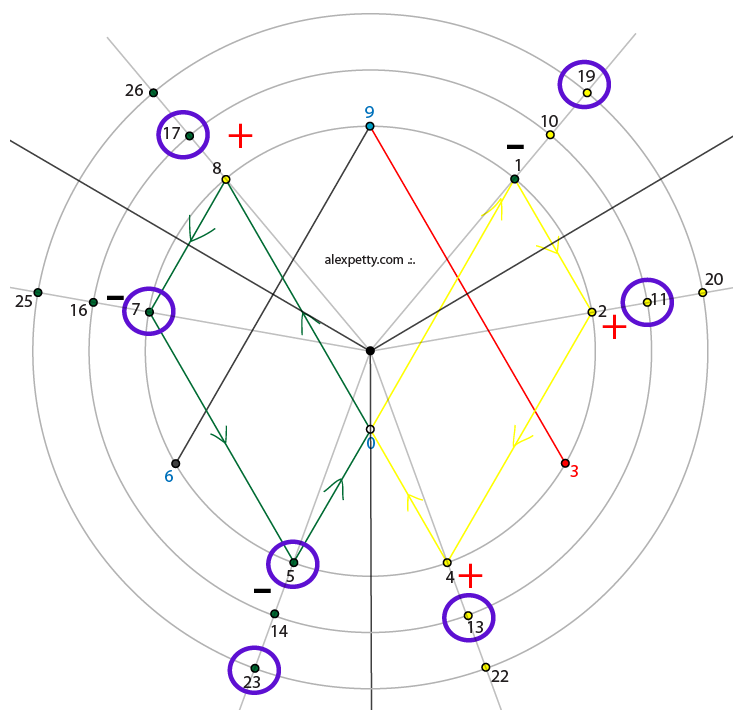
Each full rotation around the circle represents an increment of nine numbers. As the increments increase, the density of primes decreases. This is consistent with the well-known thinning of prime numbers as they grow larger. But even as they thin, they remain confined to the same spokes of the wheel. The geometry is stable. Only the density changes.
Larger tables
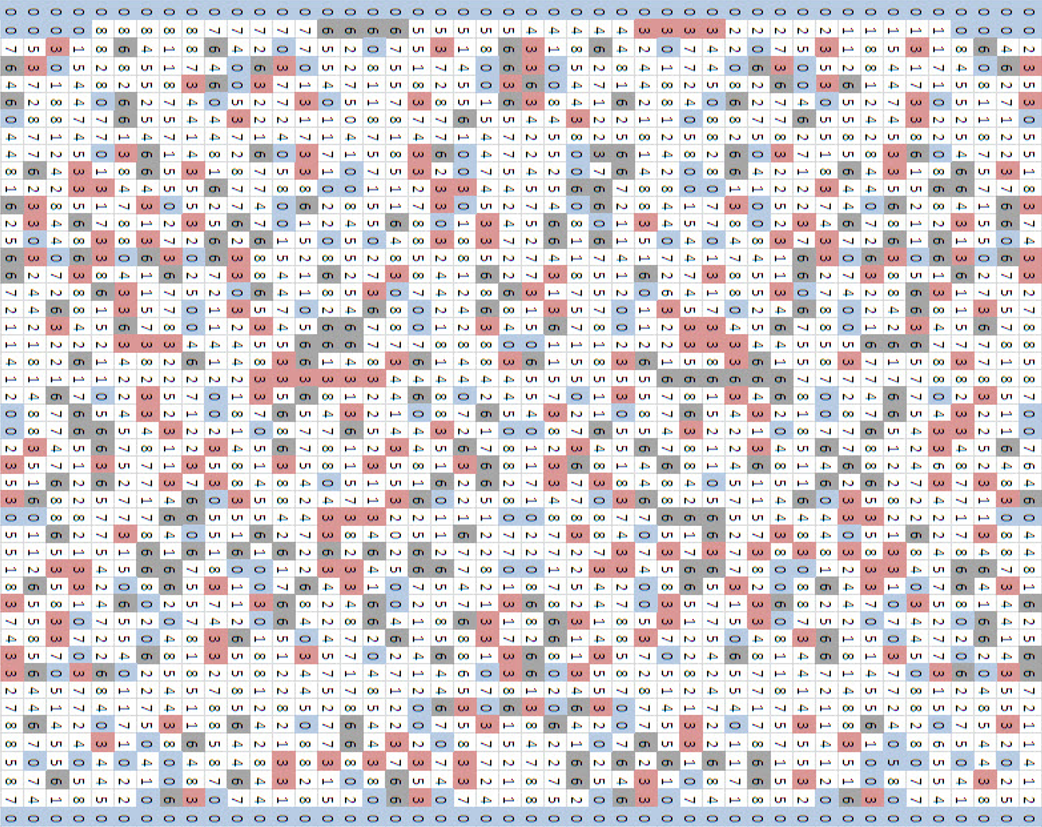
The table below extends the polarity mapping across the first several hundred cycles.

When reorganized according to polarity, the same information collapses into a denser structure. No prime appears in more than one polarity column. The positive and negative sides do not share a single prime. Whatever polarity is, the primes respect it completely. Not a curiosity. A constraint.

In this form, patterns of clustering and separation between columns become easier to see. Primes are not spread uniformly across the allowed positions. They favor certain columns and avoid others, and these preferences shift as the numbers grow. I do not know what governs these preferences, but the patterns are persistent enough to suggest that something does.
Fibonacci sequence
The Fibonacci sequence also produces repeating polarity patterns when viewed through the same mod-9 mapping.
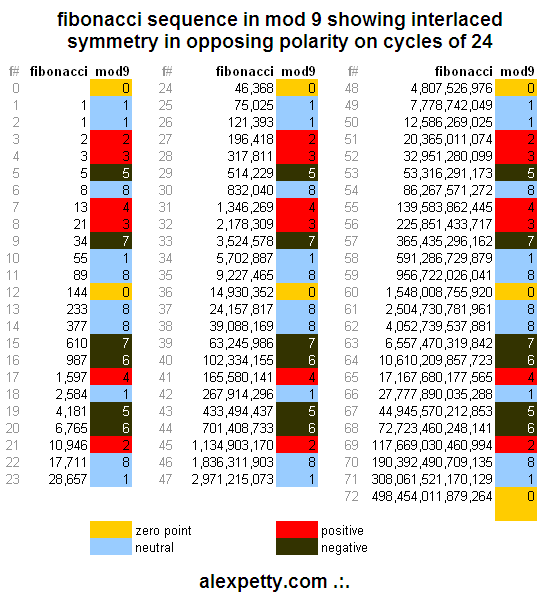
The sequence of residues repeats with a period of 24 terms. Within each period the polarity pattern is fixed and symmetric. I do not know what this shares with the prime structure, if anything. But I keep coming back to it.
Prime quintuplets
The densest clusters of primes are the quintuplets. Five primes packed as tightly as the constraints allow. The first examples appear in the table below.
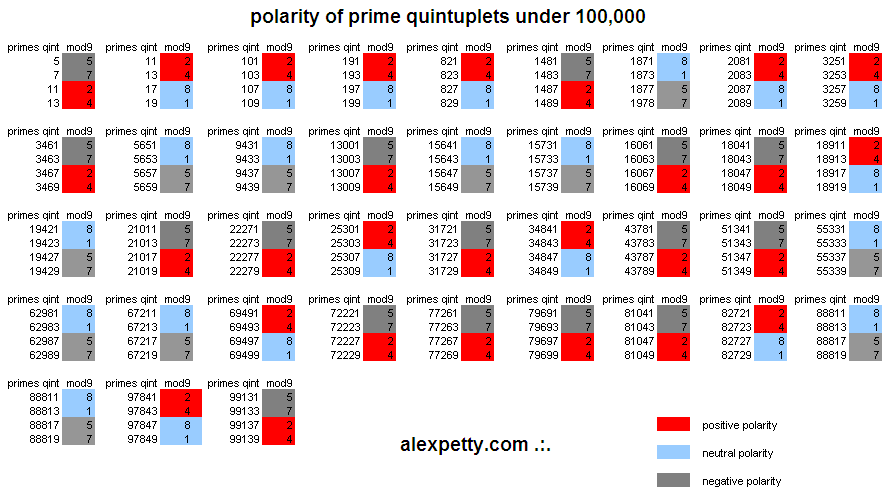
When mapped onto the circle of nine, these quintuplets fall into exactly three configurations. I call them neutral, positive, and negative, based on which spokes they occupy.
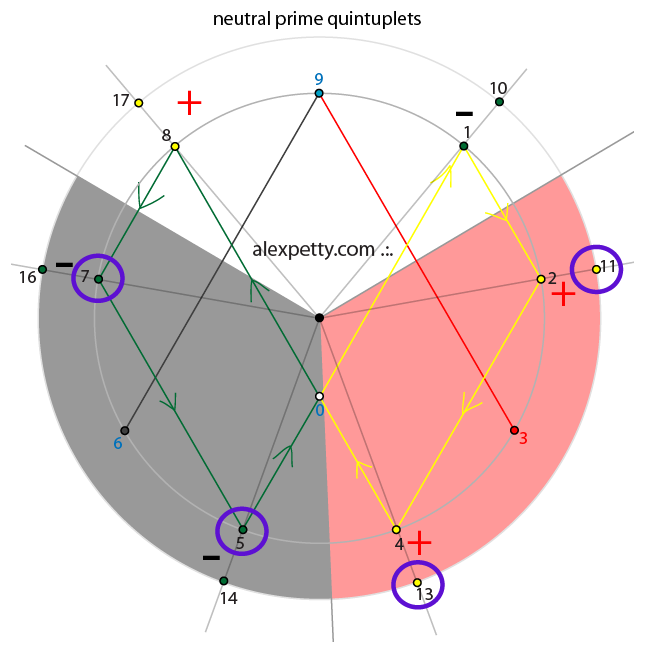
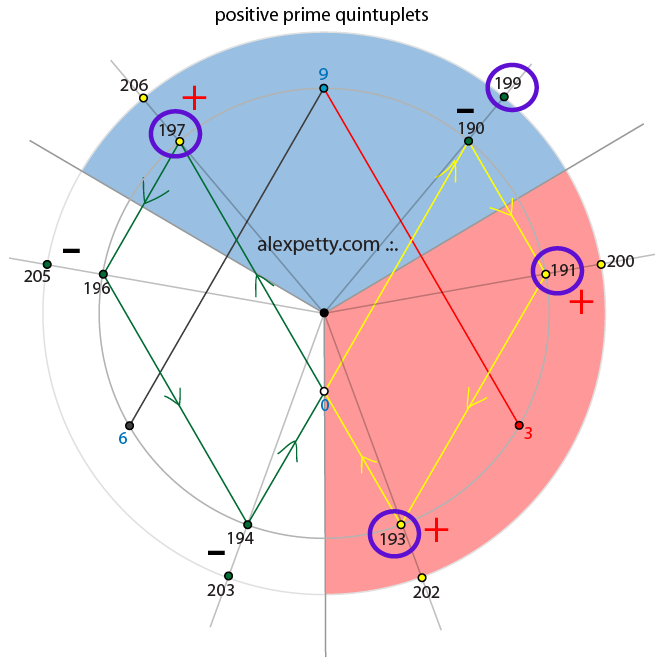
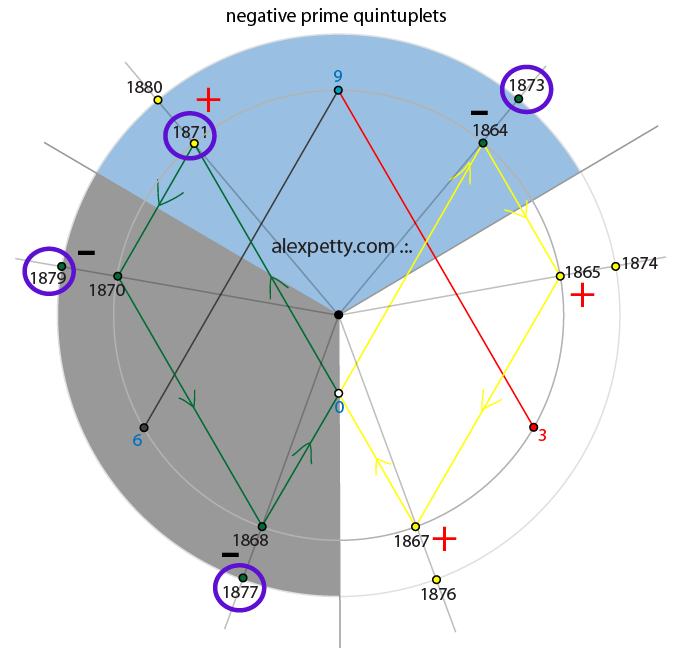
Every prime quintuplet falls into one of these three shapes. No other shapes are possible. The ninefold geometry constrains even the densest clusters of primes into a small number of configurations.
The limits of the diagram
These diagrams do not prove a theory of primes.
What they show is that when numbers are arranged on simple geometric structures, patterns begin to appear. The patterns are consequences of modular arithmetic, but they are easier to perceive in visual form than in symbolic form, and some of them, like the three quintuplet configurations, are not immediately obvious from the algebra alone.
I believe there is deeper structure here. I do not yet know how to reach it. But the circle of nine keeps revealing things, and I intend to keep looking.
.:.
A note, seventeen years later
April 2026
The question I was asking in 2009 turned out to be the right one. The tools came later.
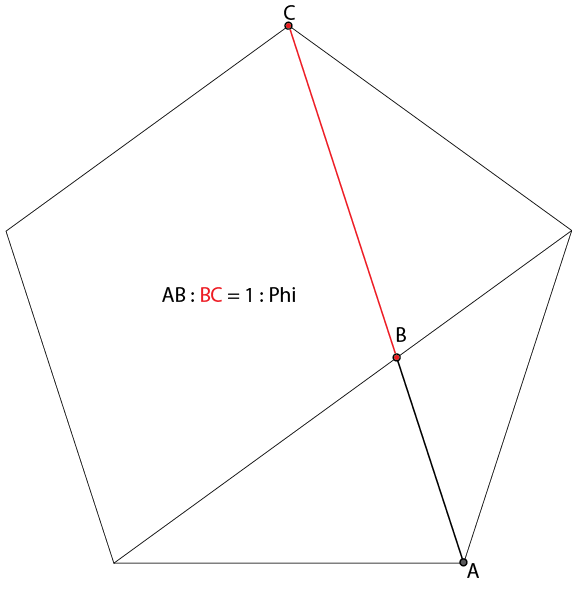
Why does the prime $3$ play a distinguished structural role in the organization of numbers? It took years to find a precise version of that question, and longer still to answer it. The answer came through what I now call repetend alignment, a measure of how coherently a denominator $n$ organizes the fractional field ${k/n}$. For denominators of the form $n = 3m$, the alignment follows the formula $\alpha = (2m - 1)/(3m - 1)$, and the golden ratio turns out to select $p = 3$ uniquely through the factorization of a self-referential cubic. The details are in Why the Golden Ratio Selects the Prime Three.
The mod-$9$ circle here is a shadow of the digit function $\delta(r) = \lfloor br/p \rfloor$ that became central to the later work. The polarity between residue classes is what Digit-Partitioning Primes formalizes as the digit-partitioning property: for primes $p \le b + 1$, different residue classes never share a digit at any repetend position. The exclusion zones on the circle of nine are a geometric reflection of this partition.
The polarity visible here turned out to be something more specific than the diagrams suggest. The complement map $a \mapsto m - a$ on residue classes forces an exact antisymmetry on the collision invariant: $F(a) + F(m - a) = 0$. The positive and negative sides on the circle of nine are not metaphors. They are the sign of a real-valued field defined on the integers, locked into opposite values on complementary classes. The field decomposes entirely into odd Dirichlet characters. No even character contributes. The complement involution forces this, the way a vibrating string fixed at both ends can only produce odd harmonics. The details are in The Polarity Field.
The three involutions present in these diagrams, $a \mapsto m - a$ on classes, $\chi \mapsto \bar\chi$ on characters, $s \mapsto 1 - s$ on the critical strip, turned out to be the same symmetry operating at three levels of the same structure. The polarity field lives at the first level and constrains the third.
The diagrams here are not rigorous. The philosophical framing reflects 2009. But the patterns were real, and they were the beginning.
.:.