The Cross-Alignment Matrix
Compare every fraction to every other, digit by digit. The result is a symmetric matrix whose eigenvalues encode the internal structure of the fractional field.
April 2021, revised April 2026
Every number has a face it shows to the world and a geometry it keeps to itself. The alignment scores from the previous posts are the face. Single numbers, easy to compare, easy to rank. But a single number cannot tell you what is happening inside a fractional field. It cannot tell you which fractions agree with each other, which ones are strangers, or whether the agreement has structure.
Build the full grid. Compare every fraction of $n$ to every other fraction, digit by digit. Record the proportion of matches. Lay the results in a table with fractions on both axes. That table is the cross-alignment matrix $\mathbf{A}(n)$.
It has a shape. And the shape is not what you expect.
Three fields, three shapes
At $p = 7$, the matrix is the identity. Six fractions, six distinct six-digit patterns, no two sharing a single digit at any common position. The grid is white on the diagonal and dark everywhere else. Nothing in that field talks to anything else.
At $p = 13$, the isolation breaks. Twelve fractions, and they are no longer all strangers. They fall into two groups of six. Within each group, fractions share digits at some positions. Between the groups, nothing. Two bright blocks appear off the diagonal, symmetric, definite.
At $n = 12$, the field fractures differently. Terminating fractions, fractions repeating 3, fractions repeating 6. Three families, each agreeing only with its own. Three solid blocks, different sizes, sharp edges.
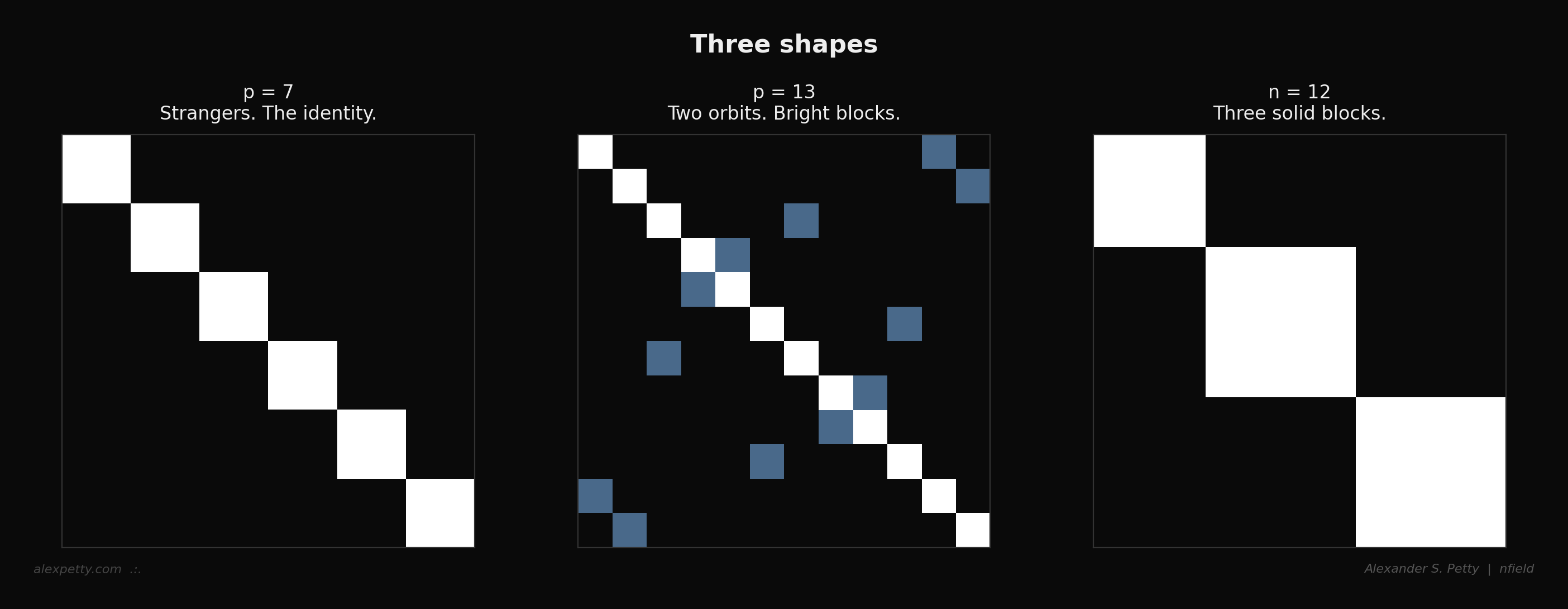
Same alignment score. Three completely different internal geometries. The averages cannot tell these apart. The matrix can.
Eigenvalues
Every symmetric matrix carries a set of eigenvalues, numbers that describe its independent modes of variation. Think of them as the natural frequencies of the matrix. A matrix with one repeated eigenvalue has one mode. A matrix with many distinct eigenvalues has rich internal structure.
At $p = 7$, every eigenvalue is 1. The identity matrix has one mode, repeated six times. There is nothing to decompose.
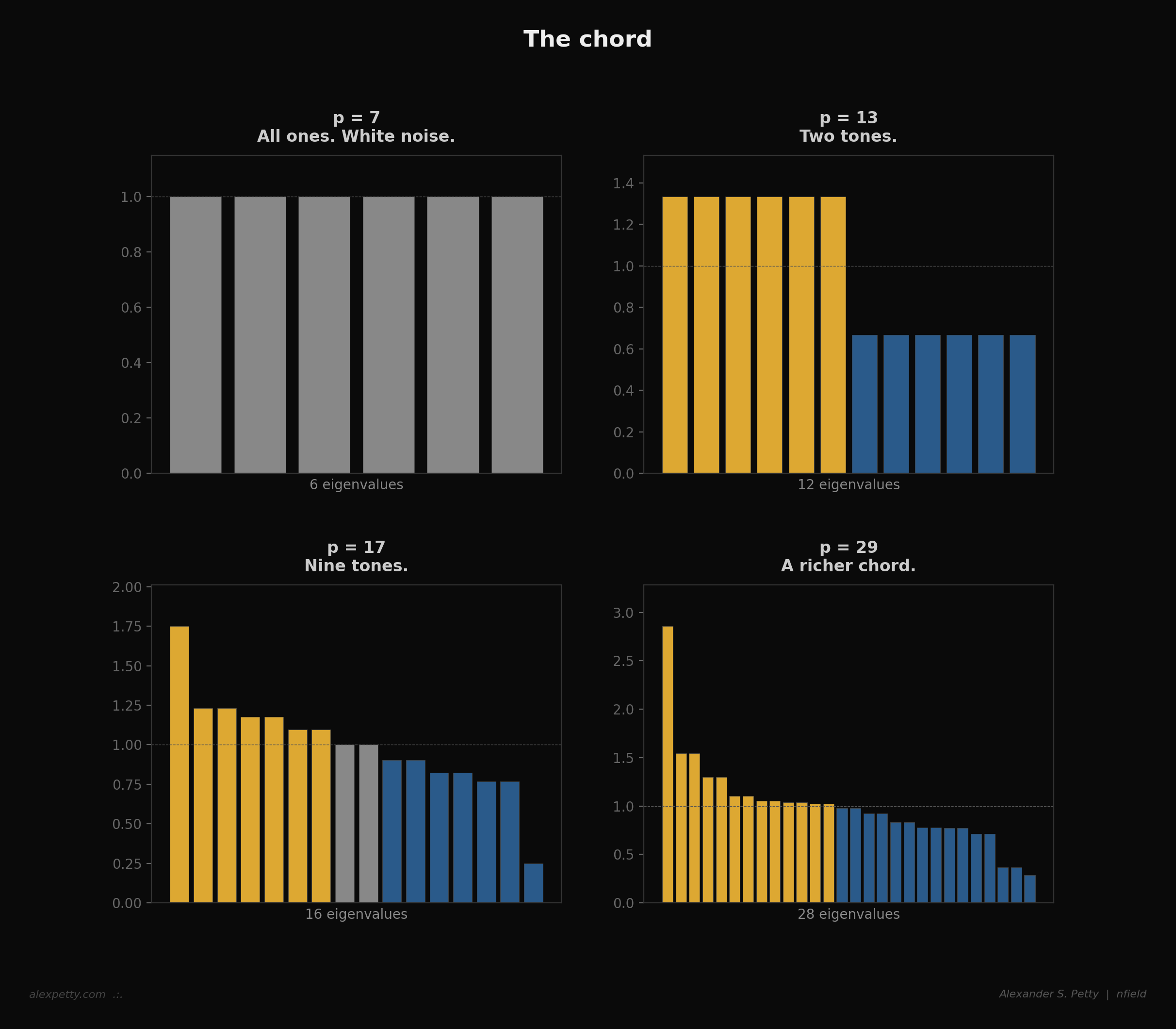
At $p = 13$, two distinct eigenvalues appear. $4/3$ and $2/3$, each with multiplicity 6. The field has split into two levels. The eigenvalue $4/3$ corresponds to the within-orbit mode, where fractions in the same group reinforce each other. The eigenvalue $2/3$ corresponds to the between-orbit mode, where fractions in different groups do not. Two numbers encode the entire block structure of the matrix.
At $p = 17$, nine distinct eigenvalues spread between $0.25$ and $1.75$. At $p = 23$, the count grows further. At $p = 97$, the spectrum is a dense forest of distinct levels, each one encoding a different mode of internal agreement among the fractions.
The spectrum fans out as the prime grows, and the fanning is not random. It has a pattern.
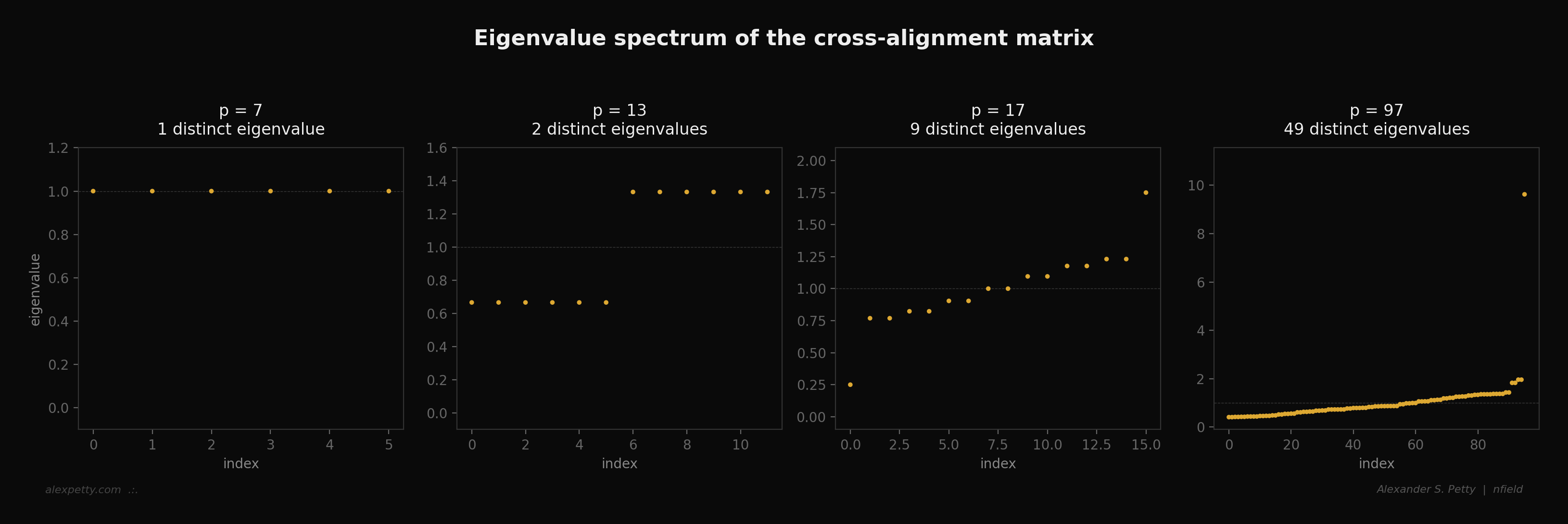
At $p = 7$, flat. At $p = 13$, two levels. At $p = 17$, nine. At $p = 97$, forty-nine distinct eigenvalues, a dense forest. The pattern turns out to be the Fourier transform of a sequence that has been sitting in plain sight for three hundred years.
The circulant
For primes where 10 is a primitive root, the rows of $\mathbf{A}(p)$ are cyclic shifts of each other. The second row is the first row shifted one position. The third is the first shifted two. All the way down.
A matrix built from cyclic shifts of a single row is called a circulant. Circulants are one of the best-understood objects in linear algebra. They were studied systematically in the nineteenth century, and their spectral theory is complete. The eigenvalues of any circulant are the discrete Fourier transform of its first row. No matter what the first row contains, the eigenvalues are its frequency spectrum.
This means a single row determines everything. Write down the first row. Take its Fourier transform. You have the eigenvalues. The entire matrix, with all its structure, is encoded in one sequence of numbers.
The first row
What is the first row of $\mathbf{A}(p)$?
It is the autocorrelation of the digit sequence of $1/p$. Take the repeating digits of $1/p$, shift them by one position, count how many digits match. Shift by two, count again. Shift by three. The sequence of match counts is the first row.
See it at $p = 7$. The repeating digits of $1/7$ are 1, 4, 2, 8, 5, 7.
Shift by 1 and compare: 1 vs 4, 4 vs 2, 2 vs 8, 8 vs 5, 5 vs 7, 7 vs 1. Zero matches.
Shift by 2: 1 vs 2, 4 vs 8, 2 vs 5, 8 vs 7, 5 vs 1, 7 vs 4. Zero matches.
Shift by 3: 1 vs 8, 4 vs 5, 2 vs 7, 8 vs 1, 5 vs 4, 7 vs 2. Zero.
Every shift gives zero. The autocorrelation is [1, 0, 0, 0, 0, 0]. That is the first row of the identity matrix. The digit sequence of $1/7$ is maximally uncorrelated with itself at every lag. No wonder the fractions are all strangers.
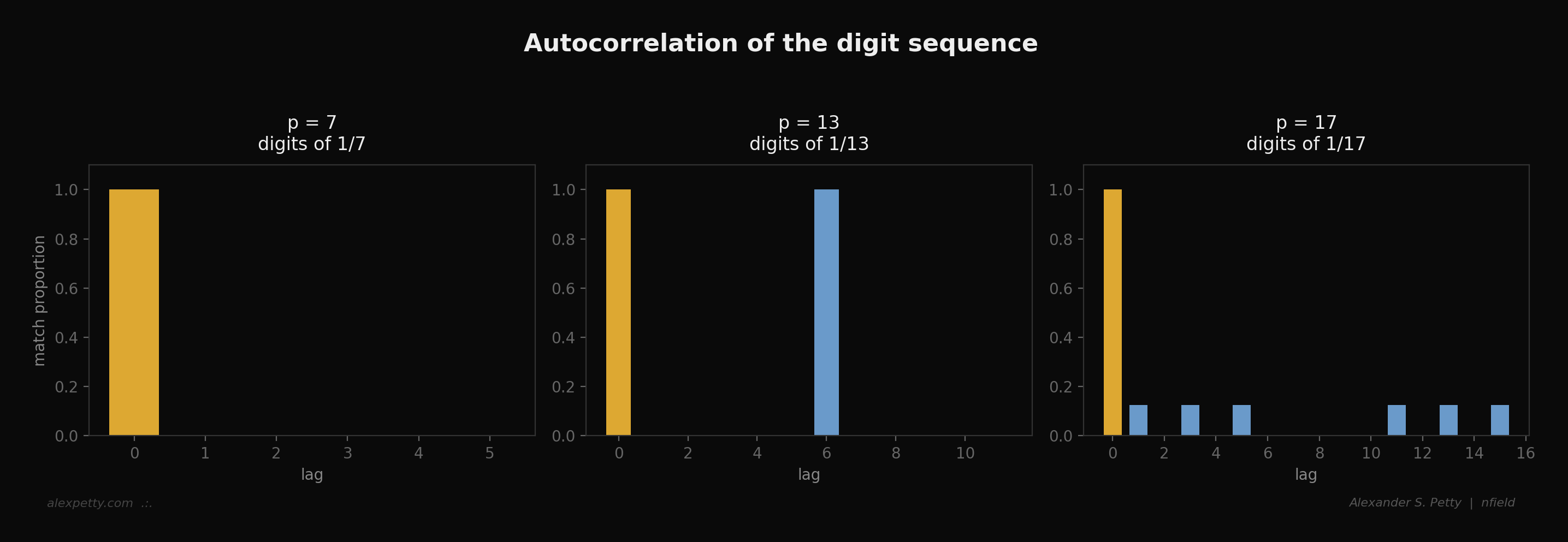
At $p = 7$, the autocorrelation is a single spike at lag zero and nothing else. At $p = 13$, a second spike appears at lag 6, the orbit length. At $p = 17$, multiple lags show partial matches, and the spectrum fans out.
The remarkable thing about $1/7$ is not just that its repetend is cyclic. That has been known for centuries. The remarkable thing is that its digit sequence has zero autocorrelation at every nonzero lag. In signal processing, a sequence with this property is called white noise. The digit sequence of $1/7$ is as random as a deterministic sequence can be, not because it was designed that way, but because 7 is a full-reptend prime in base 10 and the digits spread evenly across all ten bins.
This is why the fractions of 7 are perfect strangers. No fraction of 7 resembles any other at any digit position, because the underlying signal has no self-similarity at any lag. The identity matrix is not a coincidence. It is the matrix of white noise.
Now $p = 13$. The repeating digits of $1/13$ are 0, 7, 6, 9, 2, 3. Shift by 3: 0 vs 9, 7 vs 2, 6 vs 3, 9 vs 0, 2 vs 7, 3 vs 6. Zero matches. But shift by other amounts and some digits do coincide. The autocorrelation is no longer all zeros. The first off-diagonal entries appear, and with them, the two-orbit block structure.
At $p = 13$, the noise is no longer white. The autocorrelation has peaks at specific lags, and those peaks correspond to the orbits. Fractions within the same orbit share a resonance. Fractions in different orbits do not. The two eigenvalues, $4/3$ and $2/3$, are the amplitudes of those two modes. The block structure in the matrix is the spatial picture of a spectral fact.
The power spectrum
That digit sequence has been sitting in arithmetic tables since before Euler. Gauss tabulated these in the 1790s. Every schoolchild who has done long division has produced a piece of one. The cyclic structure of the repetend of $1/7$ has been marveled at for centuries, usually without explanation.
Here is the explanation. The repeating digits of $1/p$ are the first row of a circulant. The eigenvalues of that circulant are the Fourier transform of the autocorrelation.
In signal processing, this relationship has a name. The Wiener-Khinchin theorem, proved independently by Norbert Wiener and Aleksandr Khinchin in the 1930s, says the power spectrum of any stationary signal is the Fourier transform of its autocorrelation function. It is one of the foundational results of spectral analysis. Engineers use it to characterize noise in circuits. Physicists use it to study thermal fluctuations. Climatologists use it to find periodic signals in temperature records. Genomicists use it to detect repeating motifs in DNA.
The cross-alignment matrix computes the same thing for the digit sequence of a prime. The fractional field has a frequency signature. It comes from long division. And it connects an object that every schoolchild produces to a theorem that took three centuries of mathematics to formulate.
The distance between long division and spectral analysis turns out to be one matrix.
Circulants have been understood since the nineteenth century. Wiener and Khinchin proved their theorem in the 1930s. But nobody had built this particular matrix, compared every fraction of a prime to every other fraction digit by digit, and read the eigenvalues as a frequency signature. The pairwise agreement structure of the entire fractional field is encoded in the Fourier content of the digit sequence you have been looking at since Why the Golden Ratio Selects the Prime Three.
It was always there. Nobody had built the matrix.
The matrix is the object
$\alpha$, $\sigma$, and $F$ from The Coherence Decomposition are averages of this matrix. They are what you see when you squint. The matrix is what you see when you open your eyes.
The earlier scalars were shadows of a larger object. Once the matrix is written down, the geometry of the field is visible. The eigenvalues tell you how many independent modes the field has. The eigenvectors tell you which fractions participate in each mode. The Fourier transform of the first row gives you the whole spectrum at once.
Everything that the alignment score compressed into a single number is here, separated into its components, each one accessible, each one a window into a different aspect of the field's internal life.
The same grid idea, a finite table indexed by residue classes with structure written into its cells, survives into the collision work that follows. The complement symmetry remains. The block structure remains. What changes is what is being measured.
Try it yourself
See the autocorrelation. At $p = 7$, white noise. At $p = 13$, the orbit structure appears.
$ ./nfield autocorrelation 7     # [1, 0, 0, 0, 0, 0] -- white noise
$ ./nfield autocorrelation 13    # spike at lag 6 -- two orbits
$ ./nfield autocorrelation 17    # multiple lags -- complex structure
Now the eigenvalue spectrum. The Fourier transform of the autocorrelation.
$ ./nfield spectral 7    # all eigenvalues = 1
$ ./nfield spectral 13   # two eigenvalues: 4/3 and 2/3
$ ./nfield spectral 17   # nine distinct eigenvalues
$ ./nfield spectral 97   # forty-nine distinct eigenvalues
Watch the spectrum fan out as the prime grows. At $p = 7$, one mode. At $p = 97$, forty-nine. The internal geometry of the fractional field gets richer with every prime, and the eigenvalues are its frequency signature.
Code: github.com/alexspetty/nfield
Alexander S. Petty
April 2021 (revised April 2026)
.:.