The Coherence Decomposition
Alignment splits into two parts: a focused component from the repetend orbit, and a pairwise component from cross-matches. The decomposition explains why some integers are more coherent than others.

January 2021, revised April 2026
The Three-Tier Theorem classified every positive integer by alignment. The classification is clean but it does not explain itself. When the alignment is high, why is it high?
There are two ways a denominator can score well. One is that the reference fraction $1/n$ happens to share digits with many of the other fractions, even though those other fractions do not particularly agree with each other. The other is that the whole field is already internally coherent, the fractions all resemble each other, and $1/n$ rides that shared structure. The alignment number blends both effects into a single score.
They come apart cleanly.
Take $n = 7$. The fractions of 7 are all rotations of 142857. No two share a digit at any position. The field has zero internal agreement. But $1/7$ still matches the pattern at some positions, so the alignment is $0.167$. All of that score comes from $1/7$ itself. None comes from the field.
Now take $n = 77$. The fractions of 77 are not rotations of each other. Some share digits, some do not. The internal agreement is $0.065$. The reference $1/77$ adds a small amount on top, $0.022$. The total alignment is $0.088$. Most of that score comes from the field, not from $1/77$.
Same kind of number. Same tier. Completely different internal structure. The alignment alone cannot tell you which is which.
Two pieces, one sum
The background agreement at $n = 7$ was zero. At $n = 77$ it was $0.065$. Call this the pairwise alignment, $\sigma(n)$. It measures how much the fractions agree with each other on average, across all pairs, without any reference to $1/n$.
The part that belongs to $1/n$ alone, the excess it has beyond the background, is the focused alignment, $F(n)$. At $n = 7$, the focused part was the entire score, $0.167$. At $n = 77$, it was only $0.022$.
The total alignment is their sum.
$$\alpha(n) = F(n) + \sigma(n)$$
One piece is focused on $1/n$. The other is spread across the field.
For digit-partitioning primes, both pieces have closed forms. The focused part is $F(pm) = m/(pm-1)$. The pairwise part is $\sigma(pm) = (m-1)/(pm-1)$. As the smooth factor $m$ grows, both approach $1/p$ and the total approaches $2/p$. In the limit the two pieces become equal. The coherence splits evenly between the reference fraction and the field around it.
The golden gap
At $p = 3$, the focused part approaches $1/3 \approx 0.333$. The pairwise part approaches the same number. Neither one reaches the golden threshold at $0.618$. Not separately. Not even close.
But $1/3 + 1/3 = 2/3 \approx 0.667$. Above.
That is the golden gap. The threshold sits above each component but below their sum. The two pieces need each other to clear the line, and at $p = 3$ they have each other. At no other prime.
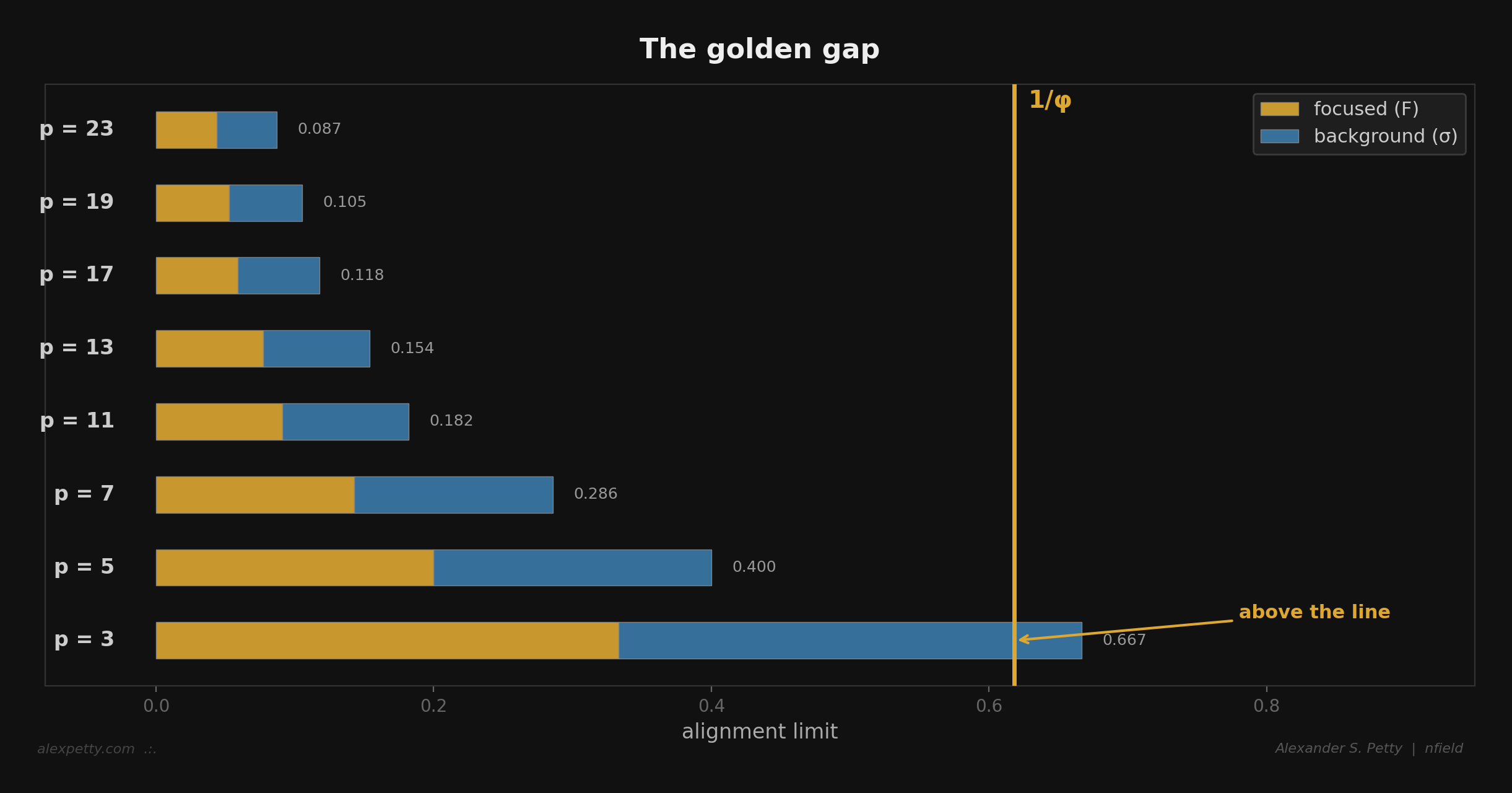
The gold bar is the focused part. The blue bar is the pairwise part. At $p = 3$, the two stack together and cross the golden line. At $p = 5$, the sum is $0.4$. At $p = 7$, it is $0.286$. The bars shrink as the prime grows.
At $p = 3$, the threshold sits between the components and their sum. For every larger prime, even the total falls below the line.
The grid
There is a way to see both pieces at once. Compare every fraction of an integer to every other fraction, digit by digit. Record the proportion of matches for each pair. Lay them in a grid. The diagonal entries are always 1, since every fraction matches itself perfectly. The off-diagonal entries measure how much each pair agrees. The pairwise part $\sigma$ is the average of the off-diagonal entries. The focused part $F$ is whatever $1/n$'s row adds beyond that average.
At $p = 11$, ten fractions, ten distinct two-digit blocks. No two share a digit at any position. The grid has a one everywhere a fraction meets itself and a zero everywhere it meets a stranger.
        1/11 2/11 3/11 4/11 5/11 6/11 7/11 8/11 9/11 10/11
 1/11 [  [1]   0    0    0    0    0    0    0    0    0  ]
 2/11 [   0   [1]   0    0    0    0    0    0    0    0  ]
 3/11 [   0    0   [1]   0    0    0    0    0    0    0  ]
 4/11 [   0    0    0   [1]   0    0    0    0    0    0  ]
 5/11 [   0    0    0    0   [1]   0    0    0    0    0  ]
 6/11 [   0    0    0    0    0   [1]   0    0    0    0  ]
 7/11 [   0    0    0    0    0    0   [1]   0    0    0  ]
 8/11 [   0    0    0    0    0    0    0   [1]   0    0  ]
 9/11 [   0    0    0    0    0    0    0    0   [1]   0  ]
10/11 [   0    0    0    0    0    0    0    0    0   [1] ]
The pairwise part $\sigma$ is zero. No fraction agrees with any other. The cross-alignment matrix of 11 is the identity.
Now take $p = 13$. Twelve fractions, six-digit repeating blocks. Build the same grid. Dots are zeros.
          1    2    3    4    5    6    7    8    9   10   11   12
   1  [  [1]   .    .    .    .    .    .    .    .    .  0.3    . ]
   2  [   .   [1]   .    .    .    .    .    .    .    .    .  0.3 ]
   3  [   .    .   [1]   .    .    .  0.3    .    .    .    .    . ]
   4  [   .    .    .   [1] 0.3    .    .    .    .    .    .    . ]
   5  [   .    .    .  0.3  [1]   .    .    .    .    .    .    . ]
   6  [   .    .    .    .    .   [1]   .    .    .  0.3    .    . ]
   7  [   .    .  0.3    .    .    .   [1]   .    .    .    .    . ]
   8  [   .    .    .    .    .    .    .   [1] 0.3    .    .    . ]
   9  [   .    .    .    .    .    .    .  0.3  [1]   .    .    . ]
  10  [   .    .    .    .    .  0.3    .    .    .   [1]   .    . ]
  11  [ 0.3    .    .    .    .    .    .    .    .    .   [1]   . ]
  12  [   .  0.3    .    .    .    .    .    .    .    .    .   [1]]
Six pairs of fractions share digits at some positions. The $0.3$ entries are small, but they are there. The grid is no longer the identity. Some fractions have started to resemble each other, and that resemblance is the pairwise part coming to life.
At $p = 11$, no off-diagonal matches. At $p = 13$, they begin to appear. The identity matrix cracks.
Scale up.
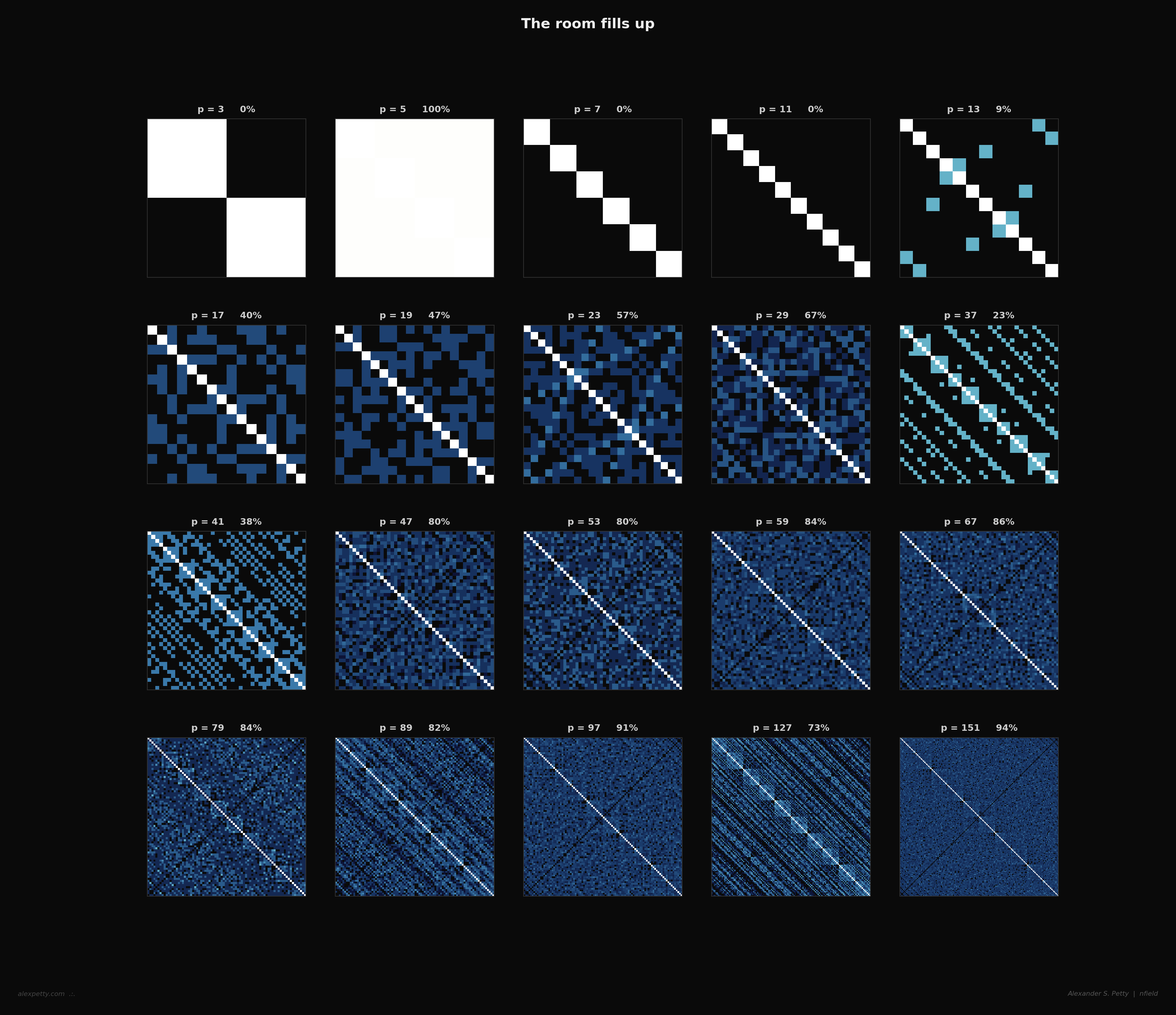
Twenty primes, from 3 to 151. At $p = 3$, the grid is nearly full. At $p = 5$, completely full. At $p = 7$ and $p = 11$, the grid goes dark: white diagonal, black everywhere else. These are the digit-partitioning primes, with $\sigma = 0$. Then at $p = 13$, the first off-diagonal entries appear and the filling begins.
More off-diagonal agreement does not mean higher alignment. The pairwise part can grow while the focused part shrinks.
The pinch
The golden gap exists when the threshold $1/\varphi$ sits between the two components. That requires each component to be below $1/\varphi$ (so neither piece clears the line alone) while their sum is above it. Since both components approach $1/p$, this means
$$\frac{1}{p} < \frac{1}{\varphi} < \frac{2}{p}$$
The left side says $p > \varphi \approx 1.618$. Every prime satisfies that. The right side says $p < 2\varphi \approx 3.236$. Only two primes satisfy that, $p = 2$ and $p = 3$. The prime 2 is degenerate, so among odd primes only $p = 3$ remains.
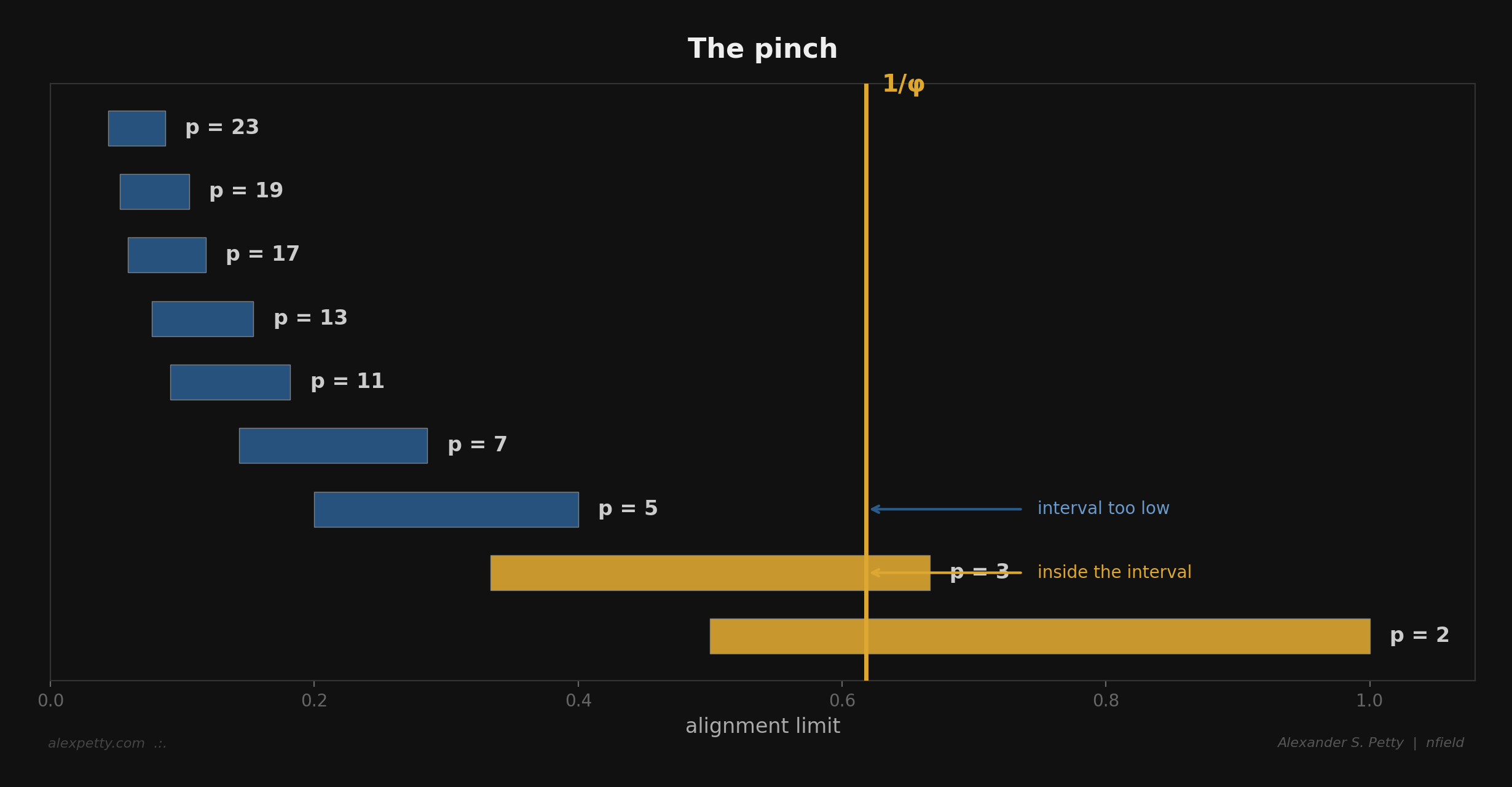
Each bar is the interval from $1/p$ to $2/p$ for one prime. The golden line at $1/\varphi$ cuts through only one of them. Only the bar for $p = 3$ reaches across the line, with $1/3$ on one side and $2/3$ on the other.
The golden ratio is not in this picture for aesthetic reasons. It is the unique number whose reciprocal fits between $1/p$ and $2/p$ at exactly one odd prime.
The threshold is crossed not by one dominant piece, but by two smaller pieces whose sum succeeds only at a single prime.
Splitting a measurement into signal and background is an old idea. Applying it to the alignment of fractional fields, finding closed forms for both pieces, and discovering that the golden ratio sits in the gap between them at exactly one prime, these are new. Nobody had decomposed the alignment this way, and the pinch that results had not been observed.
Try it yourself
$ ./nfield decompose 12
  alpha  = 0.636  (total)
  sigma  = 0.273  (background)
  F      = 0.364  (focused)
  1/phi in gap = yes

$ ./nfield decompose 120
  alpha  = 0.664  (total)
  sigma  = 0.328  (background)
  F      = 0.336  (focused)
  1/phi in gap = yes
Watch what happens as the smooth part grows. The focused number $F$ drops from $0.364$ toward the limit $1/3$. The pairwise number $\sigma$ rises from $0.273$ toward the same limit. The two components move toward each other while their sum stays above $1/\varphi$.
Now try 7. No collisions, no shared digits.
$ ./nfield decompose 7
  alpha  = 0.167  (total)
  sigma  = 0.000  (background)
  F      = 0.167  (focused)
  1/phi in gap = no
Zero pairwise background. The fractions of 7 are completely independent. The matrix is the identity. The only coherence is focused, and $1/7$ alone cannot carry the total anywhere near $0.618$.
Now $77 = 7 \times 11$. Two primes that individually had zero pairwise part. Both components are present but both are tiny. Together they reach $0.088$.
The decomposition is not just bookkeeping. It tells you why an integer fails to make the cut. At digit-partitioning primes like 7 and 11, the pairwise part vanishes. At composite Tier 3 numbers like 77, both components are present but small. At Tier 2, both are needed. At Tier 1, the alignment is trivially perfect.
$ ./nfield decompose 77
  alpha  = 0.088  (total)
  sigma  = 0.065  (background)
  F      = 0.022  (focused)
  1/phi in gap = no
Code: github.com/alexspetty/nfield
Alexander S. Petty
January 2021 (revised April 2026)
.:.