The Character Structure of the Collision Fluctuation
The collision fluctuation decomposes over Dirichlet characters. Only the odd characters survive, forced there by the complement involution. This is where the algebra begins.

I added up the collision deviations for every prime in base 10 up to a cutoff, weighted by $1/p$. The sum drifted downward. Not fast. Unimaginably slowly. The rate turned out to be $\log \log x$, the iterated logarithm, one of the slowest-growing functions in analysis. Between a million and a trillion, it increases by less than one.
But the drift had structure. It was not a single stream. When I split the primes by their last digit, four parallel currents appeared, each carrying its own share of the drift. This paper takes that observation and works out what each current carries.
The splitting is proved. What comes out the other side is mostly conjecture supported by computation.
Splitting the signal
In base $10$, every prime past $5$ ends in one of four digits: $1$, $3$, $7$, or $9$. Each is a residue class modulo $10$, the set of all integers sharing the same last digit in base ten. Four parallel streams of primes, sorted by last digit.
Do the four streams contribute differently to the total drift? Maybe primes ending in $1$ do most of the work and primes ending in $9$ barely matter. Maybe the four streams contribute equally. The tool for sorting this out has been around since $1837$, when Dirichlet invented it to prove that every residue class contains infinitely many primes. The tool is called a Dirichlet character.
A Dirichlet character is a recipe for assigning a small complex number to each residue class, with one constraint. The number assigned to a product of two classes must equal the product of the numbers assigned to each. If a character assigns the value $i$ to the class of primes ending in $3$, and $-1$ to the class ending in $7$, then it must assign $-i$ to the class ending in $1$, because $3 \times 7 = 21$ ends in $1$ and the values have to multiply correctly. The character respects multiplication.
How many such recipes exist in base ten? Exactly four. The count is $\varphi(10) = 4$, Euler's totient applied to the base. One of the four is the trivial character, which assigns the value $1$ to every class. The other three assign different complex weights in ways that respect multiplication.
These four characters do for the residues coprime to $10$ what sines and cosines do for periodic signals on the real line. They form an orthogonal basis. Any function defined on the four classes can be uniquely expanded as a weighted sum of the four characters. The trivial character carries the average across all four classes. The non-trivial characters carry the corrections, how much each class deviates from the average.
For each character $\chi$ mod $b$, take the fluctuation $\Delta_p$ at each prime $p$, multiply it by $\chi(p)$, divide by $p^s$, and sum over all primes past the base up to a cutoff $x$:
$$L_{\chi,x}(s, \ell) = \sum_{b < p \le x} \frac{\chi(p) \cdot \Delta_p(\ell)}{p^s}.$$
Four characters, four sums. The proposition that ties them together is short. At each finite cutoff $x$, the fluctuation taken only over primes in a single residue class $r$ is a finite linear combination of the four character components, with weights $\overline{\chi}(r) / \varphi(b)$ where $\overline{\chi}$ is the complex conjugate of $\chi$. This is the orthogonality of Dirichlet characters applied to a new signal. It is the only proved result in this paper, and everything else hangs on it.
Four components in base ten
character_components 10 --lag 1

primes ≤ x    |L_χ₀,x| |L_χ₁,x| |L_χ₂,x| |L_χ₃,x|
----------    -------  -------  -------  -------
   100        1.073    0.254    0.321    0.254
   500        1.278    0.356    0.350    0.356
   800        1.341    0.380    0.355    0.380
  1225        1.393    0.398    0.350    0.398
Each column is one character. The trivial character $\chi_0$ weights every class equally and carries the largest share, climbing past $1.4$ by the time a thousand primes enter the sum. The three non-trivial characters carry smaller weights, around $0.35$ to $0.40$ apiece. The characters $\chi_1$ and $\chi_3$ are complex conjugates of each other, and conjugation preserves magnitudes, so $|L_{\chi_1,x}| = |L_{\chi_3,x}|$ exactly. Every row in the table confirms this.
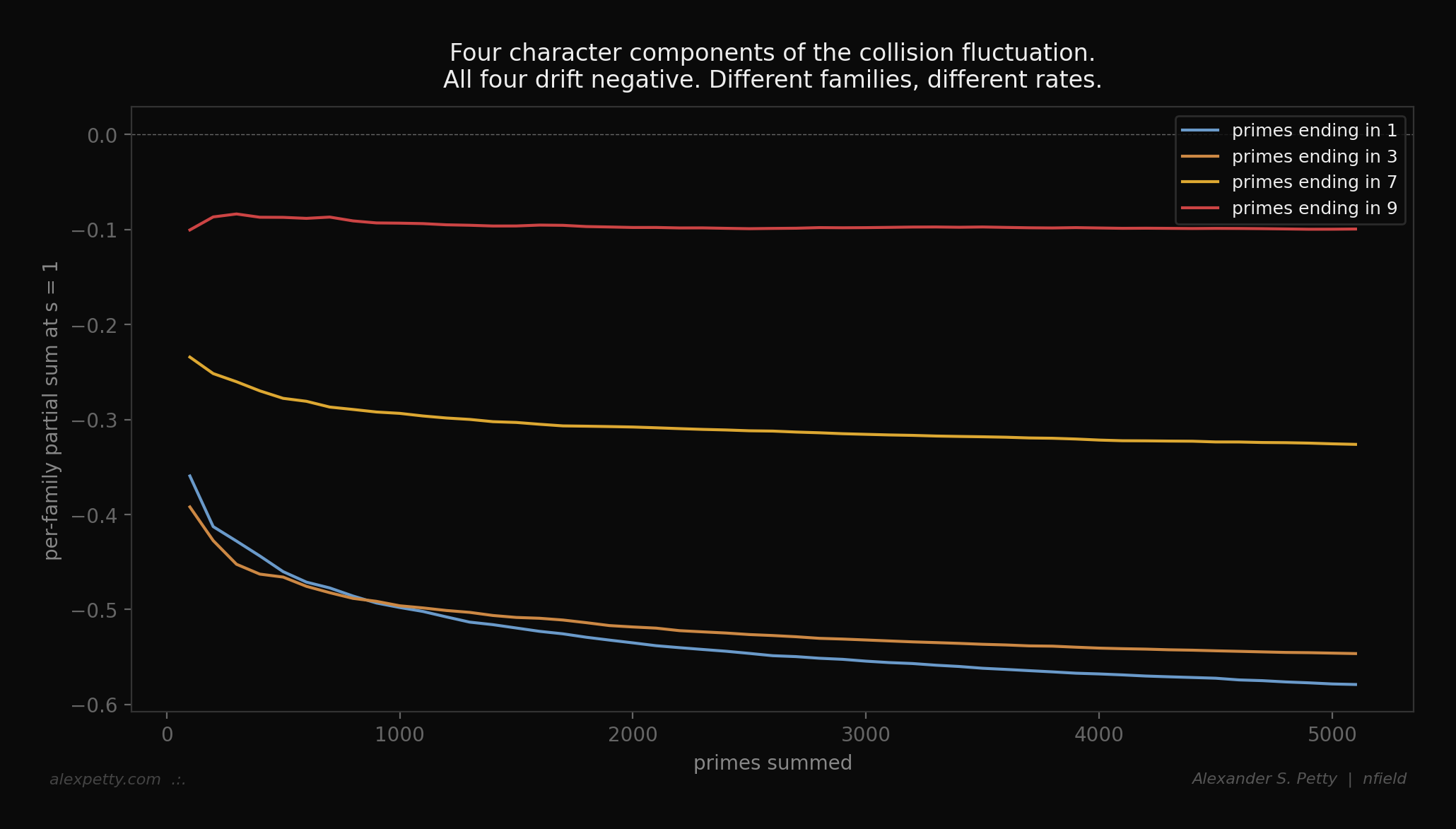
All four components appear to grow at the same rate, the same $\log \log x$ creep. The trivial character carries the bulk of the signal. The non-trivial characters carry the per-class corrections. They are smaller in magnitude but they grow at the same rate.
The collision fluctuation does not concentrate in one residue class. It spreads across all four, each class carrying a character-specific weight, all four weights growing at the same rate at the boundary.
Not the classical L-values
The natural hope was that the character components would turn out to be the classical Dirichlet $L$-values in disguise. For each character $\chi$, classical number theory defines
$$L(s, \chi) = \sum_{n = 1}^{\infty} \frac{\chi(n)}{n^s}.$$
At the special exponent $s = 1$, this series converges to a specific number, $L(1, \chi)$. These special values govern how primes distribute across residue classes. Dirichlet himself studied them in 1837. They have been central to analytic number theory ever since. If our new character components were proportional to $L(1, \chi)$ at $s = 1$, the new objects would be the old objects in disguise.
They appear not to be. In base $10$ at lag $\ell = 1$:
$$\frac{|L_{\chi_2,x}(1, 1)|}{|L(1, \chi_2)|} \approx 0.54, \qquad \frac{|L_{\chi_1,x}(1, 1)|}{|L(1, \chi_1)|} \approx 0.40.$$
If the two were proportional, these ratios would be constants. They are not. They are not simple rational numbers, they depend on the lag $\ell$, and they change shape from base to base.
The character components are something new. They live in the same space the classical $L$-functions inhabit, built from the same Dirichlet characters, but they carry information the classical objects do not encode. If they had been proportional to $L(1,\chi)$, the collision program would be restating known results in new language. They are not. The digit function is producing something the classical machinery does not already contain. I did not yet know what they were made of. That would take three more years.
Five bases, the same shape
mertens_growth --bases 3,6,7,10,12 --lag 1

  base    Φ_x(1, 1) at x = 8000   Φ_x(0.9, 1) behavior
  ----    ----------------------   --------------------
    3            -1.38              diverging (power law)
    6            -1.29              diverging (power law)
    7            -1.34              diverging (power law)
   10            -1.37              diverging (power law)
   12            -1.32              diverging (power law)
At $s = 1$, every base gives a partial sum near $-1.3$ to $-1.4$, growing at the Mertens rate. At $s = 0.9$, every base diverges. The critical boundary sits at $s = 1$ in every base tested.
The specific numbers depend on the base. The qualitative structure does not. Five bases, the same shape. This is the universality conjecture. Supported by computation, not proved.
Flat across the spectrum
Sort the primes not by residue class but by which eigenvalue of the cross-alignment matrix they sit on. For a primitive-root prime, the cross-alignment matrix diagonalizes cleanly and its eigenvalues are indexed by a frequency $k$ running from $1$ through $b - 1$. The difference between each eigenvalue and its limiting value is the eigenvalue fluctuation $\psi_p(k)$. Sum these across primes weighted by $1/p$:
$$G(s, k) = \sum_{p > b} \frac{\psi_p(k)}{p^s}.$$
spectral_fluctuation 10 --primes 1000

primes ≤ x   G(1,1)   G(1,2)   G(1,3)   G(1,4)   G(1,5)
----------   ------   ------   ------   ------   ------
   100       0.1642   0.1642   0.1642   0.1640   0.1639
   500       0.1650   0.1650   0.1649   0.1646   0.1644
  1000       0.1651   0.1651   0.1650   0.1646   0.1644
Five frequencies, five sums, all converging to nearly the same value. The collision fluctuation appears to distribute its energy evenly across the spectrum. No harmonic mode dominates. The chord drifts, but it drifts uniformly at every frequency.
This is the spectral equidistribution conjecture. Whether it holds at every frequency, and whether the limiting value has a closed form, are open questions.
Around the polarity circle
The cumulative polarity of the repetend traces a path on the fixed circle of residues modulo $b - 1$. At each position of the repetend, the running digit sum modulo $b - 1$ takes one of $b - 1$ values. Count how many positions land on each value. For primes where $b$ is a primitive root, the polarity histogram approaches the uniform distribution as $p$ grows. The path visits each value approximately $L/(b-1)$ times.
The collision fluctuations measure departure from this equilibrium. The Mertens growth law says the departures, weighted by $1/p$, accumulate at rate $\log \log x$. The spectral equidistribution conjecture says the departures are nearly flat across the harmonic spectrum. Together, these suggest that the field approaches its equilibrium on the polarity circle, and that the rate of approach is controlled by the critical boundary $s = 1$, if the conjecture holds.
Three decompositions, one boundary
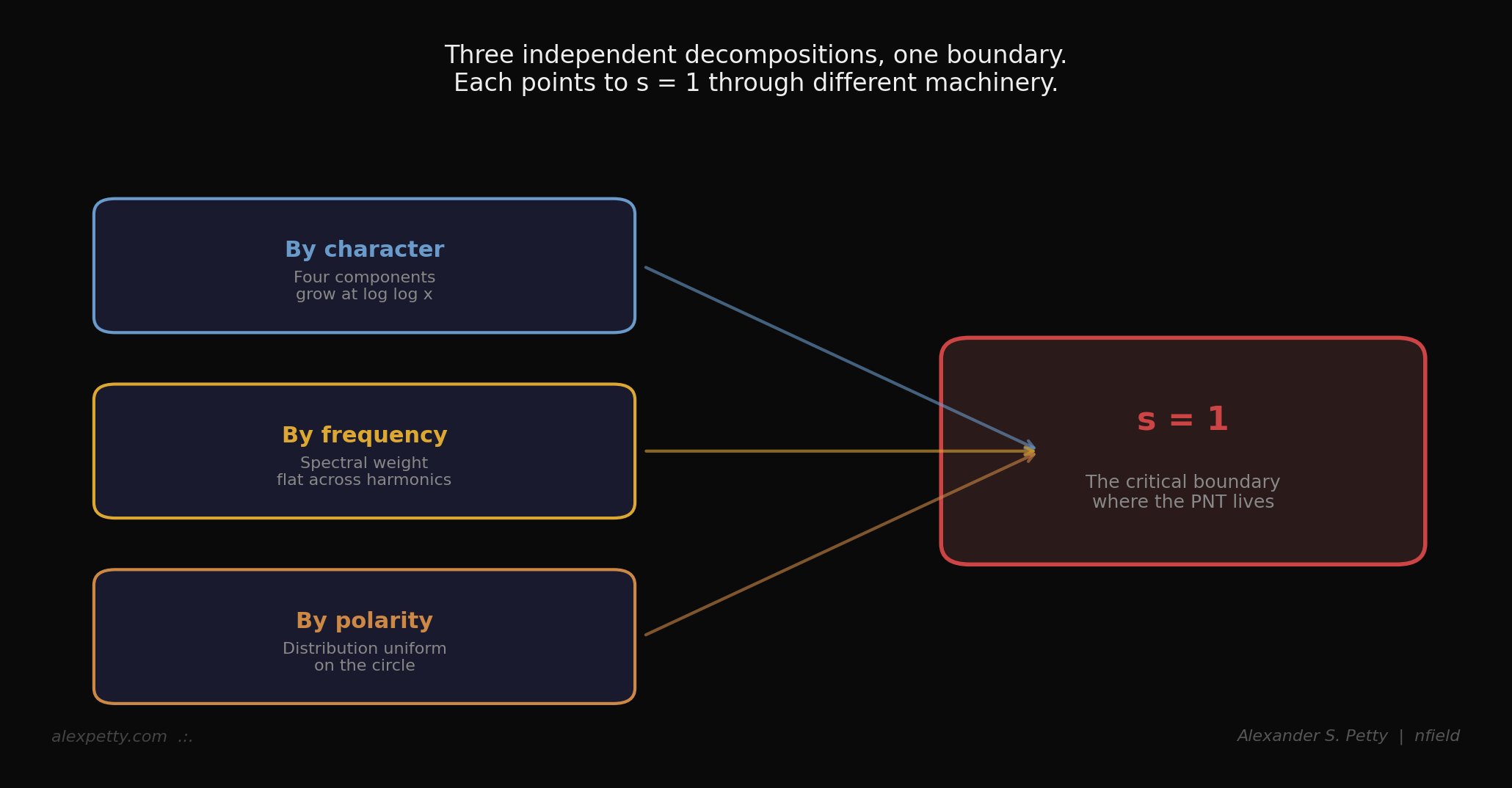
The collision fluctuation admits three independent decompositions, each living in a different mathematical space.
Sort the primes by their last digit and the sum splits into one clean component per residue class. In base ten, four classes, four components. The trivial character carries the average. The non-trivial characters carry the corrections. This decomposition is proved.
Sort by which eigenvalue of the cross-alignment matrix the prime sits on, and the weight spreads evenly across all eigenvalues. Every frequency carries the same drift. This decomposition is conjecture.
Sort by where each prime's running digit sum lands on the polarity circle, and the distribution is uniform around the circle. Every position gets the same share. This decomposition is observational.
Three decompositions, no shared machinery, three different mathematical spaces. Each points to the same critical boundary at $s = 1$. The character components grow logarithmically there. The frequency fluctuations converge there. The polarity equidistribution sets in at a rate controlled by the same exponent.
The collision fluctuation has structure. I intend to develop it.
A note from 2026
April 2026
Almost every conjecture in the body got upgraded to a theorem in the work that followed. The character decomposition became the central technical move. By The Collision Spectrum, the same orthogonality argument was being applied to the collision invariant table itself, and the new family of arithmetic objects turned out to be the elementary side of a Bernoulli-L-value formula whose Fourier coefficients factor as $B_1(\bar\chi) \cdot S_G(\chi) / \varphi(b^2)$. None of that was visible from here. It needed three more years.
The spectral equidistribution conjecture turned out to be more subtle than flat across the spectrum. The per-frequency differences cancel under a Parseval-style identity in The Collision Spectrum. The polarity equidistribution observation became the seed of the polarity field, where three involutions (complement in the table, conjugation of the character, reflection of the exponent) first conjectured here, are recognized as the same symmetry operating at three different levels.
Before this work, the fluctuation was a single signal. After it, three orthogonal decompositions, each carrying independent information.
Try it yourself
Character magnitudes and sign structure.
$ ./nfield character_components 10
The Mertens growth at the boundary.
$ ./nfield fluctuation_sum 10 --lag 1 --primes 5000
Code: github.com/alexspetty/nfield
Paper: The Character Structure of the Collision Fluctuation
Alexander S. Petty
October 2022 (updated April 2026)
.:.