Silent Primes
At seven primes in base 10, the collision count is exactly zero. The recipe that finds them involves the bin partition and a specific floor-function identity.
Consider the prime $13$.
Divide one by thirteen the long way, the way you learned in school. Write the digits as they come. After a few steps you find that the digits start repeating: zero, seven, six, nine, two, three, zero, seven, six, nine, two, three, and on it goes, forever. Six digits in the repeating block, then back to the beginning. This block, $076923$, is what mathematicians call the repetend of the fraction $1/13$. It is the part of the decimal that loops, and it is the soul of the prime as far as base ten is concerned.
Now do something a child might do. Cut the repetend out, paste it onto a thin strip of paper end to end so you have a long ribbon with the same six digits repeating across it. Make a second copy. Lay one ribbon on top of the other so the digits line up perfectly. Then slide the top ribbon to the right by one position and look at the two ribbons together.
What you see is two rows of digits stacked, position by position. Compare them down the line. Where the digit on top equals the digit on bottom, you have a match. Count the matches.
For the prime $13$, the count is zero. Not one match. The two ribbons, written out from the same six digits in different rotations, share no common digit at any position. They are perfectly mismatched. Even random sliding would be expected to produce one or two accidental matches. This produces none.
Try the prime $17$. Its repetend is sixteen digits long. Cut a strip, make a copy, slide one position over, and count. The answer is positive. A few of the sixteen positions happen to share their digit with the slid copy.
Try $19$. Eighteen-digit repetend. Slide one. Count. Zero again. None of the eighteen positions match.
Try $23$. Twenty-two digits. Slide one. Count. Zero.
Try $29$. Twenty-eight digits. Slide one. Count. Positive.
Try $37$. Zero. Try $41$. Zero. Try $43$. Positive. Try $47$. Positive. Try $53$. Positive. Try $73$. Zero.
Walking up through the primes one at a time, sliding the ribbon by one position and counting the matches, most primes give a small positive number, in the neighborhood of one or two or three. But a handful give exactly zero. The ribbon and its shifted copy refuse to overlap at any position whatsoever, not even by accident. I call these the silent primes.
A list and a formula
Walk through the primitive-root primes up to a thousand and write down the silent ones. The list comes out short:
$${11,\ 13,\ 19,\ 23,\ 37,\ 41,\ 73}.$$
Seven primes. After $73$, no more silent ones at this slide. Walk all the way up to a million primes, ten million, a billion. The list does not grow. There are exactly seven primitive-root primes greater than ten that are silent under a one-position slide in base ten. Forever.
That, on its own, is the first surprise. There are finitely many silent primes, and you can list them with seven entries. Past the seventh, the universe of primes goes on without producing another one.
The second surprise is that you do not need to walk through every prime to find the list. There is a recipe, and it falls out of Bin Derangements and the Gate Width Theorem with one line of algebra.
That paper proved a clean structural fact about deranging multipliers. At any prime $p$ in base ten, there are exactly nine multipliers that move every residue out of its original digit bin. Those nine multipliers are not random. They are nine specific rational numbers, the same nine for every prime, just reduced modulo the prime in question. Here are the nine rationals in base ten:
$$-\tfrac{1}{9},\quad -\tfrac{1}{4},\quad -\tfrac{3}{7},\quad -\tfrac{2}{3},\quad -1,\quad -\tfrac{3}{2},\quad -\tfrac{7}{3},\quad -4,\quad -9.$$
At each prime $p$, reduce these nine rationals modulo $p$. The result is nine specific residues, and those residues are exactly the deranging multipliers there. The list of nine rationals is the same at every prime. The reductions are different.
For $p$ to be silent at slide one, the multiplier $g = 10$ must fall in the deranging set. The deranging set is the reduction of the nine rationals modulo $p$. So silence means $10$ has to equal one of the nine rationals reduced mod $p$. Take the rational $-u/(10 - u)$, where $u$ is one of $1, 2, \ldots, 9$. The silence condition is
$$10 \equiv -\frac{u}{10 - u} \pmod{p}.$$
Multiply both sides by $(10 - u)$ to clear the fraction. The left side becomes $10(10 - u) = 100 - 10u$. The right side becomes $-u$. Subtract:
$$100 - 10u - (-u) = 100 - 9u.$$
The condition is that $100 - 9u$ is divisible by $p$. Clear one fraction, simplify, read off the integer.
A prime $p$ is silent at slide one in base ten if and only if $p$ divides one of the integers $100 - 9u$ for $u = 1, 2, \ldots, 9$. Compute $100 - 9$. Then $100 - 18$. Then $100 - 27$, subtracting another $9$ each time, until you have walked through nine subtractions. Nine numbers:
$$91,\quad 82,\quad 73,\quad 64,\quad 55,\quad 46,\quad 37,\quad 28,\quad 19.$$
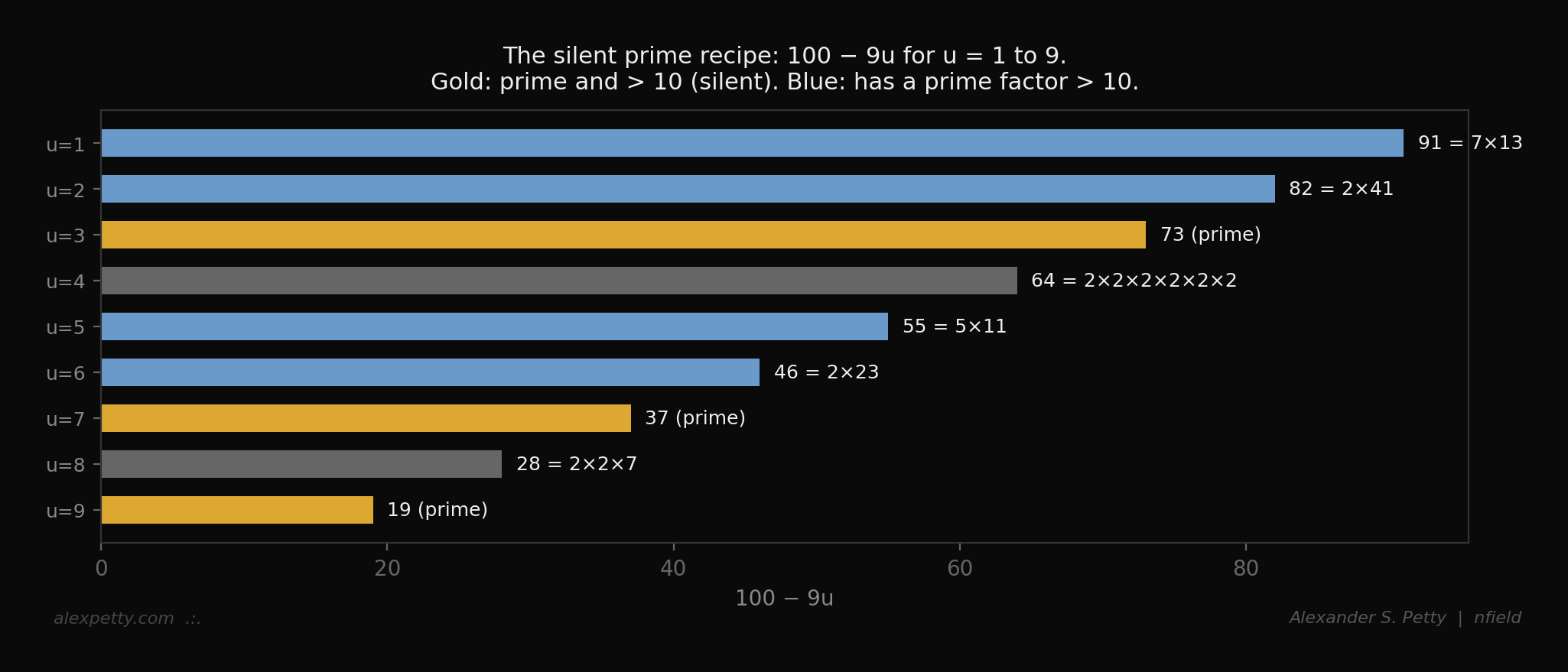
Factor each of the nine numbers and read off the prime factor greater than ten.
value    factored      silent prime
-----    ----------    ------------
  91     7 × 13              13
  82     2 × 41              41
  73     prime               73
  64     2^6                 none
  55     5 × 11              11
  46     2 × 23              23
  37     prime               37
  28     2^2 × 7             none
  19     prime               19
Throw out the two rows that contributed nothing. Collect the seven primes: $13$, $41$, $73$, $11$, $23$, $37$, $19$. Sort them: $11$, $13$, $19$, $23$, $37$, $41$, $73$. These are exactly the seven silent primes listed at the top of this section. Every single one, recovered by hand, from a recipe that took less than five minutes to apply.
Silent primes in the primitive-root regime are not a hidden subset you have to discover one at a time by computation. They are the prime divisors of nine specific small integers. Past the last factor, no further primitive-root silent primes exist at this lag. The mystery of which primes are silent has the kind of answer most number theory questions never have. A finite list. An exact recipe. No exceptions inside the theorem's scope.
The recipe generalizes. At a slide of two positions, the integers to factor are $1000 - 99u$ for $u = 1, \ldots, 9$. At a slide of three, $10000 - 999u$. At every fixed slide, a finite list. At every fixed slide, an exact recipe. In the primitive-root regime, the silent primes at any slide in any base are the prime divisors of a small arithmetic progression that depends only on the base and the slide.
The seven silent primes in base ten are not seven curiosities. They are the extreme case of something much larger that runs across every prime. The second half of this paper measures that larger thing. The silent primes are where it hits its furthest boundary. They are not a side observation. They are the tail of a distribution.
The wobble
Most primes are not silent. They give a positive count when you slide the ribbon by one position and tally the matches. The count varies from prime to prime. At one prime it might be six, at the next four, at the next nine. Here are a few primes in base ten with their bin sizes and their actual counts:
prime p     bin size Q     count C(10)
-------     ----------     -----------
   97            9             6
  193           19            14
  499           49            40
  997           99            84
 1999          199           173
 4999          499           440
 9973          997           885
The counts are near the bin sizes but never equal. At $p = 97$, the bin size is $9$ and the count is $6$, below by $3$. At $p = 9973$, the bin size is $997$ and the count is $885$, below by $112$.
The counts are wobbling around their expected values. Take the deviation, square it, average over many primes. That gives the variance. The square root of the variance is the standard deviation, the typical size of the wobble. Compute the standard deviation across all primes up to ten thousand and divide by the square root of the bin size $Q$:
prime p     bin size Q     standard deviation / √Q
-------     ----------     -----------------------
    97            9               0.817
   193           19               0.857
   499           49               0.909
   997           99               0.923
  1999          199               0.933
  4999          499               0.940
  9973          997               0.942
The numbers in the right column are climbing toward something. They start in the low $0.8$s and walk up steadily, slowing as they climb. By ten thousand primes the ratio is about $0.94$, and the slowing strongly suggests convergence to some constant near there.
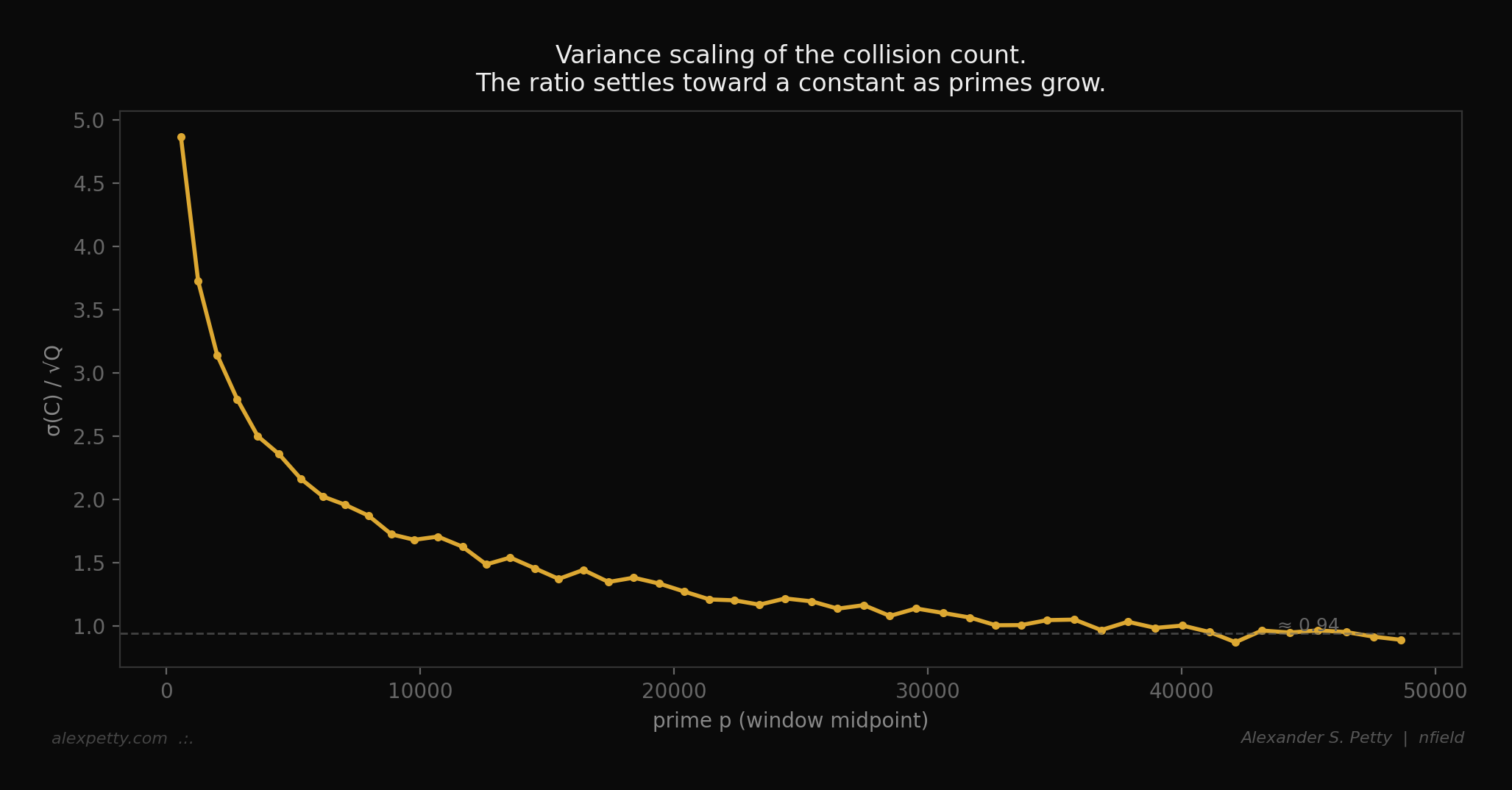
The wobble of the count, measured properly, is the square root of the bin size, with a constant in front that depends only on the base.
Now you can see what the silent primes were. The collision count usually wobbles around its mean by something on the order of $\sqrt{Q}$. The seven primes from the first half were the special cases where the wobble hit exactly the bottom of its possible range. The count fell all the way to zero, the largest possible negative excursion the wobble can take. Silent primes are not seven oddities. They are the seven places where the wobble in base ten ran out of room.
Like the Riemann Hypothesis
There is a function in number theory called the prime counting function, written $\pi(x)$. It counts how many primes are less than or equal to $x$. So $\pi(10) = 4$, $\pi(100) = 25$, $\pi(1000) = 168$, $\pi(10000) = 1229$.
The prime number theorem, proved at the end of the nineteenth century by Hadamard and de la Vallée Poussin independently, says that $\pi(x)$ is approximately equal to $x$ divided by the natural logarithm of $x$. A slightly more accurate approximation uses the logarithmic integral $\mathrm{li}(x)$. The basic story is the same. The prime counting function has a smooth approximation, and the approximation gets better as the prime grows.
The approximation is not exact. The difference between $\pi(x)$ and $\mathrm{li}(x)$ is not zero. The size of this error is one of the central questions of analytic number theory, and it has been for a hundred and sixty years.
The Riemann Hypothesis is the conjecture that the error is bounded by a particular shape. Specifically, it predicts that the difference between the actual count and the smooth approximation is at most about the square root of $x$, times a logarithmic factor. The square root marks the boundary between two regimes. An error smaller than $\sqrt{x}$ would imply stronger regularity in the prime distribution than any known mechanism can produce. An error larger than $\sqrt{x}$ would be inconsistent with the known zero-free region of the zeta function. The square root is the conjectured exact size of the deviation from the smooth answer.
The Riemann Hypothesis has been unproved for a hundred and sixty years. It is the most famous unsolved problem in mathematics. There is a million-dollar prize for the first person to settle it. Generations of analytic number theory have grown up around its edges. The square root is the heart of the conjecture. Whoever proves the Riemann Hypothesis proves that the primes deviate from their smooth approximation by exactly that much, no more, no less.
The wobble of the collision count is also approximately the square root of the bin size. Not the bin size. Not a constant. The square root. The same shape, the same threshold, the same fingerprint that the Riemann Hypothesis predicts for the prime counting function.
The collision count is not the prime counting function. The bin size is not $x$. The two phenomena live in different parts of the mathematical landscape, and there is no direct way to derive one from the other. But the shape of the deviation is the same, and the shape is what matters in this kind of question.
What this suggests, but does not prove, is that the same kind of analytic structure that controls the prime counting function also controls the collision count. The Riemann Hypothesis is about the zeros of a particular function called the Riemann zeta function, and those zeros appear to govern the deviations of $\pi(x)$ from $\mathrm{li}(x)$. The hope behind this paper is that some similar analytic structure, some similar list of zeros in some related function, governs the deviations of the collision count from its bin size. If the hope is real, the digit function and the Riemann zeta function are looking at the same structure from two different sides.
Right now the hope is just a hope. The square-root scaling of the collision count is a numerical conjecture, supported by computation but not proved. The connection to a hidden $L$-function is suggested by the matching square-root shape but not established. The Character Structure of the Collision Fluctuation picks it up from here.
A note from 2026
April 2026
The central observation has held up and the central conjecture has gotten sharper. The square-root variance scaling for the collision count was verified well past the original computation, and the constant in front of the square root now has a closed-form expression in terms of the elementary geometry of the digit function. The variance conjecture is no longer just a numerical observation. It has a structural reason, and the reason is that the deterministic comparisons inside the collision count behave like a sum of weakly correlated coin flips whose decorrelation is controlled by the equidistribution of certain residues modulo the prime.
The connection between the silent primes and the wobble of the rest, which this paper presents as one continuous story, was a connection I did not see at all when I wrote the original research note. At the time, the two halves felt like two separate observations that happened to live in the same write-up. It took a while to realize that the silent primes are the tail of the same distribution the wobble measures, and that asking about silence is asking about the tails.
The hope at the end of the paper turned out to be partially right and partially wrong. The right part: the collision count does connect to $L$-function values, through a mechanism worked out in The Character Structure of the Collision Fluctuation and made precise in The Collision Spectrum. The wrong part: the connection is not to the same $L$-function zeros that govern the prime counting function. It is to $L$-function special values at $s = 1$, which come from the elementary side via Bernoulli numbers. The mechanism is real. It is just not exactly the mechanism I was guessing at.
The square-root scaling itself has not been upgraded to a theorem. It remains a conjecture. In some sense it is the analog of the Riemann Hypothesis for the collision count. A precise quantitative statement about a fluctuation, supported by all the data, plausible from the structural arguments, and not yet proved.
Try it yourself
List the seven silent primes at lag 1 in base 10.
$ ./nfield silent_primes 10 --lag 1
The collision variance ratio climbs toward a constant.
$ ./nfield variance 10
Code: github.com/alexspetty/nfield
Paper: Silent Primes and the Variance of the Collision Count
Alexander S. Petty
January 2023 (updated April 2026)
.:.